Category Archives: Education/Knowledge

Privileges, Potentials And Principles

GlassesHaving trouble seeing, you say? My glasses work great. They really help me see a lot better. Here, put them on — I’m sure they’ll work for you, too. No, really, try them…

Swiss countryside through train window

Swiss Countryside Through Train Window

Have you ever noticed how we all see things differently? I’ve had experiences in which, **POP**, my vision changes and I see things in a totally new light. For example, as we traveled by train from Switzerland to Italy, our cabinmate happened to be a young Swiss woman returning from home to her studies in Italy. Out the window, I saw with interest how the scenery changed from the über neat, carefully kept Swiss houses, each looking like a music box cottage, to the houses of the Italian countryside, with a few roof tiles askew and some external wall plaster that needed patching. Initially, I was disappointed with some of the residents of Italy, thinking, “Don’t they care?” I mentioned it to our new student friend, and she said simply, “Yes, isn’t it quaint?” **POP** I began to see these dwellings through her eyes — Instantly, I got it, and in place of the seemingly dilapidated houses I had seen in my mind’s eye just a moment before, the homes looked lovely to me. Suddenly, I couldn’t make these homes stay in the train window long enough, and I missed them after they disappeared from view. I thanked our friend, and I was stunned by the speed of the process by which she helped me to adjust my vision.

Sometimes, the needed adjustment is of little consequence. For example, who knew of the potential to use one’s body as a percussion instrument?

http://www.youtube.com/watch?v=lWZcRTSnX2A&feature=youtu.be

At other times, however, the needed adjustment may indeed be costly, especially when we underestimate our privileges or our potential:

As Dieter Uchtdorf is teaching, the costs can be great of not seeing my own potential. The potential for poor vision increases as I base my views on poor principles. Since I live in a world where principles are prized less and less, where principles are more and more mocked and scorned, discarded as a garment in a hot furnace, sad experience has taught me the importance of seeing on a higher plane.

Young Man Adjusting His Vision

Young Man Adjusting His Vision

I have learned for myself that I achieve little or nothing when I fight against God — That’s when I fail. In contrast, I am most successful, I achieve things of eternal importance, when I succeed in getting my understanding to **POP**, when I adjust my vision, when I see others as the Lord sees them, when I see myself as the Lord sees me. And I have learned for myself that this is true for each of us, for all of us.


——– End of Post ——–

WebCredits—List of web resources used in this post but not explicitly credited above:

  • Drawing, glasses—www.123rf.com/photo_8284355_cartoon-eyes-with-glasses.html
  • Photo, “Swiss Countryside Through Train Window”—graphics.stanford.edu/~lucasp/pictures/switzerland/countryside/
  • Address, “Your Potential, Your Privilege”, Dieter F. Uchtdorf, LDS General Conference, Apr 2011—www .lds.org/general-conference/2011/04/your-potential-your-privilege?lang=eng
  • Photo, “Young Man Adjusting His Vision”—www.lds.org/media-library/images/youth/gospel-living?lang=eng&start=11&end=20#young-man-praying-738191
  • Photo, “Mountains Through Train Window”—mattstansberryblog.wordpress.com/2009/12/16/rome-day-5/train-window/

——– End of WebCredits ——–

train-window

Mountains Through Train Window

Bats, Courage, And The Modern Pioneer

Townsend's Big-eared Bat

Townsend’s Big-eared Bat

Our prophet has recently highlighted the global need for pioneers today. In what ways can we be a pioneer?

Bats And Blind, Shallow Courage
I was a pioneer once, and it was scary. A friend with a new baby called and asked my son, Todd (then in high school), if he could come help her out—Her husband wasn’t at home, and she had a bat in her house.  It seems that bats and mothers of new babies don’t do well together. Todd assured her that he’d be right over. Then he called me immediately. I was in a meeting, which was terminated for the bat. Neither Todd nor I had any batty experience; it was just the blind leading the bat. Fortunately for us, our friend happened to have a wastecan, which we emptied in order to shroud the squeaky thing. Fortunately for the bat, it had become more orderly by the time we arrived. We grabbed the empty can and a piece of cardboard large enough to cover the mouth of the wastebasket, calmly placed the container over the stationary animal, inserted the cardboard between the can and the wall, and carried the contained bat outside. Our meager courage did not fail.    

While our winged mammal required us to have courage, its capture is a fairly wussy example of being a modern pioneer. Dictionary.com defines a pioneer as “one who is first to settle a region for development by others” or “one who is among the earliest in a field of inquiry, enterprise or progress.” So there may be a lot to learn from a non-wussy pioneer. For instance, there’s Matt Harding. Stuck in a job he didn’t enjoy, he decided that he was willing to take a risk and try something new. He has turned his silly characteristic dance into a video model of global community outreach, and people all over the world jostle to be with Matt, to laugh, jump and clap hands together. Now, it’s his full-time (yes, paying) job. All from some great music and from being willing to dance badly in front of people: Fun to watch.

Seeing More Deeply
So why pioneer? What’s the urgency to pioneer? The importance? As President Monson taught us, “We forget how the Greeks and Romans prevailed magnificently in a barbaric world and how that triumph ended—how a slackness and softness finally overcame them to their ruin. In the end, more than they wanted freedom, they wanted security and a comfortable life; and they lost all—comfort and security and freedom.” (See Paragraph 11.)

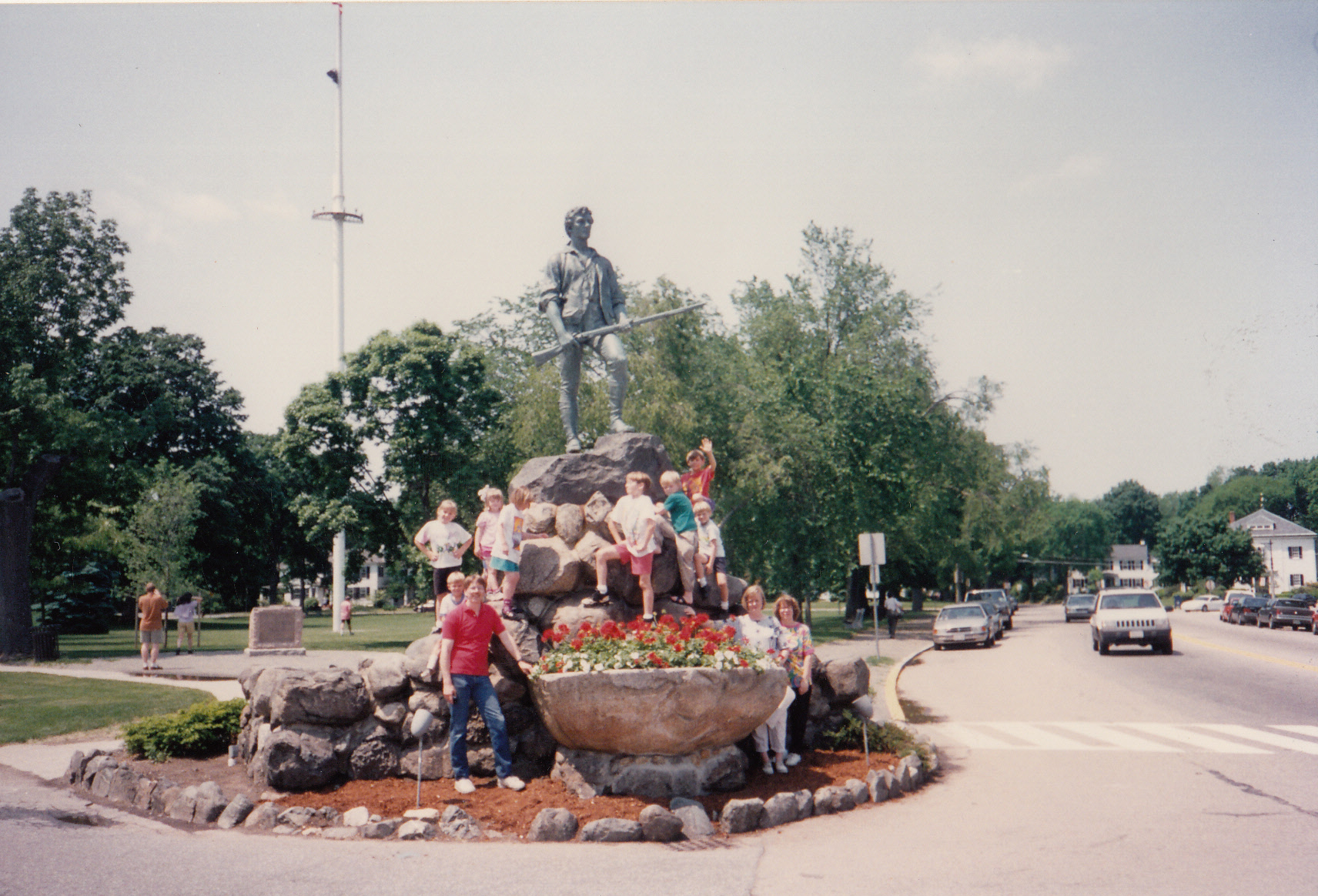
Learning Our Heritage--Minute Men in the Making at Lexington

Learning Our Heritage: Minute Men In The Making At Lexington, Massachusetts

I love the hymn They, the Builders of the Nation. Becoming a pioneer today takes courage, and it takes some out-of-the-box thinking. How may each of us be a “pillar, guide, and inspiration to the hosts of waiting youth”? (See Verse 3—sing, read or listen.) What are some important ways that we may broaden our understanding of how to serve more effectively the community around us? How to serve those who may have needs that we don’t perceive, and how we may be a part of meeting those unmet needs? Each of us can do things to become modern-day pioneers and to tread new ground in some important ways. Even if it isn’t to us, it can be very important to whom we serve.

Bogatyri (“Valiant Warriors of Old”) (1898), Viktor Vasnetsov

Bogatyri (“Valiant Warriors Of Old”) (1898), Viktor Vasnetsov

Now that I think deeper, I was indeed a pioneer when I hurried to help my friend whose wife and family had just died in a plane crash. Despite being suicidal at the time, he and I bonded, and in his darkest moments, his extended family would seek me out repeatedly: “Come, Davy—Come quick. He needs you again.” I’d hasten once more to his side—we’d sit, sometimes talk, but I felt that our hearts were in constant conversation, even in silence, and I could feel him taking strength from me, and I gave freely, for I knew that I had strength to spare. By connecting with those around him, with people for whom he cared deeply, he quickly learned to develop his own sources of strength.

Again, I was a pioneer when I served diligently in our congregation as a home teacher (volunteer shepherd) to a family with five young children. Despite his severe substance abuse concerns, this young father and I bonded easily, and he sometimes called me in the wee hours when the pull of drugs was strong and he was weak and needed to talk. As we’d sit on the stoop of his small house in the darkness, we’d have the most amazing talks filled with light. He opened the door to whole new era in my home teaching experience when one day, he interrupted me mid-sentence to ask, “How do you do it, Dave? How do you get us to feel these things?” We opened our hearts to each other like never before, and our souls were knit together like David and Jonathan of old. It was as if we could read each other’s minds. When we talked of truths at night (Hymn 147, “Sweet Is the Work,” end of Verse 1), I remember many times thinking, “There is nowhere else on earth that I would rather be than right here, right now, on this stoop, talking with this man.” I could feel him taking courage from me, and I gave freely, for I knew that I had courage to spare. He moved away, then I moved, and always I will miss our conversations.

Consider More Deeply
So, consider increasing your courage. Do what is right. Serve others not on your terms but on theirs; meet them on their level not yours. Get out of your box. Each of us may enjoy doing what we can to stand with other people for that which is good, for that which we know to be right. Be a pillar, a guide. Maybe be an inspiration. Maybe to youth. Couldn’t we all benefit from spending some time to consider how we may improve our efforts to become a modern pioneer? I know I will.

Modern Pioneers in Many Ways

Modern Pioneers In Many Ways

——– End of Post ——–
WebCredits—List of web resources used in this post but not explicitly credited above: 

  • Photo, “Townsend’s Big-eared Bat”—en.wikipedia.org/wiki/File:Big-eared-townsend-fledermaus.jpg
  • Address, “The World Needs Pioneers Today”, President Thomas S. Monson, Ensign, Jul 2013—www .lds.org/ensign/2013/07/the-world-needs-pioneers-today?lang=eng
  • Painting, «Богатыри» Or Bogatyri (“Valiant Warriors Of Old”) (1898), Viktor Vasnetsov (Tretyakov Gallery, Moscow)—en.wikipedia.org/wiki/File:Die_drei_Bogatyr.jpg
——– End of WebCredits ——–