Category Archives: Personal Challenges

Showing Initiative, Saving Goals, and Second Efforts

Mongolian Archer

Mongolian Archer

At the archery portion of the Naadam Festival held in July each year in Ulaanbaatar, a female archer in elegant Mongolian dress aims to topple a small wall of marked blocks from over half a football field away. The skill demonstrated by the archers in the competition is absolutely amazing as they more often than not hit the center portion of the marked blocks.

For Hunger Games archer Katniss Everdeen, it was take initiative or starve to death. After her father died and her mother was crippled with grief, feeding the family fell to Katniss. It took time, but she learned to recognize that she had developed skills that could save her family if she would put to work the tools her father had given her:

For a while, I hung around the edges of the Meadow, but finally I worked up the courage to go under the fence. It was the first time I’d been there alone, without my father’s weapons to protect me. But I retrieved the small bow and arrows he’d made me from a hollow tree. I probably didn’t go more than twenty yards into the woods that day. Most of the time, I perched up in the branches of an old oak, hoping for game to come by. After several hours, I had the good luck to kill a rabbit. I’d shot a few rabbits before, with my father’s guidance. But this I’d done on my own.

We hadn’t had meat in months… The woods became our savior, and each day I went a bit farther into its arms. It was slow-going at first, but I was determined to feed us. (The Hunger Games, Chapter 4, Paragraphs 17-19, Pages 50-51)

Nephi also learned to show initiative when faced with severe difficulties. His ability to feed his family was threatened when his bow made of fine steel was broken. He made a decision that saved his family. While others complained, he set a self-imposed goal: To make a bow of wood and to put it to work. Nephi would have had to carve a piece of wood long enough, thick enough, straight enough, and flexible yet strong enough to draw back with great force without breaking it. Suitable wood in the area may have included olive, pomegranate, acacia, or juniper.

Nephi Finds Food While Others Complained

But it’s what he did next that sets Nephi apart. He went to his spiritual leader to seek his counsel. And it came to pass that I, Nephi, did make out of wood a bow, and out of a straight stick, an arrow. … And I said unto my father: Whither shall I go to obtain food?

Nephi chose to act. He did what he could to fix a bad situation. He didn’t wait to be “compelled in all things” but decided to be “anxiously engaged” and to do something “of [his] own free will” (D&C 58:26–27). The Lord then blessed his efforts by helping him to have a successful hunt (1 Nephi 16:29–31). His goals were not just self-imposed goals; they were goals that saved his family.

Clay Christensen and Ideas That Change The World

Clayton M. Christensen has put this same lesson to work. As a world-renowned innovation expert and the Kim B. Clark Professor of Business Administration at the Harvard Business School, he has bit of experience with showing initiative. Throughout his book, The Power of Everyday Missionaries, Clay describes repeatedly how he has used self-imposed goals to bring about incredible changes in his own life and in the lives of others. No simple quote — Just lots of inspiring counsel from one who knows, from one who learned by doing.

I have learned for myself the importance of showing initiative. It helps us to aim high, to stretch ourselves and our bowstrings, and to reach new goals. It especially helps when we seek counsel from a trusted spiritual leader. And I know that by so doing, we may save our ourselves and our families.
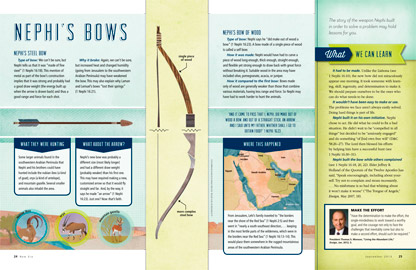
Nephi's Bows

Nephi’s Bows

Article: Nephi’s Bows

PDF: Nephi’s Bows

——– End of Post ——–
WebCredits—List of web resources used in this post but not explicitly credited above:

  • Photo, Mongolian Archer—www .pinterest.com/jurekes/arco/
  • Book, The Hunger Games, Suzanne Collins (2008, Scholastic Press, New York NY), ISBN 978-0-439-02348-1
  • Painting, Nephi Finds Food While Others Complained—www.lds.org/manual/book-of-mormon-student-manual/chapter-5-1-nephi-16-18
  • Photo, Ideas That Change The World—www.claytonchristensen.com
  • Book, The Power of Everyday Missionaries: The What and How of Sharing the Gospel, Clayton M. Christensen (2012, Deseret Book, Salt Lake City UT), ISBN 978-1-60907-315-2 (paperbound), 978-1-60907-316-9 (hardbound)
  • Article, “Nephi’s Bows”, New Era, Sep 2013, www .lds.org/new-era/2013/09/nephis-bows?lang=eng
    or www.lds.org/bc/content/shared/content/images/magazines/new-era/2013/09/ne13sep24-25-000-nephis-bows.pdf

——– End of WebCredits ——–

“Even darkness must pass; A new day will come!”

If anyone knows our family, they know we are huge fans of the Lord of the Rings! I remember as a young boy listening to my Dad read the trilogy to me and my brothers as we laid in our beds. Dad would put all his emotions into it as he would get excited with us, laugh with us, be sad with us, and, yes, cry with us. You can imagine our joy when we heard the news that they were making the movies! Needless to say, we loved them as well!

There is one scene in The Two Towers (that wasn’t in the book, but we’ve since forgiven Peter Jackson!) that I have been pondering about a lot lately. In the city Osgiliath, Frodo hits a breaking point when his burden as a ringbearer seems too much to handle and all hope seems lost. He is about to give himself up to temptation and be captured when Samwise the Brave comes to rescue him. Sam then delivers one of the most epic speeches about overcoming adversity and fighting for what’s right.

As I have watched and rewatched this scene, I ask myself, “How many times do I feel like Frodo here?” And I ask you, how often do you feel helpless, alone, and without hope? We often hit similar breaking points where our load seems too heavy to bear. In these “Frodo” moments, we ask ourselves the same questions in Sam’s speech. These moments are the shadows and the darkness he spoke about. Even Joseph Smith had Frodo moments in the Sacred Grove and in Liberty Jail when he cried out, “Oh God, where art thou?” (D&C 121:1.)

To those who feel, or have felt, this way before, I empathize with you. I too have come to up against the wall that seems impossible to get over and move on. I have longed for a “Sam” to come rescue me and tell me everything is going to be alright. I’m here to tell you that God will come! He is our Sam in the story. He reminds us that “even darkness must pass. A new day will come! And when the sun shines, it will shine out the clearer!” God reminds us of our purpose and “what [we’re] holding on to.” (See Joseph Smith-History 1:16-17 and D&C 121:7-10 for God’s response to Joseph’s Frodo moments.)

I want to share a story of one my own Frodo moments. A little over a year ago I was going through a really hard time. I had just lost the girl I loved, I was struggling with finding a major at school, work was wearing me down, and it just seemed like anything I desired was always out of reach. I felt helpless, abandoned, and hopeless. I’m sure I wearied my Heavenly Father with my endless prayers of gloom and sadness. My Sam in this story came in the form of a poem that I wrote. It brought peace and hope to my life as I was able to put my thoughts into words. It inspired me to keep going:

In the same place

In the same place night after night,
My corner chair that fits just right,
I examine my considered plight,
Which has become my endless fight.

In the same place I try to see,
While Pandora sings soothingly
To my troubled and longing heart,
The pathway that I now should start.

In the same place when all retire,
I earnestly search for the fire
That drives, that pushes, and inspires,
To achieve heart’s deepest desire.

In the same place night after night,
Past memories dance into my sight.
I muse, I smile, and seldom cry,
But often time think, “why, oh why?”

In the same place through thick and thin,
I overcome the pain within.
Arise, go forth, begin to mend!
Surprises will come around the bend.

As I wrote this, I could feel the Lord’s love surround me. I was not alone, help was given, and hope restored. God is ever aware of lives and what we are passing through in this very moment. He loves us! We may feel like Frodo in our own personal Mt. Doom hanging on for dear life. The Lord, just as Sam did, reaches out to us when we are about to give up and says, “Don’t you let go!” I want you to know that your shadow IS only a passing thing, and surprises do come around the bend! I echo the words that King David said to his son Solomon, “Be strong and of good courage, and do it: fear not, nor be dismayed: for the Lord God, even my God, will be with thee; he will not fail thee, nor forsake thee, until thou hast finished all the work for the service of the house of the Lord.” (1 Chronicles 28:20.)

The Lord will not give up on you, so you shouldn’t give up on yourself! Look for the “Sams” in your life; I know you’ll find them. God answers our prayers in a variety of ways, often time through other people. May we also strive to be Sam in the lives of others.

I recommend these videos that helped me in times of need. They also touch on this topic:

The words from “Does the Journey Seem Long” http://www.youtube.com/watch?v=imd4fIjNx7s

“Good Things to Come” by Elder Jeffrey R. Holland http://www.youtube.com/watch?v=8nczw6xHJ0I

What One Can Glean from the Mud

I used to picture life as a fist fight…in the rain.  Perhaps that is because I’m currently at home with four young children (a stage in life oft referred to as “in the trenches”), I’m not sure but a muddy fist fight is what life looked like.  If I drew a picture I would have drawn a brown rippling circle, a Goliath stick figure with a little mud on his shins and t-shirt that said, “LIFE EATS PEOPLE”  or “GUNS DON’T KILL PEOPLE LIFE DOES” and a dinky stick figure face down in the mud with a large arrow labeling it, “whitney”

Life vs Whitney

A few months after my 3rd child was born, during my husband’s last year of  medical school/intern year of residency, compounded by some mixed muddled thinking in my own head, depressed and anxiety ridden I thought about that muddy fist fight A LOT.

Generally speaking, I thought of myself as a fighter.  And I used to be! Strong mentally and physically—breaking is not something I did.  PAH!   Oh, how the proud need to be humbled.  There were times when I felt I was still in the fight but I wasn’t making any forward progress.  In fact, I didn’t really have an offensive strategy at all.  It was all defensive and evasion techniques.   Soon I lacked the strength to even be evasive.  It took everything I had just to take the hits and stay on my feet.  I was so exhausted.

Then the hits started to hurt and they started to break things.  Then my will cracked and I flounder about lost. Within months, I was lying face down in the mud trying to figure out where I was and how I came to be there.   One evening my husband sat on the end of the bed and said, “Whitney, I think we need to get you some help.”

Over the next several months of healing I realized a few things I want to share:

First, when you get that low the outcome of your fight is determined by the decision you make with your face in the mud.  Do you lay there, conquered, and die?  Or do you tap out?  Tapping out is probably the most difficult thing I have ever done.   I had no idea the strength it would take to truly yield my will to the Father’s, trust in the power of the Atonement, and turn over my burdens.  Even as debilitated as I was, I felt it necessary to finish the fight on my own.

Segue way to another thing I learned: this fight is not intended or designed to be solo. You know those scriptures that talk about not being tempted/tried above your ability to handle it.  NEWS FLASH WHITNEY: If you attempt to take it on, on your own, YOU WILL FAIL.  Our lives are a partnership with Heavenly Father through the Gift of the Holy Ghost.  In our mortal existence we are blessed with all the things necessary to successfully navigate our trials and return home to live with our Eternal Father and our families.  We are blessed with scriptures, prophets, The Holy Ghost, prayer, families, and Priesthood leadership all to aid us in our fight for life and our eternal welfare.

While these were principles I knew in theory—I had topically study: faith, hope, patience, and humility in detail before—living out the very literal application of these Christ-like characteristics is a completely different experience and lends to a whole new realm of understanding.  Especially, I think, in situations where not only do you need to turn to your Savior to pull out of this one, but some professional help as well.

Doctrine and Covenants 98:12 “For he will give unto the faithful line upon line, precept upon precept; and I will try you and prove you herewith.”

Isaiah 28:10 “For precept must be upon precept, precept upon precept; line upon line, line upon line; here a little, and there a little:”

So, why the heck didn’t I tap out earlier and spare myself the pain and suffering?  Pride.  Had I been humble enough to endure my trials with the Lord as my co-pilot… had I been teachable enough to listen and learn without being ‘compelled to be humble’… my ability to be long-suffering would have been enhanced and the shirt on stick figure me would have read, HEAVEN POWERS MY PUNCHES.

Me and My CoPilot

Now, a few years later, I try to remember to start out turning to the Lord.  Through Him my burdens are lightened and I can feel peace in my trials.  And I tend to view life as a climb, rather than a fight.  It’s hard work, there are some easy stretches and some extremely difficult ones.  Sometimes you move up and sometimes you slip and slide down.  In order to be safe, you must have other people aiding you in your climb.  You still get scratches, bruises, and broken bones, but there are always resources and people there to help you, lead you, and cheer you on.

“Come unto me, all ye that labour and are heavy laden, and I will give you rest.” Matt 11:38 KJV

What I learned in high school–almost 40 years after graduation

school exterior

At the high school where I work we have a special needs student who has a mood disorder complicated by autism.  He has difficulty controlling himself and appropriately expressing his feelings.  Once, when he became upset in our office, he threw everything off the counter tops and hurled charts and trays to the ground.  He flung himself to the floor and tossed his shoes.  It’s an understatement to say he can be quite violent.

students

Because of this, he wears a harness so that he can be controlled should he become aggressive.  He is always accompanied by a one-on-one aide. At the beginning of one school year, this student’s aide was a huge man, 6’ 5” and 250 lbs.  The aide managed to control the student by the sheer power of his physical presence.  In the event that the student became combative, his aide could simply man-handle him into submission.  Unfortunately, this Atlas was reassigned to another student.  Even worse, he was replaced by a petite young woman.  She was so tiny and young that I worried she would be snapped in two by one of the student’s rages—but she wasn’t.

Over the course of the following weeks, I watched this little woman charm our student.  While she always held his harness, she never had to hang on for dear life.  When he refused to cooperate, she stepped close to the student and whispered persuasively in his ear.  When they walked the halls together, she and he were in frequent eye contact, talking and laughing together.  Once when he became upset in our office, instead of cowering (which I was doing!) she stood right beside him, gently rubbing his back, soothing him into submission.  I was amazed.

This wonderful woman was able to work with and, for the most part, gain the cooperation of a most difficult student.  She knew something about the power of love.  Oh, so this is was the Savior was talking about!

After His death and resurrection, Jesus called to members of the twelve from the shore of the Sea of Galilee.  They had been fishing all night but caught nothing.  Knowing their discouragement and hunger, Jesus directed them to cast their net on the right side of the ship.  Then, when the nets were hauled in near to breaking, He bid the fishermen come ashore and dine with him.  They found a small fire with fish and bread ready to eat.  As they sat around the meal, the Savior taught Peter and those listening about love.  The Savior asked Peter, “lovest thou me?”  When Peter responded, “yea, Lord” the Savior instructed: “feed my sheep.”   A three word injunction made more powerful by repetition, this commandment should govern my every action:  in the work place, at church, in the community and at home.

Good Shepherd

As a member of the Church of Jesus Christ of Latter-day Saints, I feel I am under a particular mandate to share truth and demonstrate goodwill.  That can be difficult in this hardened world; my efforts may be (have been!) met with mistrust, cynicism, and outright disbelief.    In a 2005 General Conference talk, Ulisses Soares taught how to overcome these attitudes.  He said, “People are most receptive to our influence when they feel that we truly love them.” Read his entire address here. This is what that tiny one-on-one aide knew, what the Savior was teaching to teach Peter and what I’m trying to do.

 Fundamental to serving God is loving His sheep.  For me this is a constant challenge.  I battle impatience and annoyance all day long and return home to live with a wonderful man who sometimes makes me crazy!  And then, there are some folks are just hard to love.  I am a work in progress here, but experience has taught me that prayers for help, for a softened heart, for compassion and empathy do not go unanswered.

Thank God.

——– End of Post ——–
WebCredits—List of web resources used in this post but not explicitly credited above:

  • Photo, school exterior—www.morethandodgeball.com/serve/i-could-not-think-of-a-better-use-for-our-building
  • Photo, students—www.foxnews.com/us/2012/09/02/teachers-students-in-one-alabama-city-told-to-fight-back-if-facing-violent
  • Photo, good shepherd—medleyminute.blogspot.com/2013/04/the-good-shepherd-loves-his-sheep.html
  • Address, “Feed My Sheep,” Elder Ulisses Soares, LDS General Conference, Oct 2005—www .lds.org/general-conference/2005/10/feed-my-sheep?lang=eng

——– End of WebCredits ——–

Bats, Courage, And The Modern Pioneer

Townsend's Big-eared Bat

Townsend’s Big-eared Bat

Our prophet has recently highlighted the global need for pioneers today. In what ways can we be a pioneer?

Bats And Blind, Shallow Courage
I was a pioneer once, and it was scary. A friend with a new baby called and asked my son, Todd (then in high school), if he could come help her out—Her husband wasn’t at home, and she had a bat in her house.  It seems that bats and mothers of new babies don’t do well together. Todd assured her that he’d be right over. Then he called me immediately. I was in a meeting, which was terminated for the bat. Neither Todd nor I had any batty experience; it was just the blind leading the bat. Fortunately for us, our friend happened to have a wastecan, which we emptied in order to shroud the squeaky thing. Fortunately for the bat, it had become more orderly by the time we arrived. We grabbed the empty can and a piece of cardboard large enough to cover the mouth of the wastebasket, calmly placed the container over the stationary animal, inserted the cardboard between the can and the wall, and carried the contained bat outside. Our meager courage did not fail.    

While our winged mammal required us to have courage, its capture is a fairly wussy example of being a modern pioneer. Dictionary.com defines a pioneer as “one who is first to settle a region for development by others” or “one who is among the earliest in a field of inquiry, enterprise or progress.” So there may be a lot to learn from a non-wussy pioneer. For instance, there’s Matt Harding. Stuck in a job he didn’t enjoy, he decided that he was willing to take a risk and try something new. He has turned his silly characteristic dance into a video model of global community outreach, and people all over the world jostle to be with Matt, to laugh, jump and clap hands together. Now, it’s his full-time (yes, paying) job. All from some great music and from being willing to dance badly in front of people: Fun to watch.

Seeing More Deeply
So why pioneer? What’s the urgency to pioneer? The importance? As President Monson taught us, “We forget how the Greeks and Romans prevailed magnificently in a barbaric world and how that triumph ended—how a slackness and softness finally overcame them to their ruin. In the end, more than they wanted freedom, they wanted security and a comfortable life; and they lost all—comfort and security and freedom.” (See Paragraph 11.)

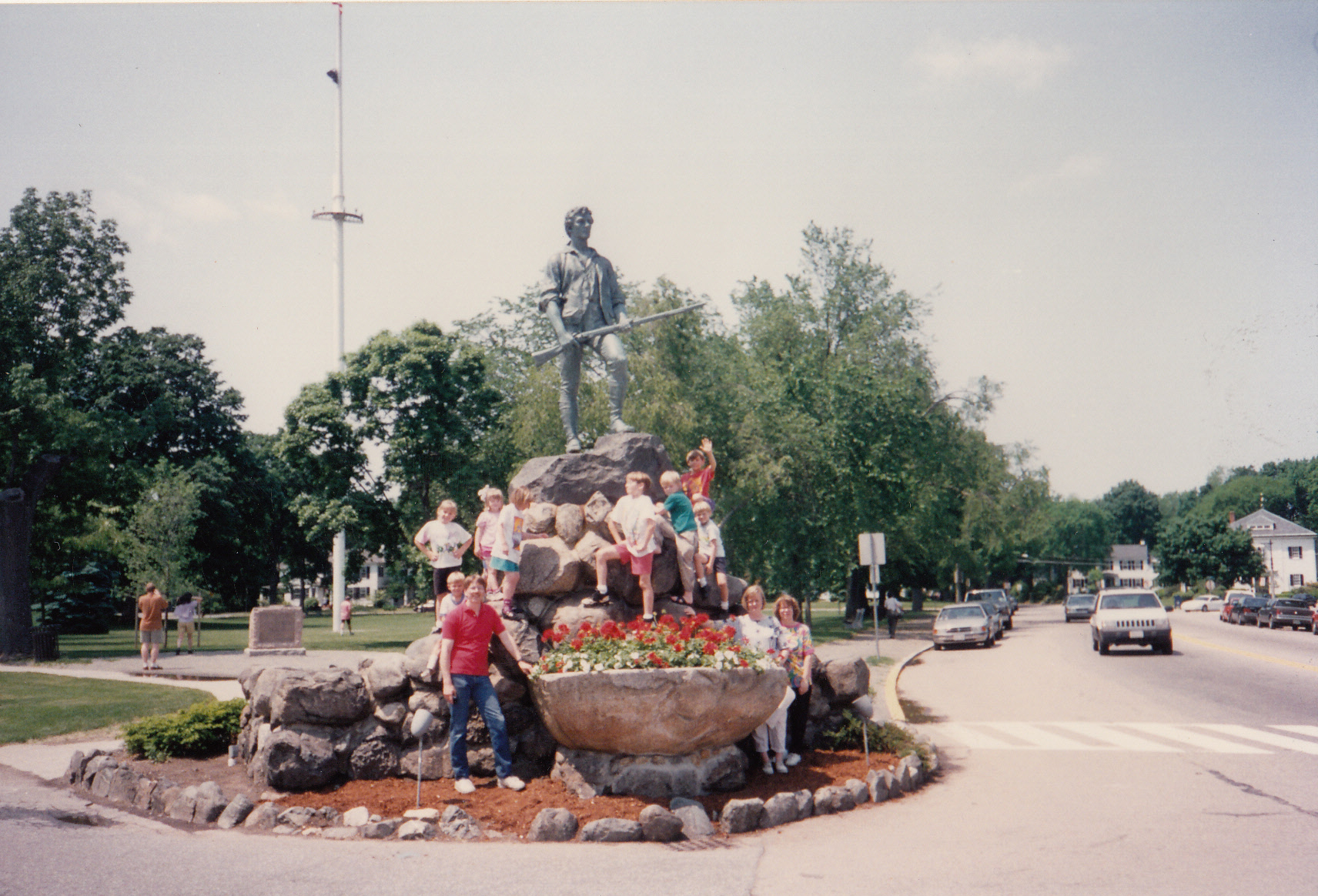
Learning Our Heritage--Minute Men in the Making at Lexington

Learning Our Heritage: Minute Men In The Making At Lexington, Massachusetts

I love the hymn They, the Builders of the Nation. Becoming a pioneer today takes courage, and it takes some out-of-the-box thinking. How may each of us be a “pillar, guide, and inspiration to the hosts of waiting youth”? (See Verse 3—sing, read or listen.) What are some important ways that we may broaden our understanding of how to serve more effectively the community around us? How to serve those who may have needs that we don’t perceive, and how we may be a part of meeting those unmet needs? Each of us can do things to become modern-day pioneers and to tread new ground in some important ways. Even if it isn’t to us, it can be very important to whom we serve.

Bogatyri (“Valiant Warriors of Old”) (1898), Viktor Vasnetsov

Bogatyri (“Valiant Warriors Of Old”) (1898), Viktor Vasnetsov

Now that I think deeper, I was indeed a pioneer when I hurried to help my friend whose wife and family had just died in a plane crash. Despite being suicidal at the time, he and I bonded, and in his darkest moments, his extended family would seek me out repeatedly: “Come, Davy—Come quick. He needs you again.” I’d hasten once more to his side—we’d sit, sometimes talk, but I felt that our hearts were in constant conversation, even in silence, and I could feel him taking strength from me, and I gave freely, for I knew that I had strength to spare. By connecting with those around him, with people for whom he cared deeply, he quickly learned to develop his own sources of strength.

Again, I was a pioneer when I served diligently in our congregation as a home teacher (volunteer shepherd) to a family with five young children. Despite his severe substance abuse concerns, this young father and I bonded easily, and he sometimes called me in the wee hours when the pull of drugs was strong and he was weak and needed to talk. As we’d sit on the stoop of his small house in the darkness, we’d have the most amazing talks filled with light. He opened the door to whole new era in my home teaching experience when one day, he interrupted me mid-sentence to ask, “How do you do it, Dave? How do you get us to feel these things?” We opened our hearts to each other like never before, and our souls were knit together like David and Jonathan of old. It was as if we could read each other’s minds. When we talked of truths at night (Hymn 147, “Sweet Is the Work,” end of Verse 1), I remember many times thinking, “There is nowhere else on earth that I would rather be than right here, right now, on this stoop, talking with this man.” I could feel him taking courage from me, and I gave freely, for I knew that I had courage to spare. He moved away, then I moved, and always I will miss our conversations.

Consider More Deeply
So, consider increasing your courage. Do what is right. Serve others not on your terms but on theirs; meet them on their level not yours. Get out of your box. Each of us may enjoy doing what we can to stand with other people for that which is good, for that which we know to be right. Be a pillar, a guide. Maybe be an inspiration. Maybe to youth. Couldn’t we all benefit from spending some time to consider how we may improve our efforts to become a modern pioneer? I know I will.

Modern Pioneers in Many Ways

Modern Pioneers In Many Ways

——– End of Post ——–
WebCredits—List of web resources used in this post but not explicitly credited above: 

  • Photo, “Townsend’s Big-eared Bat”—en.wikipedia.org/wiki/File:Big-eared-townsend-fledermaus.jpg
  • Address, “The World Needs Pioneers Today”, President Thomas S. Monson, Ensign, Jul 2013—www .lds.org/ensign/2013/07/the-world-needs-pioneers-today?lang=eng
  • Painting, «Богатыри» Or Bogatyri (“Valiant Warriors Of Old”) (1898), Viktor Vasnetsov (Tretyakov Gallery, Moscow)—en.wikipedia.org/wiki/File:Die_drei_Bogatyr.jpg
——– End of WebCredits ——–

Broken/Intact Measures Of Success

Burnt-out Fuse

At work, I have a friend, Roseanne (names have been changed), who cleans our hallway and offices. Currently, she has some personal challenges and misses a lot of work. Patrice, a mutual friend who cleans when Roseanne is gone, is a person of strong faith and has asked me to pray for Roseanne. We’ve had some great talks, and at the end, she always reminds me of the need to keep Roseanne in our prayers. The other day, as Patrice and I talked, I felt strongly that I should tell her that I was a Mormon. Given her classic Christian faith traditions, I immediately rejected the thought, knowing that it would not end well. I again felt prompted to mention my Mormon faith, and after arguing with myself (“This REALLY will NOT end well!”), I concluded that this was in truth a prompting from a celestial source and that I should follow it. I said, “Patrice, I’ll be glad to continue praying. You know, as a Mormon, my family has an active daily prayer life, and I’ll surely keep Roseanne in my prayers.”

Patrice’s face fell, and she ended the conversation abruptly. My first thought: I had been right – It did not end well. My second thought, influenced I believe by the Holy Ghost: “Of course, it did not end well, and this is exactly what Patrice needed. You have blown a fuse in her mind. You have fried her spiritual circuits. But after a time, her circuits will heal, and she’ll replace the blown fuse. She must deal with this in order to listen more fully sometime later. Give her time.”

And indeed, it took some time. Patrice no longer spoke to me, and when I saw her, her face would fall, and she would look away from me. After a month of this, I wondered whether she would ever in this life replace the busted fuse. But after about six weeks, she has now just recently started to talk to me again, as if nothing had ever happened. She’s on the way to healing, and I hope that eventually she may be in a position to listen to a friend about the Church of Jesus Christ (The Church of Jesus Christ of Latter-day Saints).

My main point has nothing to do with Roseanne or Patrice. It has to do with what we consider success or failure in our missionary experiences. The Lord’s measures of success and our own often are not the same. As Harvard Business School innovation expert Clay Christensen teaches us in his book, The Power of Everyday Missionaries, we are a successful missionary when we communicate about the gospel of Jesus Christ. As far as God is concerned, a positive or negative response to what we teach does not influence the quality of the experience; the reaction of our conversation partner(s) is independent of our success. The quality of the experience is determined by how we follow the promptings that we receive. I have learned for myself that this is true.

——– End of Post ——–
WebCredits—List of web resources used in this post but not explicitly credited above:

  • Photo, “Burnt-out Fuse”—www .videojug.com/film/how-to-replace-a-blown-fuse

——– End of WebCredits ——–