Tag Archives: Being Brave

Being Brave: Pre-mortality, Priesthood Power, and the Family Proclamation

A friend just shared this Vocal Point video with me, and an entire post popped in my head. The song is “(I Want To See You Be) Brave,” by Sara Bareilles. I thought of my wife, Kim, of our six adult kids and their families. I especially liked the sign that reads, “When I talk to new people.”

As a Mormon, as a member of The Church of Jesus Christ of Latter-day Saints, I  believe that we lived with God before we were born. True of anyone. And by celestial design, none of us remember — It was all veiled at birth. For eons before we came here, we studied hard, acquired knowledge, and learned skills, all with the goal of trying our guts out to live as God had taught and to do whatever we could to keep ourselves and others on the narrow path back to him. As we prepared with him for the moment of our birth, we knew that we would learn more from life on earth, because here we would be able to learn to walk not by memory, not by sight, but by faith, for the first time making decisions on our own in an environment where Heavenly Father was no longer around. As he sent us off, I wonder if he was singing to us a similar pre-lullaby message of “I want to see you be brave!”

This idea of a pre-existence changes many a perspective. I see my body not as mine, not to do with as I please, but as a temple of God, a gift from him, a house for my spirit now that I’m no longer with him. Such a view demands that I treat my body with respect and not with selfishness. The idea of a pre-mortal life and the idea of your body being a temple and not your own are ideas that permeate the popular post of Mormon blogger Seth Adam Smith, “Marriage Isn’t For You” (at his blog or at Huffington Post). His earthly father taught him, “Marriage isn’t for you. It’s not about you. Marriage is about the person you married.” While I heartily agree, I also counsel our kids as they head to the altar that marriage is so dang fun (for themselves as well as for their spouse).

These ideas and others are discussed concisely in the LDS Family Proclamation. These ideas help protect me, keep me be safe and secure. These perspectives, these teachings, are why families are so important. Families help us get ourselves back to God.

And in addition to giving us a family to help, God went further to give us another gift, both urgent and important. He allowed us to have a portion of his power. He gave us his priesthood, the authority to act for him, to do what he would do, if he were here with his ample arm around us, whispering what he would like us to know, to do, to be, to become. The priesthood of God isn’t for some and not for others — It’s for any of us, for all of us. It applies equally to people of any gender, in any country, of any position in life. For example, watch how Sheri Dew answers the great question: “In the Church of Jesus Christ of Latter-day Saints, what do women get?”

http://www.youtube.com/watch?v=-QYlDLChzig

I can see how God sent ALL of us here well prepared, not just to thrive, but to fight to find our way back. When we’re unsure of the path, he continues to guide us. We call that prayer, and it works like a phone. With a bit of effort, it’s a two-way communication device. Beats a cell phone or Star Trek communicator with a stick.

Dieter Uchtdorf taught us to be brave against doubt when he said, referring to another’s phrase which was first penned in 1924: “It’s natural to have questions—the acorn of honest inquiry has often sprouted and matured into a great oak of understanding. One of the purposes of the Church is to nurture and cultivate the seed of faith—even in the sometimes sandy soil of doubt and uncertainty. Therefore, my dear brothers and sisters—my dear friends—please, first doubt your doubts before you doubt your faith.” (See F.F. Bosworth, Christ the Healer (1924), Page 23, as quoted in “Come, Join With Us”.)

Most importantly, these perspectives shift my thinking, so that I tend to view life through a lens of patience and peace. These ideas give me hope and humility. Seth’s dad is spot on — It isn’t all about me. Sometimes, I don’t want my stinkin’ thinkin’ shifted, but if I learn to adjust my vision to a more godly perspective, I realize that it was short-sighted to fight the shift in thought. I hope it makes me a better husband, a better father, a better man, a better person. It helps me be brave.

From the lyrics of Brave: “Show me how big your brave is.”

Seeing Ourselves As Brave -- Being Brave For Others

Seeing Ourselves As Brave — Being Brave For Others

——– End of Post ——–
WebCredits—List of web resources used in this post but not explicitly credited above:

  • Video, “Brave by Sara Bareilles—BYU Vocal Point (a cappella tribute)”—www. youtube.com/watch?v=XeX3r8j66Qk
  • Blog Post, “Marriage Isn’t For You”, Seth Adam Smith—sethadamsmith.com/2013/11/02/marriage-isnt-for-you/
  • Blog Re-post, “Marriage Isn’t For You”, Seth Adam Smith—
    www. huffingtonpost.com/seth-adam-smith/marriage-isnt-for-you_b_4209837.html
  • Document, The Family: A Proclamation to the World
    www. lds.org/topics/family-proclamation
  • Video, “Lean on My Ample Arm”—www. youtube.com/watch?v=iWn48w7vX80
  • Hymn, “Lean on My Ample Arm”, music, recordings, lyrics—www. lds.org/music/library/hymns/lean-on-my-ample-arm?lang=eng
  • Video, “What Do LDS Women Get?”—www. youtube.com/watch?v=-QYlDLChzig
  • Address, “Come, Join With Us,” Dieter F. Uchtdorf, LDS General Conference Oct 2013—www. lds.org/general-conference/2013/10/come-join-with-us
  • Illustration, Seeing Ourselves As Brave — Being Brave For Others—https://www. lds.org/media-library/images/primary/illustrations?lang=eng#children-barking-dog-778662

——– End of WebCredits ——–

Showing Initiative, Saving Goals, and Second Efforts

Mongolian Archer

Mongolian Archer

At the archery portion of the Naadam Festival held in July each year in Ulaanbaatar, a female archer in elegant Mongolian dress aims to topple a small wall of marked blocks from over half a football field away. The skill demonstrated by the archers in the competition is absolutely amazing as they more often than not hit the center portion of the marked blocks.

For Hunger Games archer Katniss Everdeen, it was take initiative or starve to death. After her father died and her mother was crippled with grief, feeding the family fell to Katniss. It took time, but she learned to recognize that she had developed skills that could save her family if she would put to work the tools her father had given her:

For a while, I hung around the edges of the Meadow, but finally I worked up the courage to go under the fence. It was the first time I’d been there alone, without my father’s weapons to protect me. But I retrieved the small bow and arrows he’d made me from a hollow tree. I probably didn’t go more than twenty yards into the woods that day. Most of the time, I perched up in the branches of an old oak, hoping for game to come by. After several hours, I had the good luck to kill a rabbit. I’d shot a few rabbits before, with my father’s guidance. But this I’d done on my own.

We hadn’t had meat in months… The woods became our savior, and each day I went a bit farther into its arms. It was slow-going at first, but I was determined to feed us. (The Hunger Games, Chapter 4, Paragraphs 17-19, Pages 50-51)

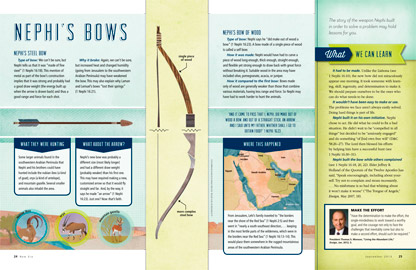
Nephi also learned to show initiative when faced with severe difficulties. His ability to feed his family was threatened when his bow made of fine steel was broken. He made a decision that saved his family. While others complained, he set a self-imposed goal: To make a bow of wood and to put it to work. Nephi would have had to carve a piece of wood long enough, thick enough, straight enough, and flexible yet strong enough to draw back with great force without breaking it. Suitable wood in the area may have included olive, pomegranate, acacia, or juniper.

Nephi Finds Food While Others Complained

But it’s what he did next that sets Nephi apart. He went to his spiritual leader to seek his counsel. And it came to pass that I, Nephi, did make out of wood a bow, and out of a straight stick, an arrow. … And I said unto my father: Whither shall I go to obtain food?

Nephi chose to act. He did what he could to fix a bad situation. He didn’t wait to be “compelled in all things” but decided to be “anxiously engaged” and to do something “of [his] own free will” (D&C 58:26–27). The Lord then blessed his efforts by helping him to have a successful hunt (1 Nephi 16:29–31). His goals were not just self-imposed goals; they were goals that saved his family.

Clay Christensen and Ideas That Change The World

Clayton M. Christensen has put this same lesson to work. As a world-renowned innovation expert and the Kim B. Clark Professor of Business Administration at the Harvard Business School, he has bit of experience with showing initiative. Throughout his book, The Power of Everyday Missionaries, Clay describes repeatedly how he has used self-imposed goals to bring about incredible changes in his own life and in the lives of others. No simple quote — Just lots of inspiring counsel from one who knows, from one who learned by doing.

I have learned for myself the importance of showing initiative. It helps us to aim high, to stretch ourselves and our bowstrings, and to reach new goals. It especially helps when we seek counsel from a trusted spiritual leader. And I know that by so doing, we may save our ourselves and our families.

Nephi's Bows

Nephi’s Bows

Article: Nephi’s Bows

PDF: Nephi’s Bows

——– End of Post ——–
WebCredits—List of web resources used in this post but not explicitly credited above:

  • Photo, Mongolian Archer—www .pinterest.com/jurekes/arco/
  • Book, The Hunger Games, Suzanne Collins (2008, Scholastic Press, New York NY), ISBN 978-0-439-02348-1
  • Painting, Nephi Finds Food While Others Complained—www.lds.org/manual/book-of-mormon-student-manual/chapter-5-1-nephi-16-18
  • Photo, Ideas That Change The World—www.claytonchristensen.com
  • Book, The Power of Everyday Missionaries: The What and How of Sharing the Gospel, Clayton M. Christensen (2012, Deseret Book, Salt Lake City UT), ISBN 978-1-60907-315-2 (paperbound), 978-1-60907-316-9 (hardbound)
  • Article, “Nephi’s Bows”, New Era, Sep 2013, www .lds.org/new-era/2013/09/nephis-bows?lang=eng
    or www.lds.org/bc/content/shared/content/images/magazines/new-era/2013/09/ne13sep24-25-000-nephis-bows.pdf

——– End of WebCredits ——–

Bats, Courage, And The Modern Pioneer

Townsend's Big-eared Bat

Townsend’s Big-eared Bat

Our prophet has recently highlighted the global need for pioneers today. In what ways can we be a pioneer?

Bats And Blind, Shallow Courage
I was a pioneer once, and it was scary. A friend with a new baby called and asked my son, Todd (then in high school), if he could come help her out—Her husband wasn’t at home, and she had a bat in her house.  It seems that bats and mothers of new babies don’t do well together. Todd assured her that he’d be right over. Then he called me immediately. I was in a meeting, which was terminated for the bat. Neither Todd nor I had any batty experience; it was just the blind leading the bat. Fortunately for us, our friend happened to have a wastecan, which we emptied in order to shroud the squeaky thing. Fortunately for the bat, it had become more orderly by the time we arrived. We grabbed the empty can and a piece of cardboard large enough to cover the mouth of the wastebasket, calmly placed the container over the stationary animal, inserted the cardboard between the can and the wall, and carried the contained bat outside. Our meager courage did not fail.    

While our winged mammal required us to have courage, its capture is a fairly wussy example of being a modern pioneer. Dictionary.com defines a pioneer as “one who is first to settle a region for development by others” or “one who is among the earliest in a field of inquiry, enterprise or progress.” So there may be a lot to learn from a non-wussy pioneer. For instance, there’s Matt Harding. Stuck in a job he didn’t enjoy, he decided that he was willing to take a risk and try something new. He has turned his silly characteristic dance into a video model of global community outreach, and people all over the world jostle to be with Matt, to laugh, jump and clap hands together. Now, it’s his full-time (yes, paying) job. All from some great music and from being willing to dance badly in front of people: Fun to watch.

Seeing More Deeply
So why pioneer? What’s the urgency to pioneer? The importance? As President Monson taught us, “We forget how the Greeks and Romans prevailed magnificently in a barbaric world and how that triumph ended—how a slackness and softness finally overcame them to their ruin. In the end, more than they wanted freedom, they wanted security and a comfortable life; and they lost all—comfort and security and freedom.” (See Paragraph 11.)

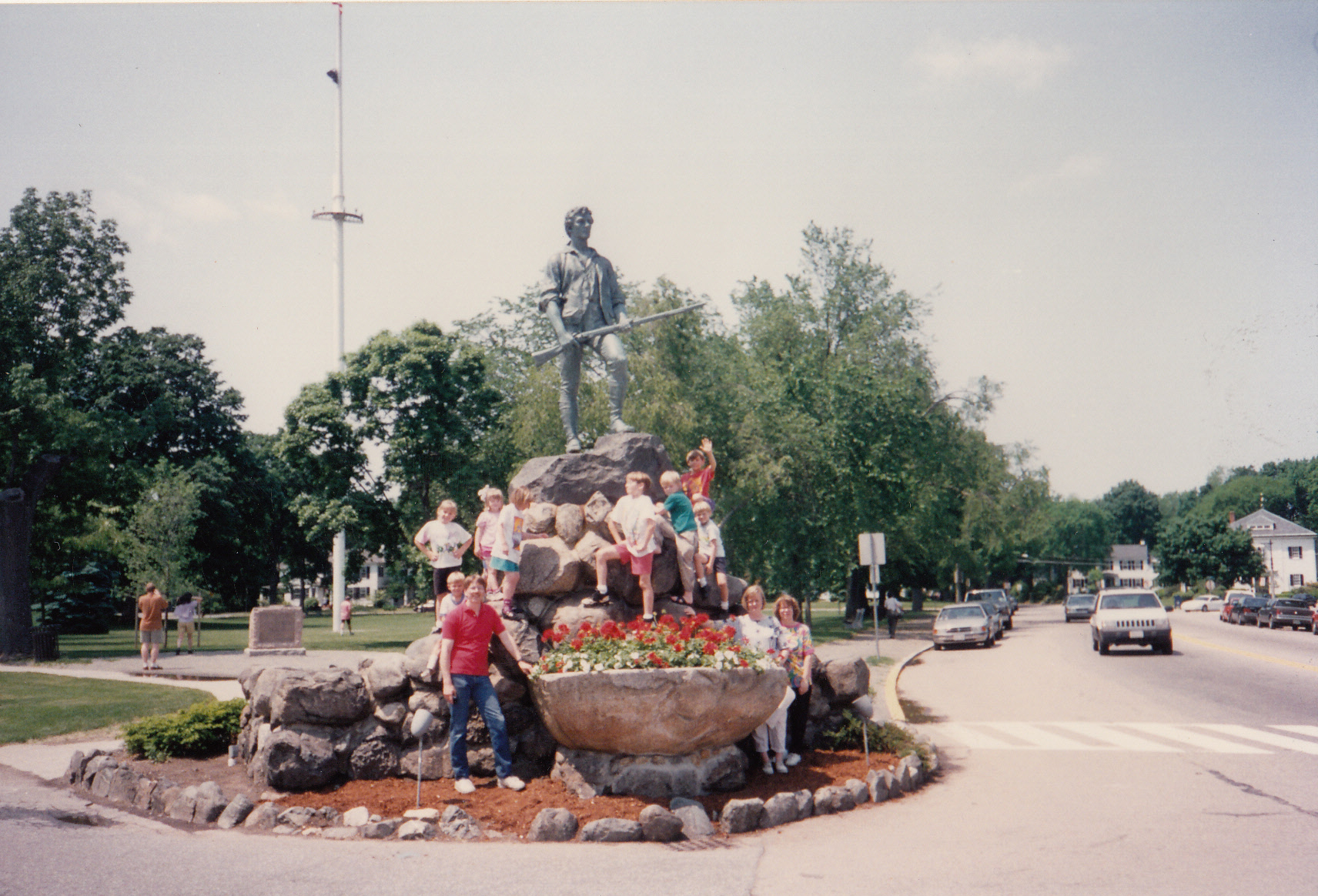
Learning Our Heritage--Minute Men in the Making at Lexington

Learning Our Heritage: Minute Men In The Making At Lexington, Massachusetts

I love the hymn They, the Builders of the Nation. Becoming a pioneer today takes courage, and it takes some out-of-the-box thinking. How may each of us be a “pillar, guide, and inspiration to the hosts of waiting youth”? (See Verse 3—sing, read or listen.) What are some important ways that we may broaden our understanding of how to serve more effectively the community around us? How to serve those who may have needs that we don’t perceive, and how we may be a part of meeting those unmet needs? Each of us can do things to become modern-day pioneers and to tread new ground in some important ways. Even if it isn’t to us, it can be very important to whom we serve.

Bogatyri (“Valiant Warriors of Old”) (1898), Viktor Vasnetsov

Bogatyri (“Valiant Warriors Of Old”) (1898), Viktor Vasnetsov

Now that I think deeper, I was indeed a pioneer when I hurried to help my friend whose wife and family had just died in a plane crash. Despite being suicidal at the time, he and I bonded, and in his darkest moments, his extended family would seek me out repeatedly: “Come, Davy—Come quick. He needs you again.” I’d hasten once more to his side—we’d sit, sometimes talk, but I felt that our hearts were in constant conversation, even in silence, and I could feel him taking strength from me, and I gave freely, for I knew that I had strength to spare. By connecting with those around him, with people for whom he cared deeply, he quickly learned to develop his own sources of strength.

Again, I was a pioneer when I served diligently in our congregation as a home teacher (volunteer shepherd) to a family with five young children. Despite his severe substance abuse concerns, this young father and I bonded easily, and he sometimes called me in the wee hours when the pull of drugs was strong and he was weak and needed to talk. As we’d sit on the stoop of his small house in the darkness, we’d have the most amazing talks filled with light. He opened the door to whole new era in my home teaching experience when one day, he interrupted me mid-sentence to ask, “How do you do it, Dave? How do you get us to feel these things?” We opened our hearts to each other like never before, and our souls were knit together like David and Jonathan of old. It was as if we could read each other’s minds. When we talked of truths at night (Hymn 147, “Sweet Is the Work,” end of Verse 1), I remember many times thinking, “There is nowhere else on earth that I would rather be than right here, right now, on this stoop, talking with this man.” I could feel him taking courage from me, and I gave freely, for I knew that I had courage to spare. He moved away, then I moved, and always I will miss our conversations.

Consider More Deeply
So, consider increasing your courage. Do what is right. Serve others not on your terms but on theirs; meet them on their level not yours. Get out of your box. Each of us may enjoy doing what we can to stand with other people for that which is good, for that which we know to be right. Be a pillar, a guide. Maybe be an inspiration. Maybe to youth. Couldn’t we all benefit from spending some time to consider how we may improve our efforts to become a modern pioneer? I know I will.

Modern Pioneers in Many Ways

Modern Pioneers In Many Ways

——– End of Post ——–
WebCredits—List of web resources used in this post but not explicitly credited above: 

  • Photo, “Townsend’s Big-eared Bat”—en.wikipedia.org/wiki/File:Big-eared-townsend-fledermaus.jpg
  • Address, “The World Needs Pioneers Today”, President Thomas S. Monson, Ensign, Jul 2013—www .lds.org/ensign/2013/07/the-world-needs-pioneers-today?lang=eng
  • Painting, «Богатыри» Or Bogatyri (“Valiant Warriors Of Old”) (1898), Viktor Vasnetsov (Tretyakov Gallery, Moscow)—en.wikipedia.org/wiki/File:Die_drei_Bogatyr.jpg
——– End of WebCredits ——–