In this, the 21st Century, we often hear the word tolerance. However, I believe that those who most often use this word do not fully understand it. Tolerance does mean respecting others’ beliefs, customs and traditions. Tolerance means, in a religious aspect, that all should be allowed to express his or her beliefs freely and practice them freely. However, being tolerant of others’ actions does not mean condoning others’ behavior.
My hometown is a very diverse place and I had the opportunity to meet many people of varying faiths and belief systems. I have a particular friend Joel, (whose name has been changed for the purpose of this blog) that is an open and practicing homosexual. I love him dearly and we have developed a very great and deep friendship. I have always been open about my belief that homosexuality is contrary to God’s law and he has always been open about his desire to continue in his sexual orientation.
His actions do not, however, mean that I should avoid him or treat him differently. And just because I do not support homosexuality does not mean that we cannot tolerate each other, or be friends. Nor does my disapproval of his actions mean that I’m being intolerant.
Now, I would like to point out that whether he “chose” to be gay or not is unimportant. To me, all that is important is what God has taught and apart from heterosexuality, God has taught that we must be tolerant. As I said I have a very deep relationship with this friend and our opposing views have never been a hindrance to that relationship. Being tolerant means that I can love him as a person, not as a “gay.” We are all children of a Loving Heavenly Father and he sees us all as His children regardless of what we may ever do.
At the archery portion of the Naadam Festival held in July each year in Ulaanbaatar, a female archer in elegant Mongolian dress aims to topple a small wall of marked blocks from over half a football field away. The skill demonstrated by the archers in the competition is absolutely amazing as they more often than not hit the center portion of the marked blocks.
For Hunger Games archer Katniss Everdeen, it was take initiative or starve to death. After her father died and her mother was crippled with grief, feeding the family fell to Katniss. It took time, but she learned to recognize that she had developed skills that could save her family if she would put to work the tools her father had given her:
For a while, I hung around the edges of the Meadow, but finally I worked up the courage to go under the fence. It was the first time I’d been there alone, without my father’s weapons to protect me. But I retrieved the small bow and arrows he’d made me from a hollow tree. I probably didn’t go more than twenty yards into the woods that day. Most of the time, I perched up in the branches of an old oak, hoping for game to come by. After several hours, I had the good luck to kill a rabbit. I’d shot a few rabbits before, with my father’s guidance. But this I’d done on my own.
We hadn’t had meat in months… The woods became our savior, and each day I went a bit farther into its arms. It was slow-going at first, but I was determined to feed us. (The Hunger Games, Chapter 4, Paragraphs 17-19, Pages 50-51)
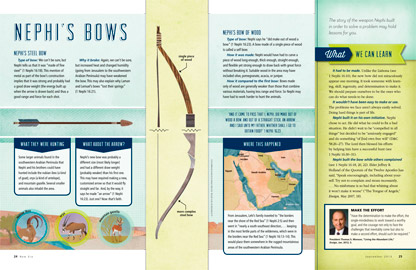
Nephi also learned to show initiative when faced with severe difficulties. His ability to feed his family was threatened when his bow made of fine steel was broken. He made a decision that saved his family. While others complained, he set a self-imposed goal: To make a bow of wood and to put it to work. Nephi would have had to carve a piece of wood long enough, thick enough, straight enough, and flexible yet strong enough to draw back with great force without breaking it. Suitable wood in the area may have included olive, pomegranate, acacia, or juniper.
Nephi chose to act. He did what he could to fix a bad situation. He didn’t wait to be “compelled in all things” but decided to be “anxiously engaged” and to do something “of [his] own free will” (D&C 58:26–27). The Lord then blessed his efforts by helping him to have a successful hunt (1 Nephi 16:29–31). His goals were not just self-imposed goals; they were goals that saved his family.
Clayton M. Christensen has put this same lesson to work. As a world-renowned innovation expert and the Kim B. Clark Professor of Business Administration at the Harvard Business School, he has bit of experience with showing initiative. Throughout his book, The Power of Everyday Missionaries, Clay describes repeatedly how he has used self-imposed goals to bring about incredible changes in his own life and in the lives of others. No simple quote — Just lots of inspiring counsel from one who knows, from one who learned by doing.
I have learned for myself the importance of showing initiative. It helps us to aim high, to stretch ourselves and our bowstrings, and to reach new goals. It especially helps when we seek counsel from a trusted spiritual leader. And I know that by so doing, we may save our ourselves and our families.
Book, The Hunger Games, Suzanne Collins (2008, Scholastic Press, New York NY), ISBN 978-0-439-02348-1
Painting, Nephi Finds Food While Others Complained—www.lds.org/manual/book-of-mormon-student-manual/chapter-5-1-nephi-16-18
Photo, Ideas That Change The World—www.claytonchristensen.com
Book, The Power of Everyday Missionaries: The What and How of Sharing the Gospel, Clayton M. Christensen (2012, Deseret Book, Salt Lake City UT), ISBN 978-1-60907-315-2 (paperbound), 978-1-60907-316-9 (hardbound)
Article, “Nephi’s Bows”, New Era, Sep 2013, www .lds.org/new-era/2013/09/nephis-bows?lang=eng
or www.lds.org/bc/content/shared/content/images/magazines/new-era/2013/09/ne13sep24-25-000-nephis-bows.pdf
If anyone knows our family, they know we are huge fans of the Lord of the Rings! I remember as a young boy listening to my Dad read the trilogy to me and my brothers as we laid in our beds. Dad would put all his emotions into it as he would get excited with us, laugh with us, be sad with us, and, yes, cry with us. You can imagine our joy when we heard the news that they were making the movies! Needless to say, we loved them as well!
There is one scene in The Two Towers (that wasn’t in the book, but we’ve since forgiven Peter Jackson!) that I have been pondering about a lot lately. In the city Osgiliath, Frodo hits a breaking point when his burden as a ringbearer seems too much to handle and all hope seems lost. He is about to give himself up to temptation and be captured when Samwise the Brave comes to rescue him. Sam then delivers one of the most epic speeches about overcoming adversity and fighting for what’s right.
As I have watched and rewatched this scene, I ask myself, “How many times do I feel like Frodo here?” And I ask you, how often do you feel helpless, alone, and without hope? We often hit similar breaking points where our load seems too heavy to bear. In these “Frodo” moments, we ask ourselves the same questions in Sam’s speech. These moments are the shadows and the darkness he spoke about. Even Joseph Smith had Frodo moments in the Sacred Grove and in Liberty Jail when he cried out, “Oh God, where art thou?” (D&C 121:1.)
To those who feel, or have felt, this way before, I empathize with you. I too have come to up against the wall that seems impossible to get over and move on. I have longed for a “Sam” to come rescue me and tell me everything is going to be alright. I’m here to tell you that God will come! He is our Sam in the story. He reminds us that “even darkness must pass. A new day will come! And when the sun shines, it will shine out the clearer!” God reminds us of our purpose and “what [we’re] holding on to.” (See Joseph Smith-History 1:16-17 and D&C 121:7-10 for God’s response to Joseph’s Frodo moments.)
I want to share a story of one my own Frodo moments. A little over a year ago I was going through a really hard time. I had just lost the girl I loved, I was struggling with finding a major at school, work was wearing me down, and it just seemed like anything I desired was always out of reach. I felt helpless, abandoned, and hopeless. I’m sure I wearied my Heavenly Father with my endless prayers of gloom and sadness. My Sam in this story came in the form of a poem that I wrote. It brought peace and hope to my life as I was able to put my thoughts into words. It inspired me to keep going:
In the same place
In the same place night after night,
My corner chair that fits just right,
I examine my considered plight,
Which has become my endless fight.
In the same place I try to see,
While Pandora sings soothingly
To my troubled and longing heart,
The pathway that I now should start.
In the same place when all retire,
I earnestly search for the fire
That drives, that pushes, and inspires,
To achieve heart’s deepest desire.
In the same place night after night,
Past memories dance into my sight.
I muse, I smile, and seldom cry,
But often time think, “why, oh why?”
In the same place through thick and thin,
I overcome the pain within.
Arise, go forth, begin to mend!
Surprises will come around the bend.
As I wrote this, I could feel the Lord’s love surround me. I was not alone, help was given, and hope restored. God is ever aware of lives and what we are passing through in this very moment. He loves us! We may feel like Frodo in our own personal Mt. Doom hanging on for dear life. The Lord, just as Sam did, reaches out to us when we are about to give up and says, “Don’t you let go!” I want you to know that your shadow IS only a passing thing, and surprises do come around the bend! I echo the words that King David said to his son Solomon, “Be strong and of good courage, and do it: fear not, nor be dismayed: for the Lord God, even my God, will be with thee; he will not fail thee, nor forsake thee, until thou hast finished all the work for the service of the house of the Lord.” (1 Chronicles 28:20.)
The Lord will not give up on you, so you shouldn’t give up on yourself! Look for the “Sams” in your life; I know you’ll find them. God answers our prayers in a variety of ways, often time through other people. May we also strive to be Sam in the lives of others.
I recommend these videos that helped me in times of need. They also touch on this topic:
What makes a strong family?
“How we preserve time for family is one of the most significant issues we face in most cultures.
“At a time when I was…in our law firm, one lawyer explained to me how she always felt like a juggler trying to keep three balls in the air at the same time. One ball was her law practice, one was her marriage, and one was her children. She’d almost given up on time for herself. She was greatly concerned that one of the balls was always on the ground. I suggested we meet as a group and discuss our priorities. We determined that the primary reason we were working was to support our families. We agreed that making more money wasn’t nearly as important as our families, but we recognized that serving our clients to the best of our abilities was essential. The discussion then moved to what we did at work that was not necessary and was inconsistent with having time for family. Was there pressure to spend time in the workplace that was not essential? We decided that our goal would be a family-friendly environment for both women and men. Let us be at the forefront in protecting time for family.” (“Lamentations of Jeremiah: Beware of Bondage,” Quentin L. Cook, LDS General Conference, Oct 2013.)
Strength Against The Storm
What makes a strong family? The importance of a strong family narrative is highlighted in the New York Times article on well-researched studies on vital long-term benefits of family history,
“The Stories That Bind Us“:
The more children knew about their family’s history, the stronger their sense of control over their lives, the higher their self-esteem and the more successfully they believed their families functioned. The “Do You Know?” scale turned out to be the best single predictor of children’s emotional health and happiness.
“We were blown away,” Dr. Duke said.
And then something unexpected happened. Two months later was Sept. 11. As citizens, Dr. Duke and Dr. Fivush were horrified like everyone else, but as psychologists, they knew they had been given a rare opportunity: though the families they studied had not been directly affected by the events, all the children had experienced the same national trauma at the same time. The researchers went back and reassessed the children.
“Once again,” Dr. Duke said, “the ones who knew more about their families proved to be more resilient, meaning they could moderate the effects of stress.”
Why does knowing where your grandmother went to school help a child overcome something as minor as a skinned knee or as major as a terrorist attack?
“The answers have to do with a child’s sense of being part of a larger family,” Dr. Duke said.
⁞
The bottom line: if you want a happier family, create, refine and retell the story of your family’s positive moments and your ability to bounce back from the difficult ones. That act alone may increase the odds that your family will thrive for many generations to come.
Strong narrative, strong family, strong kids. In the world we live in, we are expected to keep more and more balls in the air, with fewer and fewer on the ground. Well do I ask myself: How will I manage it? How will my adult kids and grandkids?
——– End of Post ——–
WebCredits—List of web resources used in this post but not explicitly credited above:
Photo, keeping the balls juggling in the air—womenonthefence.com/2009/11/25/keeping-the-balls-juggling-in-the-air/
Address, “Lamentations of Jeremiah: Beware of Bondage,” Quentin L. Cook, LDS General Conference, Oct 2013—www .lds.org/general-conference/2013/10/lamentations-of-jeremiah-beware-of-bondage?lang=eng
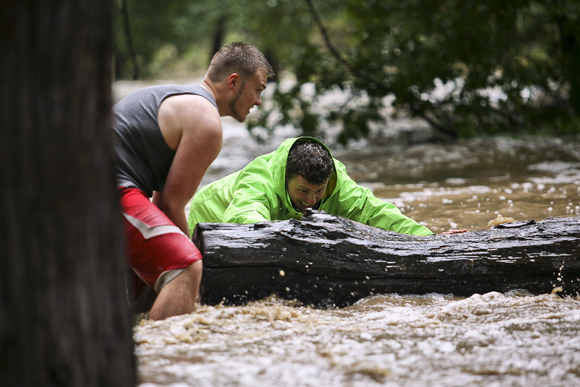
Photo, Strength Against The Storm—ngm.nationalgeographic.com/2012/09/extreme-weather/miller-text
Article, “The Stories That Bind Us”, Bruce Feiler, New York Times, 15 Mar 2013—www .nytimes.com/2013/03/17/fashion/the-family-stories-that-bind-us-this-life.html
Address, “Good, Better, Best,” Dallin H. Oaks, LDS General Conference, Oct 2007—www .lds.org/general-conference/2007/10/good-better-best?lang=eng
Photo, Strength To Manage Floods That Happen In Life—www.cuindependent.com/2013/09/17/photos-cu-independents-coverage-of-the-boulder-flood/46514
We live in a world in which there is great uncertainty and uneasiness. In the bustle of everyday life it is easy to get caught up in the frequent demands on our time, endless sources of distraction, and unlimited sources of entertainment. At times we face momentous challenges which can entirely overcome us. We can be left wanting, wishing for something greater, reaching for something we have not yet found, searching for peace.
As a physician I work with many individuals who suffer from physical and mental discontent. My patients come to me wanting. Wanting help controlling their blood pressure. Wanting guidance in their choices of healthy living. Wanting relief from great burdens of pain and mental anguish. Many are seeking peace in one respect or another.
At times it is difficult to obtain peace, because our minds are caught up in so many other things. We may seek for it in quiet meditation, doing the things we love, in the company of those we cherish, in food, in exercise, in health, in substances, or in escape. If we are searching for peace in the wrong sources we find that it does not comfort us to the extent we wish. We may experience it in glimpses, only to have it fade away from us. And again we are left wanting.
The more the years pass in my life, the more I value the sweet tranquility of peace. How do we find enduring peace?
Jesus Christ gives us pure insight:
“Peace I leave with you, my peace I give unto you: not as the world giveth, give I unto you.” – John 14:27
He offers us true and lasting peace. Peace which does not fade with time. Peace which comforts our unsettled minds and hearts. Peace which can reliably be found. Peace which comes alone through Him: Jesus Christ.
I know that there is a God in Heaven. He is a perfect, and Eternal Father. He loves us as His spirit children. He has a plan for our well-being. A plan for our peace. This plan involves our journey to this earth, and our experiences in mortality. He prepared His Great Son, Jesus Christ, as the center of His plan for our peace. This plan, and it’s source in Jesus Christ, was taught through the ages by prophets: Adam, Noah, Abraham, Moses, and many others. Each of them spoke of Jesus Christ. They knew that He would come as harbinger of peace to all on earth. He did come. He lived among men. Although He lived a perfect life, He “suffered temptations, and pain of body, hunger, thirst, and fatigue, even more than man can suffer” (Mosiah 3:7). And He did this for us. “He was wounded for our transgressions, he was bruised for our iniquities: the chastisement of our peace was upon him; and with his stripes we are healed” (Isaiah 53:5). Through Him we can find lasting peace.
Some time ago, a friend and I arranged for a play date for our children. My two older boys were going to her house to play with her son!
My boys reacting to news of a playdate
The morning of the play date my friend called to touch base and make sure we were still on board for my First Born to come play. Over the course of the conversation, she didn’t mention anything about my Second Son. Not knowing what had led her to change her mind about my Second Born I didn’t ask, in case she wasn’t feeling up for both boys coming, but my heart sank! My poor middle son who seemed often to get shafted! I felt so awful for him! He was so excited to have been invited!
I spent the next hour thinking of places we could go, things we could do, to make it up to my Second Born. I just felt so sad for him! It made my heart ache. His tender little feelings were going to be crushed!
My mental image of crushed feelings
Not too long before we needed to leave the phone rang, “ I forgot!” my friend began immediately, “Bring both boys over!” I was so relieved, I could have cried!
As I reflected on this experience and recorded it in my journal later, I felt distinctly that that second phone call had been a ‘tender mercy’ from Heavenly Father. He knew my grief, even small, and seemingly insignificant as it was! I believe that Heavenly Father brought to my friend’s mind the memory of our conversation about both boys coming to play, prompting her to call me and re-invite my Second Son.
I was reminded of the Good Shepherd who knows His sheep and leaves the ninety and nine to find the lost one. He knew my grief! He knew my sorrow! Even for something so small and seemingly insignificant BUT that was the whole point! Our Heavenly Father loves us greatly. As much as I was grieved for my son’s sorrow, Heavenly Father grieves for our sorrows. He desires our well-being and He desires our happiness! No one likes to see their children in pain–big or small, physical or mental.
Since this experience I have tried to remember to reflect on the day before I go to bed and pick out these little, almost insignificant moments, when God has showed me how well He knows me and how much He loves me. And I have been quite surprised how frequently these small events occur!
If you look through your days and seek out the evidence that Heavenly Father knows you and cares for you, you will be wonderfully surprised how much He really does!
Questions are important. Questions can be good. Questions, like anything else, come in various shapes and sizes, such as Good, Better, Best.
Thor Learning To Ask Better Questions
As do we mere mortals, Thor (God of Thunder) learned this the hard way. “My father was trying to teach me something, and I was too stupid to see it… I had it all backwards. I had it all wrong.” His friend, Erik, counseled him, “It’s not a bad thing finding out that you don’t have all the answers. You start asking the right questions.” Always tough, yet always rewarding.
Mike Nielson from Rogers, Arkansas, learned the importance of asking and discussing really good questions:
To Where May Questions Lead? With his friend, Jeremy, Mike began to learn why dialogue is important. Bob Millet, former dean of Religious Education at BYU (Brigham Young University), learned this lesson as well with his friend, Pastor Greg Johnson. “I was surprised when [Greg] then said to the group: ‘Are you listening to Bob? Do you hear what he is saying? This is important! It’s time for us to stop criticizing Latter-day Saints on matters they don’t even teach today.’ …The last question asked was by a middle-aged man: ‘This thrills my soul. I think this is what Jesus would do. I have lived in Utah for many years, and I have many LDS friends. We get along okay; we don’t fight and quarrel over religious matters. But we really don’t talk with one another about the things that matter most to us–that is, our faith. I don’t plan to become a Latter-day Saint, and I’m certain my Mormon friends don’t plan to become Evangelical, but I would like to find more effective ways to talk heart to heart. Could you two make a few suggestions on how we can deepen and sweeten our relationships with our LDS neighbors?’ (Read on? Click here, Page 15.)
Questions May Lead To Certainty My wife, Kim, and I usually see things from different points of view. Even though we know we are equally yoked in our responsibilities as spouses and as parents, each of us sees life through a different lens, and we focus on different things. We help each other to ask the best questions. I am the man who has the keys and she is the woman who has the influence (see Paragraph 8 in the section “Teaching the Rising Generation” in this address), and together we strive to bring about the work that God wants us to do in our family and in our community. By asking the right questions, I have learned for myself that working together with Heavenly Father allows any couple to raise children who find certainty in uncertain times.
Finding Certainty Together By Asking Great Questions
——– End of Post ——–
WebCredits—List of web resources used in this post but not explicitly credited above:
Address, “Good, Better, Best”, Dallin H. Oaks, LDS General Conference, Oct 2007—www .lds.org/general-conference/2007/10/good-better-best?lang=eng
Photo, “Thor Learning To Ask Better Questions”—musingsfrommarsh.blogspot.com/2012/06/thor-co.html
Article, “What Is Our Doctrine?”, Robert L. Millet, The Religious Educator, 2003, p. 15—ojs.lib.byu.edu/spc/index.php/RelEd/article/viewFile/1950/1911
Address, “Teaching the Doctrine of the Family”, Julie B. Beck, Ensign, Mar 2011—www .lds.org/ensign/2011/03/teaching-the-doctrine-of-the-family?lang=eng
The other day, my 4-year-old son and I were looking for bugs, and he wanted to hold a “roly-poly”. He was having a good time. I looked away and turned back, and I didn’t see the roly poly anymore. I asked where it went, and he said, “I smushed him with my fingers because I was done playing with him.” I told him sternly that we don’t do that, and later when he was recounting the scene to Amanda, he said, “I smushed him, which was not nice—He is dead, and he needs a Jesus roly poly to make him come back alive again.” I almost peed my pants. I think Amanda spit out whatever was in her mouth.
My younger son, who is two, just figured out that he can bother my older just as much as he is harassed him. Aaaaaaaaah… these kids… How did you do it, Mom and Dad?! Sometimes I secretly wonder if there were more of us kids to begin with and Mom and Dad only kept the better products alive….my 2-year-old is super cute though.
My older son is crazy, funny, frustrating, and messy. He loves to draw! He is very good at taking apart clicky pens and putting them back together successfully, springs and all. Sometimes, he doesn’t feel like putting them back together and thinks that playing with the ink is more fun—as we learned last week. I got home from work, and he was in his room having some quiet time and drawing. When I went to check on him a while later, he had pen ink smeared all over his face, legs, arms, stuffed animals, dresser, bed, box fan, and the walls of his bedroom. It was like someone threw a paint grenade in there. I started to yell and told him he could never use a pen again, when he burst into tears and said, “Daddy, Daddy, I drew a picture for you, see?! See, Daddy, this is for you!” I almost burst into tears looking at him with tears streaming down his face and his bottom lip quivering just trying to show me his accomplishment. Whelp… So much for that discipline… Daddy’s a sucker and just melted like Silly Putty melts into carpet (another story for some other time…). I gave him a big hug and told him how proud I was of his drawing. I still told him that his stuffed animals were gone and that he could never use pens again (today, he is still only drawing with pencils).
This experience allowed me to reflect on the Savior’s atonement for each of us. I thought of how many times I have screwed up in my life and the Lord has been very patient with me. It was those experiences, knowing that I have been in my 4 year old’s shoes so many times throughout my life, that allowed me to keep my cool and be proud of his drawing. It was difficult, and I was still very disappointed in his behavior, but I wanted him to know I was proud of his accomplishments. I feel this is how the Savior is with each of us. He is disappointed when we make poor decisions that we know are wrong, but He is there for us to join us in our celebrations of our accomplishments, and He encourages us to make better choices in the future.
Splatter Of Ink
——– End of Post ——–
WebCredits—List of web resources used in this post but not explicitly credited above:
Having trouble seeing, you say? My glasses work great. They really help me see a lot better. Here, put them on — I’m sure they’ll work for you, too. No, really, try them…
Swiss Countryside Through Train Window
Have you ever noticed how we all see things differently? I’ve had experiences in which, **POP**, my vision changes and I see things in a totally new light. For example, as we traveled by train from Switzerland to Italy, our cabinmate happened to be a young Swiss woman returning from home to her studies in Italy. Out the window, I saw with interest how the scenery changed from the über neat, carefully kept Swiss houses, each looking like a music box cottage, to the houses of the Italian countryside, with a few roof tiles askew and some external wall plaster that needed patching. Initially, I was disappointed with some of the residents of Italy, thinking, “Don’t they care?” I mentioned it to our new student friend, and she said simply, “Yes, isn’t it quaint?” **POP** I began to see these dwellings through her eyes — Instantly, I got it, and in place of the seemingly dilapidated houses I had seen in my mind’s eye just a moment before, the homes looked lovely to me. Suddenly, I couldn’t make these homes stay in the train window long enough, and I missed them after they disappeared from view. I thanked our friend, and I was stunned by the speed of the process by which she helped me to adjust my vision.
Sometimes, the needed adjustment is of little consequence. For example, who knew of the potential to use one’s body as a percussion instrument?
At other times, however, the needed adjustment may indeed be costly, especially when we underestimate our privileges or our potential:
As Dieter Uchtdorf is teaching, the costs can be great of not seeing my own potential. The potential for poor vision increases as I base my views on poor principles. Since I live in a world where principles are prized less and less, where principles are more and more mocked and scorned, discarded as a garment in a hot furnace, sad experience has taught me the importance of seeing on a higher plane.
Young Man Adjusting His Vision
I have learned for myself that I achieve little or nothing when I fight against God — That’s when I fail. In contrast, I am most successful, I achieve things of eternal importance, when I succeed in getting my understanding to **POP**, when I adjust my vision, when I see others as the Lord sees them, when I see myself as the Lord sees me. And I have learned for myself that this is true for each of us, for all of us.
——– End of Post ——–
WebCredits—List of web resources used in this post but not explicitly credited above:
Photo, “Swiss Countryside Through Train Window”—graphics.stanford.edu/~lucasp/pictures/switzerland/countryside/
Address, “Your Potential, Your Privilege”, Dieter F. Uchtdorf, LDS General Conference, Apr 2011—www .lds.org/general-conference/2011/04/your-potential-your-privilege?lang=eng
Photo, “Young Man Adjusting His Vision”—www.lds.org/media-library/images/youth/gospel-living?lang=eng&start=11&end=20#young-man-praying-738191
Photo, “Mountains Through Train Window”—mattstansberryblog.wordpress.com/2009/12/16/rome-day-5/train-window/
A short time ago, as I was driving down the road, I checked my rearview mirror and saw a car racing up behind me. Coming so close, so fast, it scared me. He swerved past me and came way too close again as he went back into my lane after he passed. I wondered how long it would be until that guy caused some serious accident to himself or to other people. Then I reflected on this thought: I have been ticketed for speeding many times. Yes we’re just going to leave that at “many times”, because I’m embarrassed of how many times it has happened. Because of those tickets, I’ve involuntarily donated hundreds and hundreds of dollars to local governments that I really wish I had back. I remembered again a lesson I’ve learned over and over, and ticket after ticket: Its always better to obey the rules. Always. And the main reason for obeying the rules is this: There is peace within keeping the rules or laws.
Kids Playing Within Bounds, Staying Out Of Treacherous Waters
When I was a teenager and talked to friends, I heard over and over how they were always speeding everywhere they went. I deduced from this that getting caught speeding is rare, especially if you are being “smart” about it. But when I was speeding, whether I was busted for it or not, I was always looking over my shoulder, nervous and paranoid. When driving now, always keeping the speed limit, I can drive to my destinations confidently and without any type of anxiety. I can feel peaceful.
This is not only true of the laws of the land, but its true for God’s laws as well. Although I haven’t racked up an embarrassing amount of spiritual tickets, I have spent too much time either ignoring or trying to find ways around the rules God has put in place for His children while they are on earth. For example, we are supposed to “love our neighbors as ourselves.” When I have been selfish and put myself and my wants ahead of others, I get what I want in that moment, but always regret my actions, and usually it doesn’t take long for the guilt to set in. However, when I give up something that I want for someone else, such as my time or resources, I am filled with happiness, love and joy.
There are consequences for every choice we make, good or bad. The ruling trend in this day and age seems to be: “Do what’s right for yourself, make yourself happy. If its within the rules, great. If not, well, you’ve got to make yourself happy first.” I see this more and more, everywhere I go it seems. Rarely do I find or hear advice to think of others or to spend time or money helping others instead of yourself. This cavalier attitude has cost so many so much. I just wish I could tell them all the lessons I learned the hard way, that obeying rules is always worth it and comes with peace of mind that is priceless.
I finally came around and grew up from trying to avoid the laws and avoid the consequences of disobeying laws, and my life is so much better for it. Not to mention my bank account. Being obedient will always pay off.
Peaceful Waters, Peace Of Mind
——– End of Post ——–
WebCredits—List of web resources used in this post but not explicitly credited above:
Drawing, “The Flash…Busted!”—www.funtastic-web.com/2012/08/flash-speeding-ticket/
Photo, “Kids Playing Within Bounds, Staying Out Of Treacherous Waters”—www .lds.org/media-library/images/children/playing?lang=eng&start=21&end=30
Address, “Believe, Obey, and Endure”, President Thomas S. Monson, General Young Women Meeting, Mar 2012—www .lds.org/broadcasts/article/general-young-women-meeting/2012/03/believe-obey-and-endure?lang=eng
Photo, “Peaceful Waters, Peace Of Mind”—www .lds.org/media-library/images/sunrises-sunsets?lang=eng&start=11&end=20#sunset-with-trees-766830
I used to picture life as a fist fight…in the rain. Perhaps that is because I’m currently at home with four young children (a stage in life oft referred to as “in the trenches”), I’m not sure but a muddy fist fight is what life looked like. If I drew a picture I would have drawn a brown rippling circle, a Goliath stick figure with a little mud on his shins and t-shirt that said, “LIFE EATS PEOPLE” or “GUNS DON’T KILL PEOPLE LIFE DOES” and a dinky stick figure face down in the mud with a large arrow labeling it, “whitney”
A few months after my 3rd child was born, during my husband’s last year of medical school/intern year of residency, compounded by some mixed muddled thinking in my own head, depressed and anxiety ridden I thought about that muddy fist fight A LOT.
Generally speaking, I thought of myself as a fighter. And I used to be! Strong mentally and physically—breaking is not something I did. PAH! Oh, how the proud need to be humbled. There were times when I felt I was still in the fight but I wasn’t making any forward progress. In fact, I didn’t really have an offensive strategy at all. It was all defensive and evasion techniques. Soon I lacked the strength to even be evasive. It took everything I had just to take the hits and stay on my feet. I was so exhausted.
Then the hits started to hurt and they started to break things. Then my will cracked and I flounder about lost. Within months, I was lying face down in the mud trying to figure out where I was and how I came to be there. One evening my husband sat on the end of the bed and said, “Whitney, I think we need to get you some help.”
Over the next several months of healing I realized a few things I want to share:
First, when you get that low the outcome of your fight is determined by the decision you make with your face in the mud. Do you lay there, conquered, and die? Or do you tap out? Tapping out is probably the most difficult thing I have ever done. I had no idea the strength it would take to truly yield my will to the Father’s, trust in the power of the Atonement, and turn over my burdens. Even as debilitated as I was, I felt it necessary to finish the fight on my own.
Segue way to another thing I learned: this fight is not intended or designed to be solo. You know those scriptures that talk about not being tempted/tried above your ability to handle it. NEWS FLASH WHITNEY: If you attempt to take it on, on your own, YOU WILL FAIL. Our lives are a partnership with Heavenly Father through the Gift of the Holy Ghost. In our mortal existence we are blessed with all the things necessary to successfully navigate our trials and return home to live with our Eternal Father and our families. We are blessed with scriptures, prophets, The Holy Ghost, prayer, families, and Priesthood leadership all to aid us in our fight for life and our eternal welfare.
While these were principles I knew in theory—I had topically study: faith, hope, patience, and humility in detail before—living out the very literal application of these Christ-like characteristics is a completely different experience and lends to a whole new realm of understanding. Especially, I think, in situations where not only do you need to turn to your Savior to pull out of this one, but some professional help as well.
Doctrine and Covenants 98:12 “For he will give unto the faithful line upon line, precept upon precept; and I will try you and prove you herewith.”
Isaiah 28:10 “For precept must be upon precept, precept upon precept; line upon line, line upon line; here a little, and there a little:”
So, why the heck didn’t I tap out earlier and spare myself the pain and suffering? Pride. Had I been humble enough to endure my trials with the Lord as my co-pilot… had I been teachable enough to listen and learn without being ‘compelled to be humble’… my ability to be long-suffering would have been enhanced and the shirt on stick figure me would have read, HEAVEN POWERS MY PUNCHES.
Now, a few years later, I try to remember to start out turning to the Lord. Through Him my burdens are lightened and I can feel peace in my trials. And I tend to view life as a climb, rather than a fight. It’s hard work, there are some easy stretches and some extremely difficult ones. Sometimes you move up and sometimes you slip and slide down. In order to be safe, you must have other people aiding you in your climb. You still get scratches, bruises, and broken bones, but there are always resources and people there to help you, lead you, and cheer you on.
“Come unto me, all ye that labour and are heavy laden, and I will give you rest.” Matt 11:38 KJV
Reader Question: I have a problem with Mormon missionaries coming to our door! They have sent three sets of people three times in the last week, and I cannot get them to understand that we are not interested in becoming Mormon! I don’t want to be rude or disrespectful to another person’s religion, but I can’t seem to get the point across! A simple “No, thank you” has not done the trick! What can I tell them to get them to stop coming back? It is the church in my town in Oklahoma, I know this is not directly related to this page. I came to this page through a friend’s facebook page! I am Catholic and do not wish to become Mormon nor does anyone in my family. I understand your message and beliefs but I cannot get the missionaries to stop coming to the door! Can you please offer me advice to get this to stop? I am sure this is not what you had in mind for questions on this page, but I am getting a little desperate here. I am not trying to be disrespectful to these missionaries, but I am not interested, and they do not seem to understand that! Thank you for your time and consideration, and I apologize if you have found this offensive, that is really the last thing I have intended!
Family Answer: Thanks for your question. Sincere, honest questions are always a good thing.
To gather an answer to your question, we talked to our adult kids. We also asked our local missionaries, because we knew they could help us. The answer from our local elders was the same as from our family: Next time your local missionaries come to your door, be kind, be honest, and be direct. Explain to them that you are simply not interested and ask that they keep track of your request not to return to your address.
Also, understand that these are young men and women who at their own expense have left their families and friends to serve for up to two years. The elders in your area and missionaries around the globe are here to help strengthen others, and they do that in the best way they can, and sometimes they make mistakes and flub up. Watch for a typical day in their life. One young woman said (at Time 2:28 of “Women Called to Serve”), “Our purpose is not to shove our beliefs down other people’s throats and make them do things they don’t want to do, but it’s to invite them to come unto Christ and to strengthen, not to change the faith that they have, but to strengthen that faith.” A young man from England serving in New York (“Men Called to Serve,” Time 5:33) said, “Sometimes you walk down the street as a missionary, and you grow such a love for these people, and there are some people who, you know, they mock you, or they laugh at you, or they simply don’t want to talk to you. I think one of the hardest things about a mission is that you believe in something so much, and then others don’t seem to trust you or give you a chance. That’s pretty hard.”
I hope this answers your question and helps you understand us better and how to talk more effectively to Mormon missionaries wherever you find them.
And let us know how we may help you further! If you find that you have any questions about religious issues that you’ve been wondering about or that you haven’t been able to get good answers to, feel free to continue on discussion with us. It turns out that there are a lot of people with questions, and most of them have given up on churches as a source of answers. In our family, it is our experience that answers are out there, that God wants us to have them, and that they tend to be answers we like and have learned to appreciate. Working together with Heavenly Father allows anyone to find certainty in uncertain times.
-Dave and the MormonPanorama Family
——– End of Post ——–
WebCredits—List of web resources used in this post but not explicitly credited above:
Address, “Ask the Missionaries! They Can Help You!”, Elder Russell M. Nelson, LDS General Conference, Oct 2012—www .lds.org/general-conference/2012/10/ask-the-missionaries-they-can-help-you?lang=eng
At the high school where I work we have a special needs student who has a mood disorder complicated by autism. He has difficulty controlling himself and appropriately expressing his feelings. Once, when he became upset in our office, he threw everything off the counter tops and hurled charts and trays to the ground. He flung himself to the floor and tossed his shoes. It’s an understatement to say he can be quite violent.
Because of this, he wears a harness so that he can be controlled should he become aggressive. He is always accompanied by a one-on-one aide. At the beginning of one school year, this student’s aide was a huge man, 6’ 5” and 250 lbs. The aide managed to control the student by the sheer power of his physical presence. In the event that the student became combative, his aide could simply man-handle him into submission. Unfortunately, this Atlas was reassigned to another student. Even worse, he was replaced by a petite young woman. She was so tiny and young that I worried she would be snapped in two by one of the student’s rages—but she wasn’t.
Over the course of the following weeks, I watched this little woman charm our student. While she always held his harness, she never had to hang on for dear life. When he refused to cooperate, she stepped close to the student and whispered persuasively in his ear. When they walked the halls together, she and he were in frequent eye contact, talking and laughing together. Once when he became upset in our office, instead of cowering (which I was doing!) she stood right beside him, gently rubbing his back, soothing him into submission. I was amazed.
This wonderful woman was able to work with and, for the most part, gain the cooperation of a most difficult student. She knew something about the power of love. Oh, so this is was the Savior was talking about!
After His death and resurrection, Jesus called to members of the twelve from the shore of the Sea of Galilee. They had been fishing all night but caught nothing. Knowing their discouragement and hunger, Jesus directed them to cast their net on the right side of the ship. Then, when the nets were hauled in near to breaking, He bid the fishermen come ashore and dine with him. They found a small fire with fish and bread ready to eat. As they sat around the meal, the Savior taught Peter and those listening about love. The Savior asked Peter, “lovest thou me?” When Peter responded, “yea, Lord” the Savior instructed: “feed my sheep.” A three word injunction made more powerful by repetition, this commandment should govern my every action: in the work place, at church, in the community and at home.
As a member of the Church of Jesus Christ of Latter-day Saints, I feel I am under a particular mandate to share truth and demonstrate goodwill. That can be difficult in this hardened world; my efforts may be (have been!) met with mistrust, cynicism, and outright disbelief. In a 2005 General Conference talk, Ulisses Soares taught how to overcome these attitudes. He said, “People are most receptive to our influence when they feel that we truly love them.” Read his entire address here. This is what that tiny one-on-one aide knew, what the Savior was teaching to teach Peter and what I’m trying to do.
Fundamental to serving God is loving His sheep. For me this is a constant challenge. I battle impatience and annoyance all day long and return home to live with a wonderful man who sometimes makes me crazy! And then, there are some folks are just hard to love. I am a work in progress here, but experience has taught me that prayers for help, for a softened heart, for compassion and empathy do not go unanswered.
Thank God.
——– End of Post ——–
WebCredits—List of web resources used in this post but not explicitly credited above:
Photo, school exterior—www.morethandodgeball.com/serve/i-could-not-think-of-a-better-use-for-our-building
Bats And Blind, Shallow Courage I was a pioneer once, and it was scary. A friend with a new baby called and asked my son, Todd (then in high school), if he could come help her out—Her husband wasn’t at home, and she had a bat in her house. It seems that bats and mothers of new babies don’t do well together. Todd assured her that he’d be right over. Then he called me immediately. I was in a meeting, which was terminated for the bat. Neither Todd nor I had any batty experience; it was just the blind leading the bat. Fortunately for us, our friend happened to have a wastecan, which we emptied in order to shroud the squeaky thing. Fortunately for the bat, it had become more orderly by the time we arrived. We grabbed the empty can and a piece of cardboard large enough to cover the mouth of the wastebasket, calmly placed the container over the stationary animal, inserted the cardboard between the can and the wall, and carried the contained bat outside. Our meager courage did not fail.
While our winged mammal required us to have courage, its capture is a fairly wussy example of being a modern pioneer. Dictionary.com defines a pioneer as “one who is first to settle a region for development by others” or “one who is among the earliest in a field of inquiry, enterprise or progress.” So there may be a lot to learn from a non-wussy pioneer. For instance, there’s Matt Harding. Stuck in a job he didn’t enjoy, he decided that he was willing to take a risk and try something new. He has turned his silly characteristic dance into a video model of global community outreach, and people all over the world jostle to be with Matt, to laugh, jump and clap hands together. Now, it’s his full-time (yes, paying) job. All from some great music and from being willing to dance badly in front of people: Fun to watch.
Seeing More Deeply So why pioneer? What’s the urgency to pioneer? The importance? As President Monson taught us, “We forget how the Greeks and Romans prevailed magnificently in a barbaric world and how that triumph ended—how a slackness and softness finally overcame them to their ruin. In the end, more than they wanted freedom, they wanted security and a comfortable life; and they lost all—comfort and security and freedom.” (See Paragraph 11.)
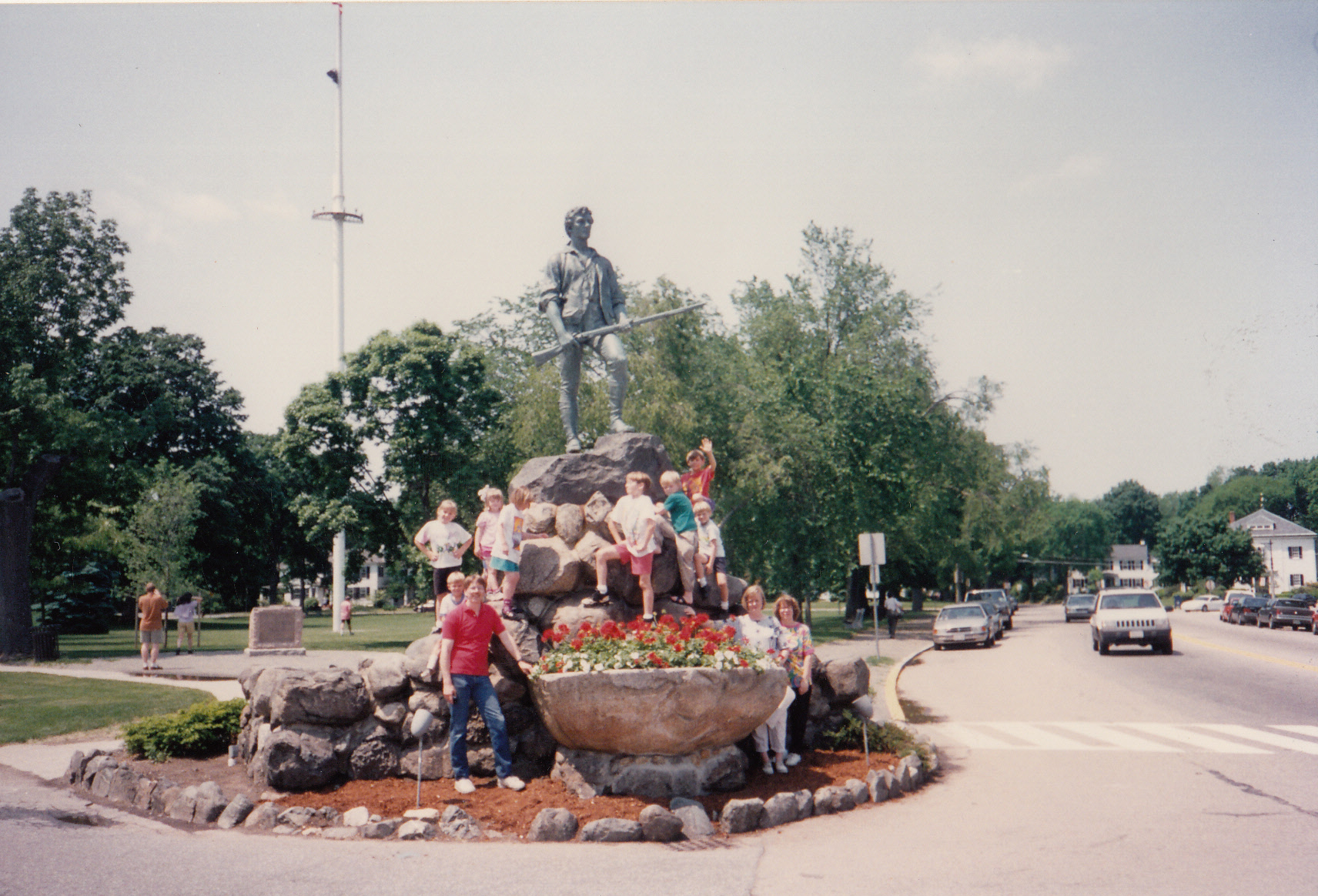
Learning Our Heritage: Minute Men In The Making At Lexington, Massachusetts
I love the hymn They, the Builders of the Nation. Becoming a pioneer today takes courage, and it takes some out-of-the-box thinking. How may each of us be a “pillar, guide, and inspiration to the hosts of waiting youth”? (See Verse 3—sing, read or listen.) What are some important ways that we may broaden our understanding of how to serve more effectively the community around us? How to serve those who may have needs that we don’t perceive, and how we may be a part of meeting those unmet needs? Each of us can do things to become modern-day pioneers and to tread new ground in some important ways. Even if it isn’t to us, it can be very important to whom we serve.
Bogatyri (“Valiant Warriors Of Old”) (1898), Viktor Vasnetsov
Now that I think deeper, I was indeed a pioneer when I hurried to help my friend whose wife and family had just died in a plane crash. Despite being suicidal at the time, he and I bonded, and in his darkest moments, his extended family would seek me out repeatedly: “Come, Davy—Come quick. He needs you again.” I’d hasten once more to his side—we’d sit, sometimes talk, but I felt that our hearts were in constant conversation, even in silence, and I could feel him taking strength from me, and I gave freely, for I knew that I had strength to spare. By connecting with those around him, with people for whom he cared deeply, he quickly learned to develop his own sources of strength.
Again, I was a pioneer when I served diligently in our congregation as a home teacher (volunteer shepherd) to a family with five young children. Despite his severe substance abuse concerns, this young father and I bonded easily, and he sometimes called me in the wee hours when the pull of drugs was strong and he was weak and needed to talk. As we’d sit on the stoop of his small house in the darkness, we’d have the most amazing talks filled with light. He opened the door to whole new era in my home teaching experience when one day, he interrupted me mid-sentence to ask, “How do you do it, Dave? How do you get us to feel these things?” We opened our hearts to each other like never before, and our souls were knit together like David and Jonathan of old. It was as if we could read each other’s minds. When we talked of truths at night (Hymn 147, “Sweet Is the Work,” end of Verse 1), I remember many times thinking, “There is nowhere else on earth that I would rather be than right here, right now, on this stoop, talking with this man.” I could feel him taking courage from me, and I gave freely, for I knew that I had courage to spare. He moved away, then I moved, and always I will miss our conversations.
Consider More Deeply So, consider increasing your courage. Do what is right. Serve others not on your terms but on theirs; meet them on their level not yours. Get out of your box. Each of us may enjoy doing what we can to stand with other people for that which is good, for that which we know to be right. Be a pillar, a guide. Maybe be an inspiration. Maybe to youth. Couldn’t we all benefit from spending some time to consider how we may improve our efforts to become a modern pioneer? I know I will.
Modern Pioneers In Many Ways
——– End of Post ——– WebCredits—List of web resources used in this post but not explicitly credited above:
Address, “The World Needs Pioneers Today”, President Thomas S. Monson, Ensign, Jul 2013—www .lds.org/ensign/2013/07/the-world-needs-pioneers-today?lang=eng
Painting, «Богатыри» Or Bogatyri (“Valiant Warriors Of Old”) (1898), Viktor Vasnetsov (Tretyakov Gallery, Moscow)—en.wikipedia.org/wiki/File:Die_drei_Bogatyr.jpg
I love the words of the narrator as we focus on his wedding ring at Time 2:53 and the kid at the door watching his parents pray at 2:34. When I walked in to see my own parents at prayer, I remember the whoosh of feelings of safety and security but mostly of sacredness.
My favorite memory of the power of a prayerful life is one at work. I knocked on a friend’s office door; normally, he responds quickly with, “Come in!”, and I open the door. Sometimes, I’ll hear water running in the office bathroom as he makes ablution, and I know not to knock at the door for a few minutes after he returns to his office. But this day I was distracted and failed to notice that my knock at the door from without brought no invitation voiced from within. Out of habit, I called him by name, adding the customary honorific suffix, and opened the door. I found my elderly friend kneeling lowly on his prayer rug. It was such a holy moment. In a familiar whoosh of feeling, I was aware that I had missed the cues of the sounds at the sink. Having cleansed himself without as he focused on cleansing himself within, he was now talking with his Maker, expressing humility without as he voiced humility within. It was just like walking in on my parents at prayer. After prayers were done, we embraced; I apologized for disturbing a sacred moment. “Oh, I don’t mind. I am just doing my duty,” he said. I replied, “It is the duty of us all.”
When I think of my favorite moments of prayer, I will always see in my mind and in my heart an elderly man from Uzbekistan, with shoes removed from off his feet, kneeling submissively on sacred ground in his office, visible to none but to Him who sees all.
I shall be telling this with a sigh
Somewhere ages and ages hence:
Two roads diverged in a wood, and I,
I took the one less traveled by,
And that has made all the difference.
-Robert Frost
Vintage Prayer Rug
——– End of Post ——–
WebCredits—List of web resources used in this post but not explicitly credited above:
Photo, “Knock, And It Shall Be Opened Unto You”—westsoundmodern.wordpress.com/2011/05/11/go-away-im-washing-my-hair-2/knock-knock-3/
At work, I have a friend, Roseanne (names have been changed), who cleans our hallway and offices. Currently, she has some personal challenges and misses a lot of work. Patrice, a mutual friend who cleans when Roseanne is gone, is a person of strong faith and has asked me to pray for Roseanne. We’ve had some great talks, and at the end, she always reminds me of the need to keep Roseanne in our prayers. The other day, as Patrice and I talked, I felt strongly that I should tell her that I was a Mormon. Given her classic Christian faith traditions, I immediately rejected the thought, knowing that it would not end well. I again felt prompted to mention my Mormon faith, and after arguing with myself (“This REALLY will NOT end well!”), I concluded that this was in truth a prompting from a celestial source and that I should follow it. I said, “Patrice, I’ll be glad to continue praying. You know, as a Mormon, my family has an active daily prayer life, and I’ll surely keep Roseanne in my prayers.”
Patrice’s face fell, and she ended the conversation abruptly. My first thought: I had been right – It did not end well. My second thought, influenced I believe by the Holy Ghost: “Of course, it did not end well, and this is exactly what Patrice needed. You have blown a fuse in her mind. You have fried her spiritual circuits. But after a time, her circuits will heal, and she’ll replace the blown fuse. She must deal with this in order to listen more fully sometime later. Give her time.”
And indeed, it took some time. Patrice no longer spoke to me, and when I saw her, her face would fall, and she would look away from me. After a month of this, I wondered whether she would ever in this life replace the busted fuse. But after about six weeks, she has now just recently started to talk to me again, as if nothing had ever happened. She’s on the way to healing, and I hope that eventually she may be in a position to listen to a friend about the Church of Jesus Christ (The Church of Jesus Christ of Latter-day Saints).
My main point has nothing to do with Roseanne or Patrice. It has to do with what we consider success or failure in our missionary experiences. The Lord’s measures of success and our own often are not the same. As Harvard Business School innovation expert Clay Christensen teaches us in his book, The Power of Everyday Missionaries, we are a successful missionary when we communicate about the gospel of Jesus Christ. As far as God is concerned, a positive or negative response to what we teach does not influence the quality of the experience; the reaction of our conversation partner(s) is independent of our success. The quality of the experience is determined by how we follow the promptings that we receive. I have learned for myself that this is true.
——– End of Post ——–
WebCredits—List of web resources used in this post but not explicitly credited above:
Enjoy reading our posts, and join in the discussions! We encourage a panorama of opinions with cordial dissent or support, and ask that comments be respectful and relevant to the post, allowing all to enjoy the shared thoughts and experiences. Entries subject to editing. Comments not in keeping with these standards may be removed at the discretion of blog editors.


























 Todd
Todd Dave
Dave Brendan Sweeny
 MormonPanorama
 Brian
Brian Brittany
 Mike
Mike Kim
Kim Kevin
Kevin Whit
Whit MormonPanorama