Tag Archives: Discarding Doubt

Reading List To Encourage Intellectual Exploring? Our Family’s Answer.

oceans-rialto-beachReader Question:
Dave, can you please provide a list of books that your family enjoyed and used as you “encouraged lots of intellectual exploring by reading widely”? Our family would truly appreciate whatever guidance you choose to give or titles you might suggest.

Family Answer:
Thanks for your question. Sincere, honest questions are always a good thing.

To gather an answer to your question, we talked to our adult kids, and here’s the list that we gathered. Note that this will be a living list, a living post, that we will add to over time as we remember other titles or learn of new ones that we wish to include.

MormonPanorama Reading List for Creating Strong Families (for children, youth, and young adults). These are for a general audience unless otherwise marked, and parents are encouraged to read beforehand and judge for themselves.

What we were looking for in books for kids as they grew up:

  • Books that have tons of material to discuss – especially about what is right and what is wrong and how to resist wrongs that are embraced by so many others around you.
  • Literature that builds up rather than drags down, that uplifts and inspires.
  • We avoided literature which stated that our moral standards are silly or which encouraged us to become less than we should be.

We hope this answers your question and helps you understand us better and how to become a more effective family, create strong citizens, and develop better young adults.

And let us know how we may help you further! If you find that you have any questions about religious issues that you’ve been wondering about or that you haven’t been able to get good answers to, feel free to continue on discussion with us. It turns out that there are a lot of people with questions, and most of them have given up on churches as a source of answers. In our family, it is our experience that answers are out there, that God wants us to have them, and that they tend to be answers we like and have learned to appreciate. Working together with Heavenly Father allows anyone to find certainty in uncertain times.

-Dave and the MormonPanorama Family

oceans-emerald-island-beach

——– End of Post ——–
WebCredits—List of web resources used in this post but not explicitly credited above:

  • Photo, ocean-rialto-beach—www. lds.org/media-library/images/oceans?lang=eng
  • Photo, ocean-emerald-island-beach—www. lds.org/media-library/images/oceans?lang=eng

——– End of WebCredits ——–

They're Fermenting Rebellion...

They’re Fermenting Rebellion…
Let The Storm Rage On — Committing To Fight The Good Fight

Quick: What do you think of when you hear this word? “Ordinances.”

Okay, that may be a bit strange. Try this one: “Covenants.”

What went through your mind? Good? Bad? Ugly? Modest? Fight? Commitment?

Sometimes (often?) I feel a need to fight against expectations. At times those expectations are of good behaviors, at other times of bad. In the movie “Frozen”, the character Elsa seemed to feel much the same way:

Not everyone appreciates her the way I do, but I love the way Idina Menzel sings. To me, the good in this song is inspiring. But not the bad. In the song, good and bad are juxtaposed, in opposition to each other, just as they are in life. And as in life, I thank Heaven for the bad. By Celestial design, the bad helps me to recognize, appreciate, and embrace the good. Some of the lyrics:

I don’t care what they’re going to say.
Let the storm rage on.
Cold never bothered me anyway. (All good.)

…the fears that once controlled me, can’t get to me at all. (good)
It’s time to see what I can do, to test the limits and break through. (good)
No right, no wrong, no rules for me. (bad) I’m free. (good)

Let it go, let it go. (good) That perfect girl is gone. (bad)

Good, bad. Bad, good. What the heck does it matter? Well, according to the prophet Isaiah, it matters a lot:

Woe unto them that call evil good, and good evil; that put darkness for light, and light for darkness…

“The emphasis on truth as the way things really are suggests that it contrasts with the way things seem to be, no matter how convincing that deception may be. One such truth is the reality of evil. As Isaiah pointed out, at the heart of moral relativism is an inability or unwillingness to recognize evil.”
Daniel L. Belnap

Dave, what does this good-evil stuff have to do with ordinances? I thought you’d never ask. Ordinances in any faith community help us to shun evil, to choose the right, to commit to be good. It draws a line in the snow. It draws a line in the sand, in the dirt, on the concrete.  A bar/bat mitzvah means “son/daughter who is subject to the commandment, to the law of God”. The first pillar of Islam is kalima shahadah, meaning to promise/testify/witness my word to God. Christian baptism is a covenant with God to repent, to be clean before Him, to accept Christ’s invitation when he said, “Come, follow me.” Ordinances and covenants are a two-way promise: We promise to follow God; he promises us certain blessings.

One thing I really, really love about being a Mormon is that my faith is full of ordinances. At eight years old, I was baptized. At twelve, I was ordained to the priesthood. At twenty-four, my wife and I were sealed for time and all eternity. Then our family gets to go to the temple together and do it all for others. Over and over. Each time, each ordinance, is a line in the snow/sand/whatever. Each is an additional level of commitment and reverence to God. Throughout life, we all make decisions. Ordinances help. They help us choose the right. They help us witness to God and to others that we will choose good over evil.

So, do what Elsa did. Do what you think is right. Be brave, and do it your way. Stay modest. Thumb your nose at a world that wants you to take your clothes off, and keep them on. Instead, yank off the gloves, and pull no punches. Stretch your powers as far as they can possibly go, and then stretch them a bit more. Say what is on your mind and in your heart.

FIGHT. Commit. Draw lines with ideas. Fight the good fight. Fight the good fight of faith.

I don’t care what they’re going to say.
Let the storm rage on — Good never bothered me anyway.

Elsa Ready To Fight

Elsa Ready To Fight, Gloves Off

——– End of Post ——–

Bonus Material:

1. Just like Elsa has powers she must learn about and learn to control, so do we. Listen or read Elder Ronald A. Rasband’s address regarding ways to tutor ourselves in having our hearts knit together in unity and in love one towards another, entitled, “Building Spiritual Power in Priesthood Quorums”. (Length of audio: 16:18.)

2. Listen or read how God’s covenant with Abraham blesses us all. (Length of audio: 12:36.)

3. Read more about moral absolutes contrasted with moral relativism in an address by Dallin H. Oaks, “Religious Values and Public Policy“, Ensign, Oct 1992.

——– End of Bonus Material ——–

WebCredits—List of web resources used in this post but not explicitly credited above:

  • Illustration, “Else Ready To Fight, Gloves Off,” www. moviefanatic.com/gallery/frozen-elsa-idina-menzel/

——– End of WebCredits ——–

Scriptures, Sacred Feelings, and Other Small and Simple Things

There’s an expression that some people are “closed books”. It indicates someone who cannot be easily understood, someone unfathomable or puzzling, while others are “open books”. One may feel this way about a book of sacred writings. Some people I know feel that holy books are closed to them. Other friends feel that a book of God has things that speak specifically to them.

As a youth long ago, I learned to love the scriptures. To me, they are open books. In Seventh Grade, I remember starting to see specific verses as if they were a good friend. Learning, pondering, searching, and memorizing scriptures is like filling a cabinet with friends, values, and truths that can be called upon any time, anywhere in the world:

(Or same video at lds.org link.)

One’s feelings are key to an open book. If I love an author, it’s usually because I love the way the writer uses words, how I feel about how she or he expresses thoughts in writing. Some authors I like because they express thoughts similar to mine, while I love others, having expressed thoughts so distinct from mine, due to the way they open my mind to new things. What’s essential is less the words of sacred authors and more how their meaning resonates both to my mind and to my heart. God combines intellect and inspiration to tailor something personal to me, that nourishes my spirit, food that I need to feed my soul on a daily basis. Watch how he taught the Children of Israel this lesson:

(Or same video at lds.org link.)

I particularly love how I have come to see the scriptures as a proactive attempt on God’s part to be less puzzling, and I understand that openness to spiritual feelings is an important part of that. These spiritual feelings come in whispers to my soul. Did not our heart burn within us, …while he opened to us the scriptures? Heavenly Father speaks directly to his children through the still, small voice of the Holy Spirit. One of life’s true paradoxes is that through these whispered feelings and thoughts, he does wonderful works through us.  By small and simple things, God brings to pass great things. “…by very small means the Lord doth confound the wise and bringeth about the salvation of many souls.” 

As a boy, Joseph Smith learned from his parents to trust the scriptures. He learned to read by them, studied them, and struggled to understand them better. When reading James 1:5-6, he learned to ask important questions with confidence that God would reveal to him the answers. By following those answers, Joseph was able to help his family find certainty in uncertain times.

The epitome of the power of the small and the simple is expressed by the essence of this Christmas season—By a babe long ago in a manger in Bethlehem. Watch how we may use his scriptures to make small and simple changes to our actions in order to bring more peace into the world.

(Or same video at mormonchannel.org link.)

Christ wants all of us to feel safe and secure, even when we have pains and troubles, big or small. I have learned for myself that he has given us the scriptures to guide us away from ideas that lead us to mistakes and regrets and towards peace and happiness, both for us and for those near and dear to us. From our family to yours, may you have the happiest and holiest of holidays.

——– End of Post ——–

Bonus Material:

1. Watch how a teenage competition through a maze is used as an analogy to show how the scriptures help us get through life. (Length: 10:02.)

2. Watch how this teacher encourages young men to search the scriptures. (Length: 1:41.)

——– End of Bonus Material ——– WebCredits—List of web resources used in this post but not explicitly credited above:

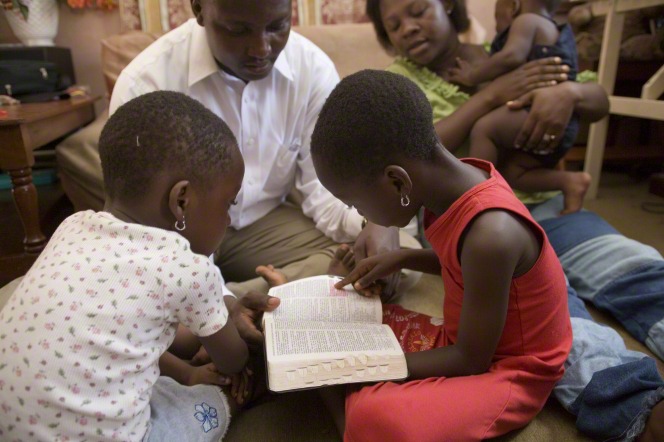
  • Photo, family scripture study—www. lds.org/media-library/images/scripture-study?lang=eng#family-scripture-study-208903
  • Video, “Words with Friends”—www. youtube.com/watch?v=IyMlkkkcbfs
  • Video, “Daily Bread: Pattern”—www. youtube.com/watch?v=2eMJ6ZDCAp4
  • Illustration, Joseph searching scriptures—www. lds.org/media-library/images/gospel-art/church-history?lang=eng&start=1&end=10#joseph-searching-scriptures-37717
  • Photo, snowflake ornament—www. lds.org/media-library/images/christmas?lang=eng&start=21&end=30#snowflake-ornament-130226
  • Video, “The Maze”—www. lds.org/media-library/video/2012-06-1030-the-maze?lang=eng
  • Video, “Searching the Scriptures”—www. lds.org/media-library/video/2013-03-002-searching-the-scriptures?lang=eng
  • Photo, lights in snow on Temple Square—www. lds.org/media-library/images/christmas?lang=eng&start=51&end=60#lights-temple-square-613721

——– End of WebCredits ——–

Showing Initiative, Saving Goals, and Second Efforts

Mongolian Archer

Mongolian Archer

At the archery portion of the Naadam Festival held in July each year in Ulaanbaatar, a female archer in elegant Mongolian dress aims to topple a small wall of marked blocks from over half a football field away. The skill demonstrated by the archers in the competition is absolutely amazing as they more often than not hit the center portion of the marked blocks.

For Hunger Games archer Katniss Everdeen, it was take initiative or starve to death. After her father died and her mother was crippled with grief, feeding the family fell to Katniss. It took time, but she learned to recognize that she had developed skills that could save her family if she would put to work the tools her father had given her:

For a while, I hung around the edges of the Meadow, but finally I worked up the courage to go under the fence. It was the first time I’d been there alone, without my father’s weapons to protect me. But I retrieved the small bow and arrows he’d made me from a hollow tree. I probably didn’t go more than twenty yards into the woods that day. Most of the time, I perched up in the branches of an old oak, hoping for game to come by. After several hours, I had the good luck to kill a rabbit. I’d shot a few rabbits before, with my father’s guidance. But this I’d done on my own.

We hadn’t had meat in months… The woods became our savior, and each day I went a bit farther into its arms. It was slow-going at first, but I was determined to feed us. (The Hunger Games, Chapter 4, Paragraphs 17-19, Pages 50-51)

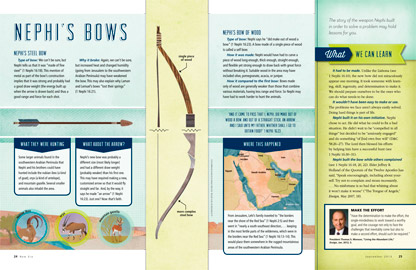
Nephi also learned to show initiative when faced with severe difficulties. His ability to feed his family was threatened when his bow made of fine steel was broken. He made a decision that saved his family. While others complained, he set a self-imposed goal: To make a bow of wood and to put it to work. Nephi would have had to carve a piece of wood long enough, thick enough, straight enough, and flexible yet strong enough to draw back with great force without breaking it. Suitable wood in the area may have included olive, pomegranate, acacia, or juniper.

Nephi Finds Food While Others Complained

But it’s what he did next that sets Nephi apart. He went to his spiritual leader to seek his counsel. And it came to pass that I, Nephi, did make out of wood a bow, and out of a straight stick, an arrow. … And I said unto my father: Whither shall I go to obtain food?

Nephi chose to act. He did what he could to fix a bad situation. He didn’t wait to be “compelled in all things” but decided to be “anxiously engaged” and to do something “of [his] own free will” (D&C 58:26–27). The Lord then blessed his efforts by helping him to have a successful hunt (1 Nephi 16:29–31). His goals were not just self-imposed goals; they were goals that saved his family.

Clay Christensen and Ideas That Change The World

Clayton M. Christensen has put this same lesson to work. As a world-renowned innovation expert and the Kim B. Clark Professor of Business Administration at the Harvard Business School, he has bit of experience with showing initiative. Throughout his book, The Power of Everyday Missionaries, Clay describes repeatedly how he has used self-imposed goals to bring about incredible changes in his own life and in the lives of others. No simple quote — Just lots of inspiring counsel from one who knows, from one who learned by doing.

I have learned for myself the importance of showing initiative. It helps us to aim high, to stretch ourselves and our bowstrings, and to reach new goals. It especially helps when we seek counsel from a trusted spiritual leader. And I know that by so doing, we may save our ourselves and our families.

Nephi's Bows

Nephi’s Bows

Article: Nephi’s Bows

PDF: Nephi’s Bows

——– End of Post ——–
WebCredits—List of web resources used in this post but not explicitly credited above:

  • Photo, Mongolian Archer—www .pinterest.com/jurekes/arco/
  • Book, The Hunger Games, Suzanne Collins (2008, Scholastic Press, New York NY), ISBN 978-0-439-02348-1
  • Painting, Nephi Finds Food While Others Complained—www.lds.org/manual/book-of-mormon-student-manual/chapter-5-1-nephi-16-18
  • Photo, Ideas That Change The World—www.claytonchristensen.com
  • Book, The Power of Everyday Missionaries: The What and How of Sharing the Gospel, Clayton M. Christensen (2012, Deseret Book, Salt Lake City UT), ISBN 978-1-60907-315-2 (paperbound), 978-1-60907-316-9 (hardbound)
  • Article, “Nephi’s Bows”, New Era, Sep 2013, www .lds.org/new-era/2013/09/nephis-bows?lang=eng
    or www.lds.org/bc/content/shared/content/images/magazines/new-era/2013/09/ne13sep24-25-000-nephis-bows.pdf

——– End of WebCredits ——–

Broken/Intact Measures Of Success

Burnt-out Fuse

At work, I have a friend, Roseanne (names have been changed), who cleans our hallway and offices. Currently, she has some personal challenges and misses a lot of work. Patrice, a mutual friend who cleans when Roseanne is gone, is a person of strong faith and has asked me to pray for Roseanne. We’ve had some great talks, and at the end, she always reminds me of the need to keep Roseanne in our prayers. The other day, as Patrice and I talked, I felt strongly that I should tell her that I was a Mormon. Given her classic Christian faith traditions, I immediately rejected the thought, knowing that it would not end well. I again felt prompted to mention my Mormon faith, and after arguing with myself (“This REALLY will NOT end well!”), I concluded that this was in truth a prompting from a celestial source and that I should follow it. I said, “Patrice, I’ll be glad to continue praying. You know, as a Mormon, my family has an active daily prayer life, and I’ll surely keep Roseanne in my prayers.”

Patrice’s face fell, and she ended the conversation abruptly. My first thought: I had been right – It did not end well. My second thought, influenced I believe by the Holy Ghost: “Of course, it did not end well, and this is exactly what Patrice needed. You have blown a fuse in her mind. You have fried her spiritual circuits. But after a time, her circuits will heal, and she’ll replace the blown fuse. She must deal with this in order to listen more fully sometime later. Give her time.”

And indeed, it took some time. Patrice no longer spoke to me, and when I saw her, her face would fall, and she would look away from me. After a month of this, I wondered whether she would ever in this life replace the busted fuse. But after about six weeks, she has now just recently started to talk to me again, as if nothing had ever happened. She’s on the way to healing, and I hope that eventually she may be in a position to listen to a friend about the Church of Jesus Christ (The Church of Jesus Christ of Latter-day Saints).

My main point has nothing to do with Roseanne or Patrice. It has to do with what we consider success or failure in our missionary experiences. The Lord’s measures of success and our own often are not the same. As Harvard Business School innovation expert Clay Christensen teaches us in his book, The Power of Everyday Missionaries, we are a successful missionary when we communicate about the gospel of Jesus Christ. As far as God is concerned, a positive or negative response to what we teach does not influence the quality of the experience; the reaction of our conversation partner(s) is independent of our success. The quality of the experience is determined by how we follow the promptings that we receive. I have learned for myself that this is true.

——– End of Post ——–
WebCredits—List of web resources used in this post but not explicitly credited above:

  • Photo, “Burnt-out Fuse”—www .videojug.com/film/how-to-replace-a-blown-fuse

——– End of WebCredits ——–