Faith, Discipline, Excellence: The Extraordinary Matt Brown
Matt Brown is a wrestler. And he’s a man of commitments. Penn State’s Mike Bacior explains. Let’s look closer:
Commitment is (a) a promise to do or give something, (b) a promise to be loyal to someone or something, and (c) an engagement or obligation that restricts freedom of action.
Let’s take these in reverse order.
Restricts your freedom of action: Once I commit to go to a certain medical school, I also limit my options. While in school, my schedule may not be my own. I can’t poke or prod people in fun anymore. I am no longer free to walk by an injured person on the street without taking action. “The relationship between commitment and doubt is by no means an antagonistic one. Commitment is healthiest when it is not without doubt, but in spite of doubt.”—Rollo May, The Courage to Create, Page 21. .
A promise to be loyal: Once I commit to think for myself, I also have to take responsibility for mistaken thoughts. But through making these mistakes, I learn to have my own voice, to be loyal to myself. The mistakes are not nearly as vital as having thoughts of my own. “It’s not so important that you have correct thoughts as that you have thoughts!”—Arthur Henry King (see also his reading list).
.
A promise to give: Once I commit to give my hand in marriage, I also promise to do many things. And I promise not to do many things. Many of which have much to do with (1) and (2) above. “Love means to commit oneself without guarantee, to give oneself completely in the hope that our love will produce love in the loved person. Love is an act of faith, and whoever is of little faith is also of little love.”—Erich Fromm
Matt Brown is a man who commits. He loves winning. He loves wrestling. He loves his faith. He loves his wife.
I have learned to practice the three lessons above. I think for myself. Rather than embrace my fear of commitment, I commit and embrace the accompanying restrictions on my freedom of action.
One thing I love about my six adult children is that they have learned these same lessons. Wrestling helped. Or maybe they learned it from rugby, football, or lifeguarding. Maybe they do it because they saw that their mom and I commit. Regardless, they apply these same lessons every day. They are committed to their families, to their faith, to themselves, to becoming their best self. And like Matt, they have found that by giving of themselves, they find themselves. Each day, they put away their fear and choose to commit.
Some people try to get you to fear commitment. Many know the blessings of commitment. Matt Brown is one of many who know.
——– End of Post ——–
Bonus Materials:
Julie Beck describes women who know to commit and who lead others to commit. Read, watch or listen. Julie B. Beck, “Mothers Who Know”, Oct 2007 LDS General Conference.
WebCredits—List of web resources used in this post but not explicitly credited above:
Header photo, “Faruk Şahin (US Army) Throws Mark Rial (Gator Wrestling Club) at USA Wrestling World Team Trials, 31 May 2009”—www. armymwr.com/news/archive/news.aspx?nid=116
Photo, “Faith, Discipline, Excellence: The Extraordinary Matt Brown”—onwardstate.com/2015/03/06/faith-discipline-excellence-the-extraordinary-matt-brown
Reader Question: A few weeks ago, a friend of mine, who happens to be Muslim, said to me, “People are always asking me whether or not I feel oppressed as a woman in Islam. And I don’t! Are Mormon women oppressed? Do women hold positions of authority in The Church of Jesus Christ of Latter-day Saints?”
Family Answer: This truly is a good question. And my friend was asking in the best way possible—with a sincere heart and mind. It was a “clean question”, a phrase we use in our family to indicate a question free of any agenda. She had no intent to pounce on my answer; her question was in no way mean-spirited; she was not intending to entrap or embarrass me or the Church. She merely was seeking information and was simply an open book. It was refreshing to see her approach, because this question, being truly a good question, unfortunately is not always asked in such a constructive way. In our family, and as Mormons, we believe strongly that sincere, honest questions are always a good thing. To gather answers to this question, we talked to our adult kids, and here are the answers we gathered:
Authority to act in God’s name and the fullness of gospel truths were lost in the centuries after the death of Jesus (Bible, Amos 8:11-12, 2 Thessalonians 2:3). For example, Christ established important roles for women disciples—As the Lord’s Church was lost in apostasy, this pattern of discipleship was also lost (Julie B. Beck, Ensign, Nov 2011). After this apostasy, people noticed inconsistencies between what the current church taught and what they read. They protested against these errors and taught the truths they saw in the Bible. Various people were inspired by God to fight against various false doctrines, and little by little, many churches moved closer to the doctrines of Jesus Christ. This process also created divisions and sects that taught a variety of conflicting doctrines. When Christ restored His authority to the earth, He restored this authority to everyone, in all walks of life. Specifically for your answer, He restored His authority both to the men and the women of the world. Here are some of the ramifications. We hope that some are meaningful to you.
···oO0···
1. Video by Sheri Dew: What do LDS women get? Are Mormon women oppressed?
···oO0···
2. While serving on a Relief Society board, Lillian DeLong visited a rural area of Ghana. Her husband was in Priesthood meeting in another room, and she was in Relief Society meeting, each conducting leadership training. After it was over, a woman came up to Lillian. In her beautiful Ghanaian church dress, she shook her hand and kept saying, “This is a woman’s church.” Lillian asked, “What do you mean, ‘This is a woman’s church?’” And she said, “We have just been in the marvelous Relief Society that teaches us not only spiritual things but temporal things about how to make our lives and our children and our families better. And at the same time your husband is in the Priesthood room and he is teaching our husbands that the culture of the church does not allow for them to beat their wives and their children.”
And she said, “In this church, my husband and I get to go to the temple and we are going to seal our children to us. And I have seven of my eleven kids that are dead. And I want my children with me. This is a woman’s church because it protects me and gives me all of those things.” (Sharon Eubank, Director, Humanitarian Services and LDS Charities, “This is a Woman’s Church”, FairMormon Conference, Provo UT, 8 Aug 2014.
···oO0···
3. In and out of the Church, Mormon women lead all the time; the influence of their leadership extends far and wide. As a global leader in the Relief Society, Sheri L. Dew taught us in Oct 2001: “Sisters, some will try to persuade you that because you are not ordained to the priesthood, you have been shortchanged. They are simply wrong, and they do not understand the gospel of Jesus Christ. The blessings of the priesthood are available to every righteous man and woman. We may all receive the Holy Ghost, obtain personal revelation, and be endowed in the temple, from which we emerge ‘armed’ with power. The power of the priesthood heals, protects, and inoculates all of the righteous against the powers of darkness. Most significantly, the fulness of the priesthood contained in the highest ordinances of the house of the Lord can be received only by a man and woman together.” (Daughters in My Kingdom: The History and Work of Relief Society, Chapter 8, “Blessings of the Priesthood for All: An Inseparable Connection with the Priesthood”, Page 128.)
I have learned for myself that women who know and live the gospel of Jesus Christ understand that “the priesthood of God is not owned by or embodied in those who hold it. It is held in a sacred trust to be used for the benefit of men, women and children alike.” (Elder Dallin H. Oaks, as quoted in Daughters in My Kingdom, Chapter 8, Page 127.)
···oO0···
4. Just as Isaac and Rebekah of the Old Testament put a lot of work into ensuring that their son Jacob and his future wife enjoyed the blessings of an eternal marriage (Julie B. Beck, Aug 2009, “Teaching the Doctrine of the Family”), my wife and I have put a lot of work into our marriage and into raising our kids. The two of us together are better than the sum of the two of us separately (Sheri L. Dew, LDS General Conference, Oct 2001, “It Is Not Good for Man or Woman to Be Alone”). As Isaac and Rebekah did, we want to be the man who has the keys and the woman who has the influence, working together as a two-are-better-than-one closely-knit team to see that we are prepared and to bring about the work that God wants us to do, equally yoked in our responsibilities as spouses and parents. “In these sacred responsibilities, fathers and mothers should help one another as equal partners.” (Family Proclamation.)
“The world does not know us, and truth…demands that we speak… We are not inferior to the ladies of the world, and we do not want to appear so.” (Eliza R. Snow, 6 Jan 1870.) While women do not hold the priesthood in the Church of Jesus Christ, women leaders in the Church impact all of us. “The world’s greatest champion of woman and womanhood is Jesus the Christ.” (Daughters in My Kingdom, Page 3.)
Early in her life, my wife, Kim, nurtured a strong desire to be a woman of power and a woman of influence. She decided that she could do that most effectively by choosing to stay at home to raise a family. Her influence on our six adult children and on their families cannot be measured. That is influence; that is power. We are grateful for her wisdom to wield these skills in such a way as to have a true impact on society.
···oO0···
5. Established in 1842 for women 18 years old and older, the Relief Society is the oldest and largest women’s organization in the world. The motto is “Charity never faileth”. President Julie B. Beck has taught us: “Relief Society should be organized, aligned, and mobilized to strengthen families and help our homes to be sacred sanctuaries from the world. I learned this years ago when I was newly married. My parents, who had been my neighbors, announced that they would be moving to another part of the world… This was before e-mail, fax machines, cell phones, and Web cameras, and mail delivery was notoriously slow. One day before she left, I sat weeping with her and asked, ‘Who will be my mother?’ Mother thought carefully, and with the Spirit and power of revelation which comes to women of this kind, she said to me, ‘If I never come back, if you never see me again, if I’m never able to teach you another thing, you tie yourself to Relief Society. Relief Society will be your Mother.’ Mother knew that if I were sick, the sisters would take care of me, and when I had my babies, they would help me. But my mother’s greatest hope was that the sisters in Relief Society would be powerful, spiritual leaders for me. I began from that time to learn abundantly from women of stature and faith.” (Daughters in My Kingdom, Pages 96-98.)
I have learned that the women of the Relief Society build faith and personal righteousness and help those in need. They have strengthened my family and my home.
···oO0···
We hope this answers your questions and helps you to understand us better, to understand better how women hold positions of authority in the Church of Jesus Christ and especially how Mormon women lead others, all the time and in all they do.
And let us know how we may help you further! If you find that you have any questions about religious issues that you’ve been wondering about or that you haven’t been able to get good answers to, feel free to continue on discussion with us. It turns out that there are a lot of people with questions, and most of them have given up on churches as a source of answers. In our family, it is our experience that answers are out there, that God wants us to have them, and that they tend to be answers we like and have learned to appreciate. Working together with Heavenly Father allows anyone to find certainty in uncertain times.
-Dave and the MormonPanorama Family
——– End of Post ——–
Bonus Materials:
1. “You Were Born to Lead, You Were Born for Glory,” Sheri Dew, President and CEO of Deseret Book Company, BYU Devotional Address, 9 Dec 2003, Read: http://speeches.byu.edu/?act=viewitem&id=984,
or Watch/Listen:
Over the years, our societal culture has embraced delayed adult development. To me, it indicates a certain lack of faith. Could it be that many parents fail to teach their kids to step out in faith?
Debating
Our daughter Whitney has always been wiser than her years and taught us repeatedly about stepping out in faith. She excelled at debate and won many awards in high school. She was going to be a senator, and she would have excelled at that, too. Then suddenly, she stopped. I was stunned. She explained, “Dad, it makes me hard.” Seeing that that was an unwise development, she no longer felt good about it, and she decided to employ her time elsewhere. She had talked with her Maker about it and chose to step out in faith in a new direction.
Leonard Bernstein said that to achieve great things, you need a plan and not quite enough time. Clinical psychologist Meg Jay teaches us about what she calls the benign neglect of adult development: “So what do you think happens when you pat a twenty-something on the head and you say, ‘You have ten extra years to start your life’? Nothing happens. You have robbed that person of his urgency and ambition, and absolutely nothing happens.” She continues:
So when we think about child development, we all know that the first five years are a critical period for language and attachment in the brain. It’s a time when your ordinary, day-to-day life has an inordinate impact on who you will become. But what we hear less about is that there’s such a thing as adult development, and our 20s are that critical period of adult development. But this isn’t what twenty-somethings are hearing. Newspapers talk about the changing timetable of adulthood. Researchers call the 20s an extended adolescence. Journalists coin silly nicknames for twenty-somethings like “twixters” and “kidults.” It’s true. As a culture, we have trivialized what is actually the defining decade of adulthood.
It’s a bold message. Here’s why she’s bold:
And then every day, smart, interesting twenty-somethings like you or like your sons and daughters come into my office and say things like this: “I know my boyfriend’s no good for me, but this relationship doesn’t count. I’m just killing time.” Or they say, “Everybody says as long as I get started on a career by the time I’m 30, I’ll be fine.”
But then it starts to sound like this: “My 20s are almost over, and I have nothing to show for myself. I had a better résumé the day after I graduated from college.”
And then it starts to sound like this: “Dating in my 20s was like musical chairs. Everybody was running around and having fun, but then sometime around 30, it was like the music turned off and everybody started sitting down. I didn’t want to be the only one left standing up, so sometimes I think I married my husband because he was the closest chair to me at 30.”
Where are the twenty-somethings here? Do not do that.
I’m glad our kids decided to skip the kidult decade. Instead, they decided to pass GO, collect $200, and become adults. They stepped out in faith in choosing a career. In choosing to date as well as to hang out. In choosing a spouse. In choosing to start having kids. In choosing to stop having kids. In choosing to stay married even when times get tough. Our kids are ready for all of these decisions. They were ready for these decisions before they turned 20.
Family in Mexico City (México, D.F. or Federal District), Mexico
Too many thirty-somethings and forty-somethings look at themselves, and at me, sitting across the room, and say about their 20s, “What was I doing? What was I thinking?”
2. A recent line of ads is from AT&T, “Embrace Your Fear Of Commitment”. Note that AT&T ironically labeled the video: “I Heart Freedom”. This is not freedom; this is selfishness. This is choosing to share your life in a friendly adolescent way and adamantly refusing to share your life in a family adult way. Delayed adult development oozes from the text of the ad:
“Marriage is a No-go,” states Joshua in the 30-second version of the ad, which is no longer available, since AT&T decided that they no longer wanted to be married to the shorter version of the ad.
The Woodstock woman says, “It’s not that I have a fear of commitment. It’s more like, uh, interest in exploring all of my options. I have a commitment to that. I have a commitment to exploration.”
Sounds good, but here is Meg Jay on the above ideas: “I’m not discounting twenty-something exploration here, but I am discounting exploration that’s not supposed to count, which, by the way, is not exploration. That’s procrastination.”
3. A related video, at least in my mind, is from Sir Ken Robinson in his presentation, “How Schools Kill Creativity“, or see interactive transcript. It reminds me of a saying in our family that you can’t let schooling get in the way of your education. Some of the most important things we must learn in life we will learn outside of formal education.
——– End of Bonus Material ——–
WebCredits—List of web resources used in this post but not explicitly credited above:
Photo, “Debating”—digitaldebating.idebate.org
Photo, “Family in Mexico City (México, D.F. or Federal District), Mexico”—Ensign Magazine, May 2014, Page 96
Reader Question:
Dave, can you please provide a list of poems that your family has enjoyed over the years? Our family really likes poetry, and it may be useful to have a handy list around. We would truly appreciate whatever guidance you choose to give or poetry you might suggest.
To gather an answer to your question, we talked to our adult kids, and here’s the list that we gathered. Note that this will be a living list, a living post, that we will add to over time as we remember other poems or experience new ones that we wish to include.
For us, poetry is an ancient, vital language. It limbers up our imagination. Here’s the MormonPanorama Poetry List for helping to stretch the minds of your family. These are for a general audience unless otherwise marked, and parents are encouraged to read beforehand and judge for themselves.
Extended poetry list from MormonPanorama — A post with additional space in order to include selected excerpts of poems or complete poems that don’t have their own webpage
What we were looking for in poetry for kids as they grew up:
Poetry that gave us material to discuss – especially about what is right and what is wrong and how to resist wrongs that are embraced by so many others around you.
Poems that build up rather than drag down, that uplift and inspire.
We avoided literature which stated that our moral standards are silly or which encouraged us to become less than we should be.
We hope this answers your question and helps you understand us better and how to become a more effective family, create strong citizens, and have fun with our youth and young adults.
And let us know how we may help you further! If you find that you have any questions about religious issues that you’ve been wondering about or that you haven’t been able to get good answers to, feel free to continue on discussion with us. It turns out that there are a lot of people with questions, and most of them have given up on churches as a source of answers. In our family, it is our experience that answers are out there, that God wants us to have them, and that they tend to be answers we like and have learned to appreciate. Working together with Heavenly Father allows anyone to find certainty in uncertain times.
-Dave and the MormonPanorama Family
——– End of Post ——–
Bonus Material:
1. 90% of People can’t pronounce this whole poem. Feel free to try it!
2. Monty Python on poetry—Kind of…
——– End of Bonus Material ——–
WebCredits—List of web resources used in this post but not explicitly credited above:
This post is an extension of a post from MormonPanorama that lists poetry that our family has learned to love over the years.
Poems appear below for which we wanted to highlight selected lines on a webpage, or for which we happened to find no convenient website for an individual work of poetry. Enjoy!
-Dave and the MormonPanorama Family
·———————————————————————————————-·
Martín Fierro, epic gaucho poem from Argentina (1872) — José Hernández
·———————————————————————————————-·
I sit me here to sing my song
To the beat of my old guitar;
For the man whose life is a bitter cup,
With a song may yet his heart lift up,
As the lonely bird on the leafless tree
That sings ‘neath the gloaming star.
May the shining Saints of the heavenly band,
That sing in the heavenly choir,
Come down and help me now to tell
The good and ill that me befell,
And to sing it true to the thrumming strings;
For such is my desire.
Come down, ye Saints, that have helped me
In many a perilous pass;
For my tongue is tied and my eyes grow dim,
And the man that calls, God answers him,
And brings him home to his own roof-tree,
Out of many a deep morass.
O many singers have I seen,
That have won a singer’s wreath,
That have talked a lot as they passed the pot,
Of the songs they sang and the songs they wrought,
Till their voices rusted in their throats,
As a knife rusts in its sheath.
Now all that a son of the plains may do,
To none shall I give best;
And none may daunt with a windy vaunt,
Or bristle my scalp with a phantom gaunt,
And as song is free to all that will,—
I will sing among the rest.
I will sing my song till my breath gives out,
I will sing when they bury me;
And singing I’ll come where the angels roam
The rolling plains of their starry home,—
Into this world I came to sing,
As I sang on my mother’s knee.
And let my tongue be glib and sweet,
My words be not halt nor few,
And the men to come that I shall not see,
In days to be will remember me,
By the song I sang in the days gone by,
That now I sing to you.
[The first seven stanzas of Martín Fierro, epic gaucho poem from Argentina (1872) — José Hernández. It was very common for people to have quotes from the work hanging on the walls of their homes, with their favorite thoughts of gaucho-esque philosophy. The entire work is 2,316 lines long, 386 stanzas of payadas or rural ballads, each with a strict six-line rhyming scheme (like the six strings of a guitar) invented by Hernández specifically for this work of poetry, as well as an 8-syllable rhythmic pattern. The first line is kept “free” and unrhymed, allowing Hernández to present a “thesis” to the stanza without having to worry about the last word being part of the rhyme scheme. Lines two, three and six rhyme together while lines four and five constitute an independent rhyming group. The English translation (traditionally, the truest English translation, using an altered but similarly strict scheme) is by Scottish translator Walter Owen, who wonderfully called his work not translation but “transvernacularisation”.]
·————————————·
The Works of Ogden Nash ·————————————·
Ogden Nash was best known for surprising, pun-like rhymes, sometimes with words deliberately misspelled for comic effect. Among his most popular writings were a series of animal verses, many of which featured his off-kilter rhyming devices:
The Jellyfish You can have my jellyfish
I’m not sellyfish
The Fly The Lord in His wisdom made the fly
And then forgot to tell us why
The Panther
The panther is like a leopard,
Except it hasn’t been peppered.
Should you behold a panther crouch,
Prepare to say Ouch.
Better yet, if called by a panther,
Don’t anther.
The Eel
I don’t mind eels
Except as meals.
And the way they feels.
The most frequently quoted of these poems is his ode to the llama: The Lama
The one-L lama, he’s a priest
The two-L llama, he’s a beast
And I would bet a silk pyjama
There isn’t any three-L lllama.
(Nash appended a footnote to this poem: “The author’s attention has been called to a type of conflagration known as a three-alarmer. Pooh.”)
Nash’s poetry was often a playful twist of an old saying or poem. He expressed this playfulness in what is perhaps his most famous rhyme. Nash observed the following in a turn of Joyce Kilmer’s words, “I think that I shall never see a poem lovely as a tree.” Song of the Open Road
I think that I shall never see
A billboard lovely as a tree.
Perhaps, unless the billboards fall,
I’ll never see a tree at all.
A Word to Husbands
To keep your marriage brimming,
With love in the loving cup,
Whenever you’re wrong, admit it;
Whenever you’re right, shut up.
Reflections on Babies
A bit of talcum
Is always walcum.
Reflections on Ice-Breaking
Candy
Is dandy
But liquor
Is quicker.
In 1968 he added:
Pot is not.
He also commented:
I often wonder which is mine:
Tolerance, or a rubber spine?
His one-line observations are often quoted:
People who work sitting down get paid more than people who work standing up.
Progress might have been all right once, but it has gone on too long.
Reader Question:
Dave, can you please provide a list of movies that your family has enjoyed over the years and used as you raised your kids? Our family would truly appreciate whatever guidance you choose to give or films you might suggest.
To gather an answer to your question, we talked to our adult kids, and here’s the list that we gathered. Note that this will be a living list, a living post, that we will add to over time as we remember other films or learn of new ones that we wish to include.
MormonPanorama Movie List for Encouraging Strong Families (for a general audience unless otherwise marked – parents are encouraged to view beforehand and judge for themselves):
What we were looking for in movies for kids as they grew up:
Films that have tons of material to discuss – especially about what is right and what is wrong and how to resist wrongs that are embraced by so many others around you.
Movies and videos (YouTube, etc.) that build up rather than drag down, that uplift and inspire.
We avoided films which stated that our moral standards are silly or which encouraged us to become less than we should be.
We hope this answers your question and helps you understand us better and how to become a more effective family, create strong citizens, and have fun with our young adults.
And let us know how we may help you further! If you find that you have any questions about religious issues that you’ve been wondering about or that you haven’t been able to get good answers to, feel free to continue on discussion with us. It turns out that there are a lot of people with questions, and most of them have given up on churches as a source of answers. In our family, it is our experience that answers are out there, that God wants us to have them, and that they tend to be answers we like and have learned to appreciate. Working together with Heavenly Father allows anyone to find certainty in uncertain times.
-Dave and the MormonPanorama Family
——– End of Post ——–
WebCredits—List of web resources used in this post but not explicitly credited above:
Unfortunately, I have a tendency to look around at other people and wish that I was something more, or someone different. At the school I go to, there are many talented and skilled people, and one can often feel a little inadequate or incompetent. I am usually very confident in myself and my abilities, but every once in awhile I hear myself saying, “Why can’t I be more like them? Why can’t I have those talents? Why can’t I be better at this?” And my personal favorite, “Why can’t that happen to me?” I find myself suddenly thinking of everything that I don’t have or that I’m not, and I forget the things I do have, or who I am.
I don’t know if you have ever felt the same, but I think it’s more common than we would like to admit. These thoughts haunted me for a long time, and I didn’t know how to escape them. They made me feel helpless, worthless, and lonely, and I wanted it to stop. It wasn’t until I learned to accept myself for who I am and what I was that these feelings stopped.
Similarly, there’s a character from Disney Pixar’s Wreck-It Ralph that was goes through the same thing. Ralph is a character of video game in the movie. He is the “bad guy” in his game, but he wants to be a “good guy” instead. He goes throughout the movie to try a prove himself something he’s not, a “good guy”. It isn’t until the end that he learns what I need to learn a long time ago. Here’s the clip where he finally understood and learned to accept himself for who he is.
This part in the movie hit me at my core. Many times throughout my life I had felt like Ralph, wanting to be something or someone else, wanting to be better, wanting to be acknowledged. But, we must grasp a deeper understanding of who we are, an acceptance of ourselves, and an appreciation for what we have. There is no one I’d rather be than me!
In the Book of Mormon, the prophet Alma had a similar experience to mine and Wreck-It Ralph’s. Alma has a desire to be more than he is and exclaims, “O that I were an angel, and could have the wish of mine heart, that I might go forth and speak with the trump of God . . . and cry repentance unto every people . . . but behold, I am a man, and do sin in my wish; for I ought to be content with the things the Lord hath alloted unto me” (Alma 29: 1-4). Even though Alma wanted to help others repent and come unto God, his desire was beyond his capabilities and he wasn’t satisfied with his current situation.
The Lord wants us to be happy. He wants us to be satisfied with ourselves and with what we have in this life. I know that now, and I understand it. We are so much more than what we know. We are children of God! We are so blessed, and we have many gifts and talents that we have been given. Why should we want to be anything or anyone different? Accepting yourself takes time and understanding, but the Lord will help us as we try to do so. Then we will be able to say with Alma, “I know that which the Lord hath commanded me, and I glory in it” (Alma 29: 6-9)
Let us remember who we are! Let us remember what we can do! Let us remember why we are here! I know that as we do so we will be happy, confident, and able to overcome what obstacles that lay before us. We will be able to say with Ralph that “there’s no one I’d rather be than me!”
Reader Question: Dave, can you please provide a list of books that your family enjoyed and used as you “encouraged lots of intellectual exploring by reading widely”? Our family would truly appreciate whatever guidance you choose to give or titles you might suggest.
To gather an answer to your question, we talked to our adult kids, and here’s the list that we gathered. Note that this will be a living list, a living post, that we will add to over time as we remember other titles or learn of new ones that we wish to include.
MormonPanorama Reading List for Creating Strong Families (for children, youth, and young adults). These are for a general audience unless otherwise marked, and parents are encouraged to read beforehand and judge for themselves.
What we were looking for in books for kids as they grew up:
Books that have tons of material to discuss – especially about what is right and what is wrong and how to resist wrongs that are embraced by so many others around you.
Literature that builds up rather than drags down, that uplifts and inspires.
We avoided literature which stated that our moral standards are silly or which encouraged us to become less than we should be.
We hope this answers your question and helps you understand us better and how to become a more effective family, create strong citizens, and develop better young adults.
And let us know how we may help you further! If you find that you have any questions about religious issues that you’ve been wondering about or that you haven’t been able to get good answers to, feel free to continue on discussion with us. It turns out that there are a lot of people with questions, and most of them have given up on churches as a source of answers. In our family, it is our experience that answers are out there, that God wants us to have them, and that they tend to be answers we like and have learned to appreciate. Working together with Heavenly Father allows anyone to find certainty in uncertain times.
-Dave and the MormonPanorama Family
——– End of Post ——–
WebCredits—List of web resources used in this post but not explicitly credited above:
This morning, I was struck by this thought-provoking sentence: “I don’t know one of [my own circle of girlfriends] who doesn’t have feelings of lingering discomfort regarding her own sexual past.” I read this in a footnote to a talk in a recent LDS General Conference interestingly titled, “The Moral Force of Women.”
The entire two-paragraph context by author Jennifer Moses is good:
So here we are, the feminist and postfeminist and postpill generation. We somehow survived our own teen and college years (except for those who didn’t), and now, with the exception of some Mormons, evangelicals and Orthodox Jews, scads of us don’t know how to teach our own sons and daughters not to give away their bodies so readily. We’re embarrassed, and we don’t want to be, God forbid, hypocrites.
Still, in my own circle of girlfriends, the desire to push back is strong. I don’t know one of them who doesn’t have feelings of lingering discomfort regarding her own sexual past. And not one woman I’ve ever asked about the subject has said that she wishes she’d “experimented” more.
In fact, the entire WSJ article is good, and not only because it stirred up a strident response. (See “Why Do We Let Them Dress Like That?”, Jennifer Moses, Wall Street Journal, 19 Mar 2011, Page C3). Here is a selection from the address that referenced Moses’ article:
[In the view of many in the world, in sharp contrast to God’s view,] there has long been a cultural double standard that expected women to be sexually circumspect while excusing male immorality. The unfairness of such a double standard is obvious, and it has been justifiably criticized and rejected. In that rejection, one would have hoped that men would rise to the higher, single standard, but just the opposite has occurred—women and girls are now encouraged to be as promiscuous as the double standard expected men to be. Where once women’s higher standards demanded commitment and responsibility from men, we now have sexual relations without conscience, fatherless families, and growing poverty. Equal-opportunity promiscuity simply robs women of their moral influence and degrades all of society. In this hollow bargain, it is men who are “liberated” and women and children who suffer most. (“The Moral Force of Women”, D. Todd Christofferson, LDS General Conference, Oct 2013. )
In his address, Christofferson also teaches us the importance of appreciating everyone’s influence for good, regardless of the ways they work all day: “A pernicious philosophy that undermines women’s moral influence is the devaluation of marriage and of motherhood and homemaking as a career. Some view homemaking with outright contempt, arguing that it demeans women and that the relentless demands of raising children are a form of exploitation. They ridicule what they call “the mommy track” as a career. This is not fair or right. We do not diminish the value of what women or men achieve in any worthy endeavor or career—we all benefit from those achievements—but we still recognize there is not a higher good than motherhood or fatherhood in marriage.”
In a second footnote are cited important words from another address: “If being ‘selfless’ means a woman must give up her own inner identity and personal growth, that understanding of selflessness is wrong… But today’s liberationist model goes too far the other way, stereotyping women as excessively independent of their families. A more sensible view is that husbands and wives are interdependent with each other… The critics who moved mothers from dependence to independence skipped the fertile middle ground of interdependence. Those who moved mothers from selflessness to selfishness skipped the fertile middle ground of self-chosen service that contributes toward a woman’s personal growth. Because of these excesses, debates about the value of motherhood have, ironically, caused the general society to discount not only mothers but women in general.” (“Motherhood and the Moral Influence of Women”, Bruce C. Hafen, World Congress of Families II, Geneva, Switzerland, Plenary Session IV, 16 Nov 1999.)
Some may assume that these thoughts refer to virtue, to dressing modestly, or to the value of a working woman, rather than viewing them as a related whole. For me, the issue here is one of influence and of power. Women wield power and influence in diverse ways, and everyone should appreciate good work, independent of where a woman chooses to do it. I have learned for myself that, regardless of our views, it is selfish to say unkind things. We can learn to use our power and influence to build rather than to belittle, even if a person makes choices we would not make for ourselves. Women should not limit themselves to roles that others define for them. The far-reaching effects of the power and influence of women is well described in and certainly not limited to the why-do-we-let-our-kids-wear-immodest-clothes article by Jennifer Moses, Matt Walsh’s …Me?-Ha!-I-WORK! post, Sheri Dew’s two-are-better-than-one talk, or Julie Beck’s mothers-who-know address. “The world’s greatest champion of woman and womanhood is Jesus the Christ.” (Daughters in My Kingdom: The History and Work of Relief Society, Page 3.)
Early in her life, my wife nurtured a strong desire to be a woman of power and a woman of influence. She decided that she could do that most effectively by choosing to stay at home to raise a family. Her influence on our six adult children and on their families cannot be measured. That is influence; that is power. We are grateful for her wisdom to wield these skills in such a way as to have a true impact on society.
——– End of Post ——–
WebCredits—List of web resources used in this post but not explicitly credited above:
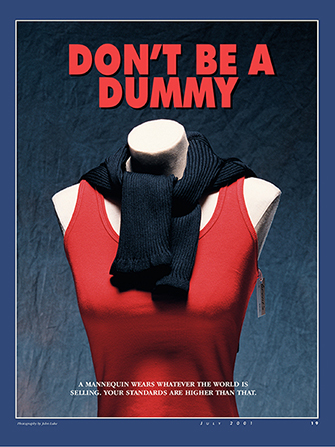
Poster, Don’t Be A Dummy: A mannequin wears whatever the world is selling. Your standards are higher than that.—www.lds.org/media-library/images/mormonads/dress-and-appearance?lang=eng#mormonad-dont-be-a-dummy-1118328 [Church standards of modesty apply equally to all genders.]
Poster, Don’t Short Change Yourself: The way you dress advertises your standards. Send the right message. (See For The Strength Of Youth, P. 8.)—www. lds.org/media-library/images/mormonads/dress-and-appearance?lang=eng#mormonad-short-change-1118313 [Church standards of modesty apply equally to all genders.]
Article, “Why Do We Let Them Dress Like That?”, Jennifer Moses, Wall Street Journal, 19 Mar 2011—online.wsj.com/news/articles/SB10001424052748703899704576204580623018562
Address, “The Moral Force of Women,” D. Todd Christofferson, LDS General Conference, Oct 2013—www. lds.org/general-conference/2013/10/the-moral-force-of-women?lang=eng
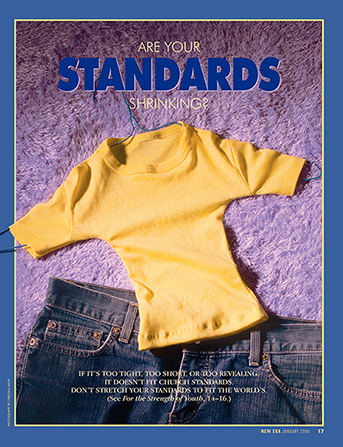
Poster, Are Your Standards Shrinking? If it’s too tight, too short, or too revealing, it doesn’t fit church standards. Don’t stretch your standards to fit the world’s. (See For The Strength Of Youth, P. 14-16.)—www. lds.org/media-library/images/mormonads/dress-and-appearance?lang=eng#mormonad-standards-shrinking-1118383 [Church standards of modesty apply equally to all genders.]
Address, “Motherhood and the Moral Influence of Women,” Bruce C. Hafen, World Congress of Families II, Geneva, Switzerland, Plenary Session IV, 16 Nov 1999 —worldcongress.org/wcf2_spkrs/wcf2_hafen.htm
Blog Post, “You’re a stay-at-home mom? What do you DO all day?”, Matt Walsh—themattwalshblog.com/2013/10/09/youre-a-stay-at-home-mom-what-do-you-do-all-day/
Address, “It Is Not Good for Man or Woman to Be Alone”, Sheri L. Dew, LDS General Conference, Oct 2001—www. lds.org/general-conference/2001/10/it-is-not-good-for-man-or-woman-to-be-alone?lang=eng
Address, “Mothers Who Know”, Julie B. Beck, LDS General Conference, Oct 2007—www. lds.org/general-conference/2007/10/mothers-who-know?lang=eng
Book, Daughters in My Kingdom: The History and Work of Relief Society (2011, Intellectual Reserve, Inc., United States of America)—www. lds.org/relief-society/?lang=eng
I love the words of the narrator as we focus on his wedding ring at Time 2:53 and the kid at the door watching his parents pray at 2:34. When I walked in to see my own parents at prayer, I remember the whoosh of feelings of safety and security but mostly of sacredness.
My favorite memory of the power of a prayerful life is one at work. I knocked on a friend’s office door; normally, he responds quickly with, “Come in!”, and I open the door. Sometimes, I’ll hear water running in the office bathroom as he makes ablution, and I know not to knock at the door for a few minutes after he returns to his office. But this day I was distracted and failed to notice that my knock at the door from without brought no invitation voiced from within. Out of habit, I called him by name, adding the customary honorific suffix, and opened the door. I found my elderly friend kneeling lowly on his prayer rug. It was such a holy moment. In a familiar whoosh of feeling, I was aware that I had missed the cues of the sounds at the sink. Having cleansed himself without as he focused on cleansing himself within, he was now talking with his Maker, expressing humility without as he voiced humility within. It was just like walking in on my parents at prayer. After prayers were done, we embraced; I apologized for disturbing a sacred moment. “Oh, I don’t mind. I am just doing my duty,” he said. I replied, “It is the duty of us all.”
When I think of my favorite moments of prayer, I will always see in my mind and in my heart an elderly man from Uzbekistan, with shoes removed from off his feet, kneeling submissively on sacred ground in his office, visible to none but to Him who sees all.
I shall be telling this with a sigh
Somewhere ages and ages hence:
Two roads diverged in a wood, and I,
I took the one less traveled by,
And that has made all the difference.
-Robert Frost
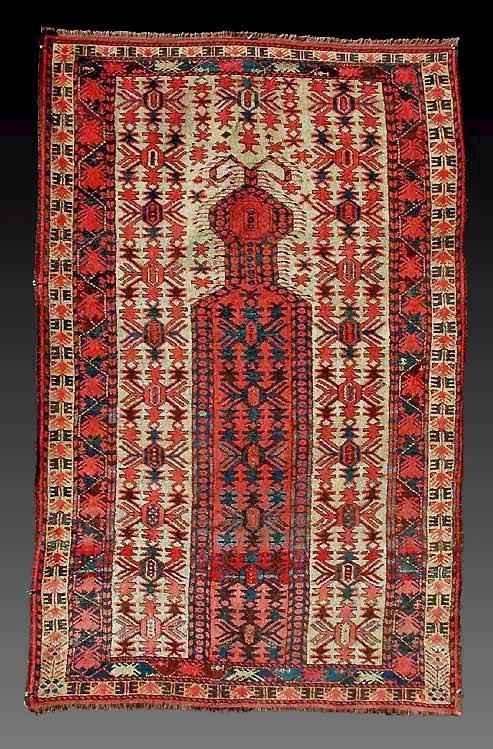
Vintage Prayer Rug
——– End of Post ——–
WebCredits—List of web resources used in this post but not explicitly credited above:
Photo, “Knock, And It Shall Be Opened Unto You”—westsoundmodern.wordpress.com/2011/05/11/go-away-im-washing-my-hair-2/knock-knock-3/
Enjoy reading our posts, and join in the discussions! We encourage a panorama of opinions with cordial dissent or support, and ask that comments be respectful and relevant to the post, allowing all to enjoy the shared thoughts and experiences. Entries subject to editing. Comments not in keeping with these standards may be removed at the discretion of blog editors.


 A promise to be loyal:




















 Todd
Todd Dave
Dave Brendan Sweeny
 MormonPanorama
 Brian
Brian Brittany
 Mike
Mike Kim
Kim Kevin
Kevin Whit
Whit MormonPanorama