Tag Archives: Out-of-the-box Thinking

How Taking Out The Trash Made Me A Better Man

I remember when I was in Ninth Grade and on a campout with friends, we went on a five-mile hike with all our equipment. We were on a dusty country road, and one kid got off the beaten path and was walking through the brush at the side. He stumbled upon a pile of magazines, which he quickly discovered were discarded pornographic magazines. As one of the wilder ones among us, he immediately let out a whoop and called everyone over to him to share in the pleasure of his treasure. While most of my friends stayed on the road, a few joined him in looking through the pictures. I remember distinctly having to make a decision. Did I feel this was right, or did I feel this was wrong? I quickly decided that this was not just wrong but very wrong, and I chose not to join the boys combing through the trash pile. When our adult leaders learned of the experience, they suggested that we go back and load the pile of trash into the back of a station wagon, which we did, and most of us were glad to discard it more appropriately. We felt that removing the pile was the right decision.

ctr-ring-with-bibleIs the concept of right and wrong something you support, something you couldn’t care less about, or something you simply find confusing? Is it possible for any of us to find an answer? In my faith tradition, we have a concept of “Choose The Right”. As kids in Primary, our children’s organization, we receive small rings – CTR rings for Choose The Right. The overall principle of right and wrong is that God is the author of right things, that decisions abound, that each of us may receive guidance from God, and that He will help us to choose the right path. I think that, while at times God may not feel strongly which decision I make, at the times when He does, as a loving Father in Heaven, He tries hard to let me know. If I listen, I can choose the right.

I’m not the only one who thinks there are unequivocal rights and wrongs. St. Augustine of Hippo taught us, “Right is right even if no one is doing it; wrong is wrong even if everyone is doing it.” And I love this gem of hope from Henry Eyring.

I have learned for myself that right and wrong actually exist and that God blesses us liberally when we choose the right.

Just As This Man Points The Way, So Does Our Heavenly Father...

Just As This Man Points The Way, So Does Our Heavenly Father…

——– End of Post ——–

Bonus Material:

1. “We all tend to approach decisions about right and wrong in one of three ways.”
—Margaret R. McLean, Director of The Applied Ethics Center at O’Conner Hospital and Director of Health Care Ethics at the Markkula Center for Applied Ethics, Santa Clara University, Santa Clara, California. Read more of her three ways.

2. Read, watch or listen to President Henry B. Eyring, “A Priceless Heritage of Hope”, Apr 2014 LDS General Conference.

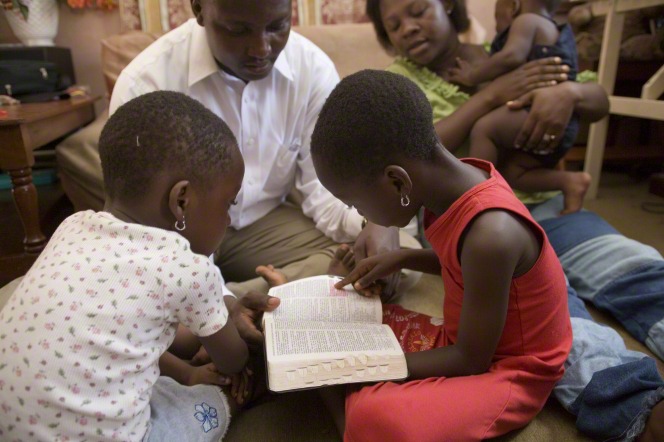
Education And Family Scripture Study Help Us Learn Right And Wrong

Education And Family Scripture Study Help Us Learn Right And Wrong

——– End of Bonus Material ——–

WebCredits—List of web resources used in this post but not explicitly credited above:

  • Photo, CTR ring with scriptures—www. lds.org/search?query=ctr+ring&x=0&y=0&lang=eng&collection=media
  • Quote: “Right is right even if no one is doing it; wrong is wrong even if everyone is doing it.”―St. Augustine of Hippo, en.wikipedia.org/wiki/Augustine_of_Hippo, as quoted in www. goodreads.com/quotes/tag/right-and-wrong
  • Photo, “Just As This Man Points The Way, So Does Our Heavenly Father…”—Ensign, May 2014, Page 25
  • Photo, “Education And Family Scripture Study Help Us Learn Right And Wrong”—www. lds.org/topics/family-history?lang=eng
  • Photo, “A Loving Family Helps Us To Choose The Right”—kaileyraephoto.blogspot.com/

——– End of WebCredits ——–

A Loving Family Helps Us To Choose The Right

A Loving Family Helps Us To Choose The Right

 

Poetry List For Imagination And Mind-stretching? Our Family’s Answer.

oceans-oregon-coastReader Question:
Dave, can you please provide a list of poems that your family has enjoyed over the years? Our family really likes poetry, and it may be useful to have a handy list around. We would truly appreciate whatever guidance you choose to give or poetry you might suggest.

Family Answer:
Thanks for your question. Sincere, honest questions are always a good thing.

To gather an answer to your question, we talked to our adult kids, and here’s the list that we gathered. Note that this will be a living list, a living post, that we will add to over time as we remember other poems or experience new ones that we wish to include.

For us, poetry is an ancient, vital language. It limbers up our imagination. Here’s the MormonPanorama Poetry List for helping to stretch the minds of your family. These are for a general audience unless otherwise marked, and parents are encouraged to read beforehand and judge for themselves.

What we were looking for in poetry for kids as they grew up:

  • Poetry that gave us material to discuss – especially about what is right and what is wrong and how to resist wrongs that are embraced by so many others around you.
  • Poems that build up rather than drag down, that uplift and inspire.
  • We avoided literature which stated that our moral standards are silly or which encouraged us to become less than we should be.

We hope this answers your question and helps you understand us better and how to become a more effective family, create strong citizens, and have fun with our youth and young adults.

And let us know how we may help you further! If you find that you have any questions about religious issues that you’ve been wondering about or that you haven’t been able to get good answers to, feel free to continue on discussion with us. It turns out that there are a lot of people with questions, and most of them have given up on churches as a source of answers. In our family, it is our experience that answers are out there, that God wants us to have them, and that they tend to be answers we like and have learned to appreciate. Working together with Heavenly Father allows anyone to find certainty in uncertain times.

-Dave and the MormonPanorama Family


oceans-pacific-grove

——– End of Post ——–

Bonus Material:

1. 90% of People can’t pronounce this whole poem. Feel free to try it!

2. Monty Python on poetry—Kind of…

——– End of Bonus Material ——–

WebCredits—List of web resources used in this post but not explicitly credited above:

  • Photo, ocean-oregon-coast—www. lds.org/media-library/images/oceans?lang=eng
  • Photo, ocean-pacific-grove—www. lds.org/media-library/images/oceans?lang=eng

——– End of WebCredits ——–

Not Poetry, But Still Fun

Not Poetry, But Still Fun

MormonPanorama Poetry List (Extended Post Including Excerpts Of Poems)

This post is an extension of a post from MormonPanorama that lists poetry that our family has learned to love over the years.

Poems appear below for which we wanted to highlight selected lines on a webpage, or for which we happened to find no convenient website for an individual work of poetry. Enjoy!
-Dave and the MormonPanorama Family

·———————————————————————————————-·
Martín Fierro
, epic gaucho poem from Argentina (1872) — José Hernández
·———————————————————————————————-·
I sit me here to sing my song
To the beat of my old guitar;
For the man whose life is a bitter cup,
With a song may yet his heart lift up,
As the lonely bird on the leafless tree
That sings ‘neath the gloaming star.

May the shining Saints of the heavenly band,
That sing in the heavenly choir,
Come down and help me now to tell
The good and ill that me befell,
And to sing it true to the thrumming strings;
For such is my desire.

Come down, ye Saints, that have helped me
In many a perilous pass;
For my tongue is tied and my eyes grow dim,
And the man that calls, God answers him,
And brings him home to his own roof-tree,
Out of many a deep morass.

O many singers have I seen,
That have won a singer’s wreath,
That have talked a lot as they passed the pot,
Of the songs they sang and the songs they wrought,
Till their voices rusted in their throats,
As a knife rusts in its sheath.

Now all that a son of the plains may do,
To none shall I give best;
And none may daunt with a windy vaunt,
Or bristle my scalp with a phantom gaunt,
And as song is free to all that will,—
I will sing among the rest.

I will sing my song till my breath gives out,
I will sing when they bury me;
And singing I’ll come where the angels roam
The rolling plains of their starry home,—
Into this world I came to sing,
As I sang on my mother’s knee.

And let my tongue be glib and sweet,
My words be not halt nor few,
And the men to come that I shall not see,
In days to be will remember me,
By the song I sang in the days gone by,
That now I sing to you.

[The first seven stanzas of Martín Fierro, epic gaucho poem from Argentina (1872) — José Hernández. It was very common for people to have quotes from the work hanging on the walls of their homes, with their favorite thoughts of gaucho-esque philosophy. The entire work is 2,316 lines long, 386 stanzas of payadas or rural ballads, each with a strict six-line rhyming scheme (like the six strings of a guitar) invented by Hernández specifically for this work of poetry, as well as an 8-syllable rhythmic pattern. The first line is kept “free” and unrhymed, allowing Hernández to present a “thesis” to the stanza without having to worry about the last word being part of the rhyme scheme. Lines two, three and six rhyme together while lines four and five constitute an independent rhyming group. The English translation (traditionally, the truest English translation, using an altered but similarly strict scheme) is by Scottish translator Walter Owen, who wonderfully called his work not translation but “transvernacularisation”.]

·————————————·
The Works of Ogden Nash
·————————————·
Ogden Nash was best known for surprising, pun-like rhymes, sometimes with words deliberately misspelled for comic effect. Among his most popular writings were a series of animal verses, many of which featured his off-kilter rhyming devices:

The Jellyfish
You can have my jellyfish
I’m not sellyfish

The Fly
The Lord in His wisdom made the fly
And then forgot to tell us why

The Panther
The panther is like a leopard,
Except it hasn’t been peppered.
Should you behold a panther crouch,
Prepare to say Ouch.
Better yet, if called by a panther,
Don’t anther.

The Eel
I don’t mind eels
Except as meals.
And the way they feels.

The most frequently quoted of these poems is his ode to the llama:
The Lama
The one-L lama, he’s a priest
The two-L llama, he’s a beast
And I would bet a silk pyjama
There isn’t any three-L lllama.

(Nash appended a footnote to this poem: “The author’s attention has been called to a type of conflagration known as a three-alarmer. Pooh.”)

Nash’s poetry was often a playful twist of an old saying or poem. He expressed this playfulness in what is perhaps his most famous rhyme. Nash observed the following in a turn of Joyce Kilmer’s words, “I think that I shall never see a poem lovely as a tree.”
Song of the Open Road
I think that I shall never see
A billboard lovely as a tree.
Perhaps, unless the billboards fall,
I’ll never see a tree at all.

A Word to Husbands
To keep your marriage brimming,
With love in the loving cup,
Whenever you’re wrong, admit it;
Whenever you’re right, shut up.

Reflections on Babies
A bit of talcum
Is always walcum.

Reflections on Ice-Breaking
Candy
Is dandy
But liquor
Is quicker.

In 1968 he added:
Pot is not.

He also commented:
I often wonder which is mine:
Tolerance, or a rubber spine?

His one-line observations are often quoted:
People who work sitting down get paid more than people who work standing up.
Progress might have been all right once, but it has gone on too long.

Webcredits:
http://www.ogdennash.org/ogden_nash_biography.htm
and
http://poetrysplash.tripod.com/ogdennash2.htm

——– End of Post ——–


A Good Reason To Get Beaten Up

Sometimes, you just gotta rock the boat and stand up for what you believe.

I remember that, when I was a kid in Columbia, Missouri, a friend at school picked a fight on the playground. He had criticized my beliefs as a Mormon and called me a moron. I chose to say, “Yes, I believe those things,” and he beat me up. A couple years later in Fifth Grade, while waiting in line at the water fountain in the hallway, another friend asked me, “Do you really believe that Old Joe Smith saw God?” I remember thinking, “Who the heck is Old Joe Smith?” And then it hit me that he was referring to the prophet Joseph Smith (whom I’d never heard called Old Joe Smith before). I said, “Yes, I do believe that Joseph Smith saw God.” He shrugged his shoulders, and that was the end of it. We got our sips of water and went back to class.

Sometimes We Row Alone

Sometimes We Row Alone

In my previous post, I discussed the importance of being at our best—Not the importance of individual achievement but of working as a team, when we all get in the boat together and pull as one. Have you noticed that being our best can demand more than mere teamwork? Sometimes, when singled out to row without help, criticized for what we think is right, we are called upon to stand alone. And while on occasion, it happens with a bang, like my fight on the playground, I’ve noticed that in general it happens quietly. Like when I volunteer at the Family History Center—I thought I would help others learn to connect with their families, but most of the time, I find I’m slowly learning more myself. Or when I’m together with friends of multiple faiths—Not only do I learn to listen better but also to express myself better so that I invite rather than annoy. No bang, just slow progress towards being our best and working as a team.

But, on occasion, we must be willing to rock the boat.

Mashed Potato Face

Mashed Potato Face

One young woman learned this as an LDS missionary. “My companion and I saw a man sitting on a bench in the town square eating his lunch. As we drew near, he looked up and saw our missionary name tags. With a terrible look in his eye, he jumped up and raised his hand to hit me. I ducked just in time, only to have him spit his food all over me and start swearing the most horrible things at us. We walked away saying nothing. I tried to wipe the food off of my face, only to feel a clump of mashed potato hit me in the back of the head. Sometimes it is hard being a missionary, because right then I wanted to go back, grab that man, and say, ‘EXCUSE ME!’ But I didn’t.”

Jeffrey R. Holland teaches us further:

Unfortunately, messengers of divinely mandated commandments are often no more popular today than they were anciently, as at least two spit-upon, potato-spattered sister missionaries can now attest.

Run Along And Pick Marigolds, Or Stand For Something

Run Along And Pick Marigolds, Or Stand For Something

It is a characteristic of our age that if people want any gods at all, they want them to be gods who do not demand much, comfortable gods, smooth gods who not only don’t rock the boat but don’t even row it, gods who pat us on the head, make us giggle, then tell us to run along and pick marigolds.  [See Henry Fairlie, The Seven Deadly Sins Today (1978), Pages 15-16.]

Defend your beliefs with courtesy and with compassion, but defend them.

I have learned for myself the value of standing for something. It’s especially satisfying when I may do so as part of building a team that rows as one.

——– End of Post ——–

Bonus Material:

The importance and vitality of the strait and narrow path:

Be strong. Live the gospel faithfully even if others around you don’t live it at all. Defend your beliefs with courtesy and with compassion, but defend them. A long history of inspired voices, including those you will hear in this conference and the voice you just heard in the person of President Thomas S. Monson, point you toward the path of Christian discipleship. It is a strait path, and it is a narrow path without a great deal of latitude at some points, but it can be thrillingly and successfully traveled, “with … steadfastness in Christ, … a perfect brightness of hope, and a love of God and of all men.” In courageously pursuing such a course, you will forge unshakable faith, you will find safety against ill winds that blow, even shafts in the whirlwind, and you will feel the rock-like strength of our Redeemer, upon whom if you build your unflagging discipleship, you cannot fall. [Jeffrey R. Holland, “The Cost—and Blessings—of Discipleship”, Ensign, May 2014, Pages 6-9.]

Sometimes, You've Got To Rock The Boat

Sometimes, You’ve Got To Rock The Boat

——– End of Bonus Material ——–

WebCredits—List of web resources used in this post but not explicitly credited above:

  • Photo, “Sometimes We Row Alone”—pseudophilosoph.wordpress.com/2014/05/01/welcome-life-has-no-meaning-but-it-can/
  • Photo, “Mashed Potato Face”—www. flickr.com/photos/mamajulie2008/6883972123/
  • Photo, “Run Along And Pick Marigolds, Or Stand For Something”—rosylittlethings.typepad.com/posie_gets_cozy/2007/08/last-night.html
  • Photo, “Sometimes, You’ve Got To Rock The Boat”—hopeofglory.typepad.com/into_the_fire/2013/04/dont-rock-the-boat-baby.html
  • Photo, “Marigolds”—gardening.about.com/od/plantprofiles/ig/Marigolds/Marigold-Colors.htm

——– End of WebCredits ——–

Marigolds

Marigolds

As I Walked In The Door, Everyone’s Jaws Dropped

The 1936 Varsity Crew, University of Washington

The 1936 Varsity Crew, University of Washington

I lived in Oklahoma and worked for a telecommunications company during the years leading up to the Year 2000. The entire computer industry had to deal with Y2K, adapting each line of millions of lines of code to allow for a four-digit year (where previously only a two-digit year had been the standard). In my group, we worked together well for the benefit of the team. During a critical week of software installs, one night I was assigned to be at work at 4AM. I woke up with a start at 1AM and felt I should go in early. As I walked in the door, everyone’s jaws dropped, and they couldn’t believe I was there. They had just identified a major concern, I was the only one who knew how to investigate it, and they had just confirmed these two facts when I happened to walk in the door in the middle of the night. They all said that they got goose bumps when they saw me, and for years, a few of my execs teased me about whether or not I could still do that “mind reading” thing. We had studied our code thoroughly, we took responsibility for working together well, we knew what was at stake, and we simply were in synch as a team.

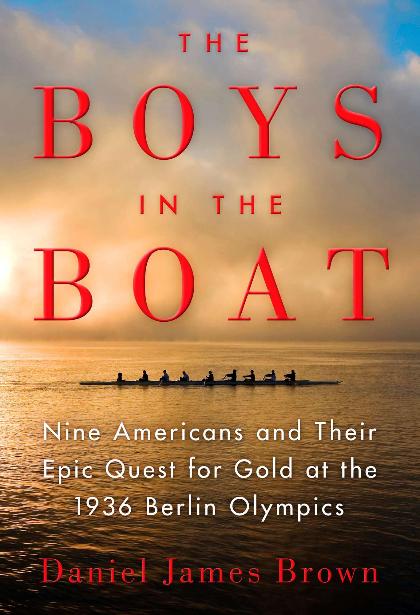
Cover, The Boys In The Boat--Nine Americans And Their Epic Quest For Gold At The 1936 Berlin Olympics

Teamwork to me has always been more satisfying than claiming center stage for oneself. Maybe that’s why I loved reading The Boys in the Boat last month, which was on the LA Times bestseller list for nine months and on the NY Times list for eighteen months. In the words of author Daniel James Brown, “This is a story of who we are when we are at our best. But it approaches it not as a story about individual achievement but a story about what we do when we come together, when we all get in the boat together and pull as one.”

Here are two of my favorite quotes and what they mean to me:

“Good thoughts have much to do with good rowing. It isn’t enough for the muscles of a crew to work in unison; their hearts and minds must also be as one.” [George Yeoman Pocock, as quoted in The Boys in the Boat: Nine Americans and Their Epic Quest for Gold at the 1936 Berlin Olympics, Daniel James Brown (2013, Viking, New York), Pages 297.]

Losing Of Self Entirely To The Crew As A Whole

Losing Of Self Entirely To The Crew As A Whole

“Where is the spiritual value of rowing?…The losing of self entirely to the cooperative effort of the crew as a whole.” [George Pocock, ibid., Page 353.]


An Andes Evening In Godoy Cruz

An Andes Evening In Godoy Cruz

When I lived in Argentina, while in the city of Godoy Cruz, we just clicked with the local folks and were able to serve others as never before. Six nights a week, my missionary companion and I would would split up, go in pairs with people in the area who happened to be Mormons, and four to eight times each night, we would teach people the gospel of Jesus Christ. These people sacrificed much of their time just to help us in our work, and that certainly helped us to build a more effective team. We grew close to these people and close as missionary companions. It was an absolutely beautiful way to spend our evenings, week after week.

It’s a delight to read stories of people when we are at our best. It’s especially a delight to read stories of not being mastered by our circumstances, stories of subjugating self to team, stories that focus on conquering ourselves.

The 1936 US Olympic Rowing Team

The 1936 US Olympic Rowing Team

——– End of Post ——–

Bonus Material:

1. Video: 1936 Olympic rowing film orchestrated by German media mogul Leni Riefenstahl (with footage of actual race, then Riefenstahl was able to get her rowing close-ups with the teams a day later)

2. Video: Daniel James Brown “The Boys in the Boat” (taped author presentation)

——– End of Bonus Material ——–

WebCredits—List of web resources used in this post but not explicitly credited above:

  • Photo, “The 1936 Varsity Crew, University of Washington”—plus.google.com/+XenoM%C3%BCller/posts
  • Photo, cover, The Boys In The Boat: Nine Americans And Their Epic Quest For Gold At The 1936 Berlin Olympics—www. startribune.com/entertainment/books/211547891.html
  • Photo, need to row—www. telegraph.co.uk/sport/othersports/10135281/Eton-Dorney-Rowing-World-Cup-2013-Great-Britains-Olympic-champion-mens-eight-finish-third.html
  • Photo, “Losing Of Self Entirely To The Crew As A Whole”—www.telegraph.co.uk/sport/olympics/rowing/9757012/Rowing-should-get-on-its-bike-says-Greg-Searle.html
  • Photo, “An Andes Evening In Godoy Cruz”—www. mendoza.travel/Godoy_Cruz.aspx
  • Photo, “The 1936 US Olympic Rowing Team”—www. newsrt.co.uk/news/the-boys-in-the-boat-by-daniel-james-brown-review-1923027.html
  • Photo, “Godoy Cruz, A Park At Night”—www. liveargentina.com/mendoza/GodoyCruz.php

——– End of WebCredits ——–

Godoy Cruz, A Park At Night

Godoy Cruz, A Park At Night

Movie List For Fun And To Build Up And Inspire? Our Family’s Answer.

ocean-big splash at Cape Kiwanda State Natural Area in OregonReader Question:
Dave, can you please provide a list of movies that your family has enjoyed over the years and used as you raised your kids? Our family would truly appreciate whatever guidance you choose to give or films you might suggest.

Family Answer:
Thanks for your question. Sincere, honest questions are always a good thing.

To gather an answer to your question, we talked to our adult kids, and here’s the list that we gathered. Note that this will be a living list, a living post, that we will add to over time as we remember other films or learn of new ones that we wish to include.

MormonPanorama Movie List for Encouraging Strong Families (for a general audience unless otherwise marked – parents are encouraged to view beforehand and judge for themselves):

12 Angry Men (1957) — being brave; best for older youth or adults
13 Going on 30 (2004) — being good beats being mean any day
A Cry in the Wild (1990) — breaking barriers
After Earth (2013) — learning to trust yourself
Akeelah and the Bee (2006) — learning to trust yourself
Aladdin (1992) — learning to trust
An Affair to Remember (1957) — discarding doubt
Anna and the King (1999) — breaking barriers
Anne of Avonlea (1987) — learning to trust
Anne of Green Gables (1985) — learning to trust
Avatar (2009) — breaking barriers; best for older youth or adults
Babe (1995) — out-of-the-box thinking
Bambi (1942) — being brave
Beauty and the Beast (1991) — progression
Ben-Hur (1959) — progression
Brigadoon (1954) — breaking barriers
Casablanca (1942) — discarding doubt
Charade (1963) — being brave; best for adults
Chicken Run (2000) — being brave
Chitty Chitty Bang Bang (1968) — fun
Deja Vu (2006) — breaking barriers; best for older youth or adults
Dumbo (1941) — learning to trust
Elf (2003) — learning to trust
Enchanted (2007) — learning to trust
Ever After: A Cinderella Story (1998) — breaking barriers
Fantasia (1940) — culture and fun
Fantasia/2000 (1999) — culture and fun
Father Goose (1964) — breaking barriers
Fiddler on the Roof (1971) — learning to trust
Field of Dreams (1989) — learning to trust; best for adults
Finding Neverland (2004) — breaking barriers
Fireproof (2008) — forgiveness; best for older youth or adults
Frequency (2000) — repentance; best for older youth or adults
Gettysburg (1993) — being brave; best for adults
Gigi (1958) — fun
Gods and Generals (2003) — being brave; best for adults
Gone with the Wind (1939) — Americana
Groundhog Day (1993) — progression; best for older youth or adults
Guess Who’s Coming to Dinner (1967) — breaking barriers
Henry V (1989) — learning to trust
Hereafter (2010) — learning to trust
Hitch (2005) — breaking barriers; best for older youth or adults
Holes (2003) — keeping promises
Hook (1991) — progression
Hoosiers (1986) — breaking barriers
How the West Was Won (1962) — breaking barriers
How to Train Your Dragon (2010) — out-of-the-box thinking
Ice Age (2002) — breaking barriers
In the Heat of the Night (1967) — breaking barriers
Inception (2010) — out-of-the-box thinking; best for adults
Indiana Jones and the Last Crusade (1989) — breaking barriers
Invictus (2009) — breaking barriers
Invincible (2006) — breaking barriers
Iron Man (2008) — breaking barriers
Iron Will (1994) — breaking barriers
It Happened One Night (1934) — breaking barriers
It’s a Wonderful Life (1946) — progression
John Carter (2012) — breaking barriers
Kate & Leopold (2001) — breaking barriers
K-PAX (2001) — breaking barriers; best for older youth or adults
Lady and the Tramp (1955) — learning to trust
Lady in the Water (2006) — finding your role in life; best for adults
Ladyhawke (1985) — learning to trust
Les Miserables (1978 with Richard Jordan) — progression
Man of Steel (2013) — learning to trust
Mary Poppins (1964) — progression
McLintock! (1963) — breaking barriers
Meet Me in St. Louis (1944) — Americana
Men in Black (1997) — progression
Men in Black 3 (2012) — progression
Miracle (2004) — breaking barriers
Miracle on 34th Street (1947) — learning to trust
Miss Pettigrew Lives for a Day (2008) — breaking barriers; best for adults
Monty Python and the Holy Grail (1975) — fun
Nanny McPhee (2005) — progression
Newsies (1992) — breaking barriers
North & South (2004) — breaking barriers
Ocean’s Eleven (2001) — breaking barriers; best for adults
October Sky (1999) — breaking barriers
Oklahoma! (1955) — Americana
Old Yeller (1957) — being brave
On a Clear Day You Can See Forever (1970) — seeing people deeper
On the Town (1949) — fun and romance
Operation Petticoat (1959) — breaking barriers
Patton (1970) — breaking barriers
Pay It Forward (2000) — breaking barriers; best for adults
Pirates of the Caribbean: The Curse of the Black Pearl (2003) — fun
Pride and Prejudice (1995) — breaking barriers
Prince of Persia: The Sands of Time (2010) — learning to trust
Raiders of the Lost Ark (1981) — breaking barriers
Ratatouille (2007) — progression
Rear Window (1954) — learning to trust; best for adults
Ring of Bright Water (1969) — breaking barriers
Rudy (1993) — breaking barriers
Sabrina (1995) — breaking barriers; best for older youth or adults
Saints and Soldiers (2003) — breaking barriers
Scrooge (1970 with Albert Finney) — learning to trust
Secondhand Lions (2003) — breaking barriers
Sense and Sensibility (1995 with Emma Thompson) — breaking barriers
Sense and Sensibility (2008 with Dan Stevens) — breaking barriers
Seven Brides for Seven Brothers (1954) — breaking barriers
Seven Samarai (1954) — breaking barriers
Shadowlands (1993) — learning through practice what you preach
Sherlock Holmes (2009) — breaking barriers; best for older youth or adults
Shrek (2001) — importance of layers in parfaits
Signs (2002) — breaking barriers
Silverado (1985) — breaking barriers
Singin’ in the Rain (1952) — progression
Star Trek (2009) — breaking barriers; best for older youth or adults
Star Wars (1977) — progression
Stargate (1994) — breaking barriers
Starman (1984) — breaking barriers
Stranger Than Fiction (2006) — breaking barriers
Surf’s Up (2007) — breaking barriers
Swiss Family Robinson (1960) — being brave
The Adventures of Robin Hood (1938) — being brave
The African Queen (1951) — being brave
The Avengers (2012) — learning to trust
The Bells of St. Mary’s (1945) — learning to trust
The Black Stallion (1979) — being brave
The Blind Side (2009) — treating people as they may become
The Bourne Identity (2002) — breaking barriers; for older youth/adults
The Bourne Legacy (2012) — breaking barriers; for older youth/adults
The Bourne Supremacy (2004) — breaking barriers; for older youth/adults
The Bourne Ultimatum (2007) — breaking barriers; for older youth/adults
The Bridge on the River Kwai (1957) — learning to trust
The Dirty Dozen (1967) — learning to trust
The Fugitive (1993) — being brave; best for adults
The Ghost and Mr. Chicken (1966) — being brave
The Gods Must Be Crazy (1980) — being brave
The Gods Must Be Crazy II (1989) — being brave
The Great Escape (1963) — breaking barriers
The Great Race (1965) — breaking barriers
The Hunchback of Notre Dame (1996) — learning to trust
The Incredibles (2004) — discarding doubt
The Iron Giant (1999) — learning to trust
The Jungle Book (1967) — learning to trust
The Lake House (2006) — breaking barriers
The Legend of Bagger Vance (2000) — learning to trust
The Lion King (1994) — learning to trust
The Little Mermaid (1989) — learning to trust
The Lord of the Rings: The Fellowship of the Ring (2001) — being brave
The Magnificent Seven (1960) — breaking barriers
The Maltese Falcon (1941) — being brave
The Mark of Zorro (1940) — being brave
The Mask of Zorro (1998) — learning to trust
The Miracle Worker (1962) — breaking barriers
The Mission (1986) — forgiveness
The Muppet Movie (1979) — fun
The Music Man (1962) — learning to trust
The Other Side of Heaven (2001) — breaking barriers
The Parent Trap (1961) — learning to trust
The Princess Bride (1987) — being brave
The Rescuers Down Under (1990) — out-of-the-box thinking
The Robe (1953) — breaking barriers
The Secret Garden (1993) — learning to trust
The Sixth Sense (1999) — believing in others; best for adults
The Sound of Music (1965) — progression
The Sting (1973) — breaking barriers; best for older youth or adults
The Sword in the Stone (1963) — out-of-the-box thinking
The Taming of the Shrew (1967) — learning to trust
The Village (2004) — breaking barriers; best for older youth or adults
The Vow (2012) — steadfastness; best for adults
The Water Horse (2007) — being brave
Thoroughly Modern Millie (1967) — seeing people deeper
Timeline (2003) — breaking barriers
To Kill a Mockingbird (1962) — being brave
To Sir, With Love (1967) — learning to trust
Tora! Tora! Tora! (1970) — breaking barriers
Toy Story (1995) — progression
Toy Story 2 (1999) — progression
Toy Story 3 (2010) — progression
Treasure Island (1950) — progression
True Grit (1969) — breaking barriers
Tuck Everlasting (2002) — breaking barriers
Up (2009) — progression against odds
Vertigo (1958) — learning to trust; best for adults
Wait Until Dark (1967) — being brave; best for adults
West Side Story (1961) — breaking barriers
What’s Up Doc? (1972) — seeing people deeper
While You Were Sleeping (1995) — learning to trust
White Christmas (1954) — fun and romance
White Fang (1991) — breaking barriers
Wizard of Oz (1939) — progression
You’ve Got Mail (1998) — progression

What we were looking for in movies for kids as they grew up:

  • Films that have tons of material to discuss – especially about what is right and what is wrong and how to resist wrongs that are embraced by so many others around you.
  • Movies and videos (YouTube, etc.) that build up rather than drag down, that uplift and inspire.
  • We avoided films which stated that our moral standards are silly or which encouraged us to become less than we should be.

We hope this answers your question and helps you understand us better and how to become a more effective family, create strong citizens, and have fun with our young adults.

And let us know how we may help you further! If you find that you have any questions about religious issues that you’ve been wondering about or that you haven’t been able to get good answers to, feel free to continue on discussion with us. It turns out that there are a lot of people with questions, and most of them have given up on churches as a source of answers. In our family, it is our experience that answers are out there, that God wants us to have them, and that they tend to be answers we like and have learned to appreciate. Working together with Heavenly Father allows anyone to find certainty in uncertain times.

-Dave and the MormonPanorama Family

ocean-Hawaiian beach

——– End of Post ——–

WebCredits—List of web resources used in this post but not explicitly credited above:

——– End of WebCredits ——–

The Power Of Great Art!

The Power Of Great Art!

Reading List To Encourage Intellectual Exploring? Our Family’s Answer.

oceans-rialto-beachReader Question:
Dave, can you please provide a list of books that your family enjoyed and used as you “encouraged lots of intellectual exploring by reading widely”? Our family would truly appreciate whatever guidance you choose to give or titles you might suggest.

Family Answer:
Thanks for your question. Sincere, honest questions are always a good thing.

To gather an answer to your question, we talked to our adult kids, and here’s the list that we gathered. Note that this will be a living list, a living post, that we will add to over time as we remember other titles or learn of new ones that we wish to include.

MormonPanorama Reading List for Creating Strong Families (for children, youth, and young adults). These are for a general audience unless otherwise marked, and parents are encouraged to read beforehand and judge for themselves.

What we were looking for in books for kids as they grew up:

  • Books that have tons of material to discuss – especially about what is right and what is wrong and how to resist wrongs that are embraced by so many others around you.
  • Literature that builds up rather than drags down, that uplifts and inspires.
  • We avoided literature which stated that our moral standards are silly or which encouraged us to become less than we should be.

We hope this answers your question and helps you understand us better and how to become a more effective family, create strong citizens, and develop better young adults.

And let us know how we may help you further! If you find that you have any questions about religious issues that you’ve been wondering about or that you haven’t been able to get good answers to, feel free to continue on discussion with us. It turns out that there are a lot of people with questions, and most of them have given up on churches as a source of answers. In our family, it is our experience that answers are out there, that God wants us to have them, and that they tend to be answers we like and have learned to appreciate. Working together with Heavenly Father allows anyone to find certainty in uncertain times.

-Dave and the MormonPanorama Family

oceans-emerald-island-beach

——– End of Post ——–
WebCredits—List of web resources used in this post but not explicitly credited above:

  • Photo, ocean-rialto-beach—www. lds.org/media-library/images/oceans?lang=eng
  • Photo, ocean-emerald-island-beach—www. lds.org/media-library/images/oceans?lang=eng

——– End of WebCredits ——–

They're Fermenting Rebellion...

They’re Fermenting Rebellion…

Callings: Murmur or Magnify?

What’s a “calling” mean to you?

We’re Responsible To Know For Ourselves

We’re Responsible To Know For Ourselves

As a Mormon, to me it means accepting an assignment from church leaders to serve others. I know my leaders have pondered and discussed and prayed before asking me to serve. After saying Yes, I have the responsibility to kneel and to find out for myself that such a calling is from God. Because I belong to The Church of Jesus Christ of Latter-day Saints, I want to magnify my calling.

Magnifying my calling is less concerned with what I do as I serve others and more concerned with how or why I serve others.

Conducting Music At Church

Conducting Music At Church

For example, I had a friend in college who moved into our congregation and immediately accepted a calling to lead the music in church each Sunday. Kathy was a recent convert to the Church of Jesus Christ, and she felt the calling was inspired of God. She gathered her roommates around her, told them of the new calling, and explained that she was terrified, as she had no musical experience whatsoever. They rallied around her, practiced singing and leading hymns in their living room over and over and over, for weeks on end, until she was comfortable directing the congregational music on her own.

I remember that first Sunday when Kathy stood before the congregation. Her fear was clear in every movement. With her hands, she deftly directed a perfect 3/4 meter in a little tiny triangular pattern, moving her hands about four inches from top of pattern to bottom. Her roommates ran up to her afterwards and all gave her a big hug. Weeks later, in our next testimony meeting, Kathy bore witness to how she had grown by accepting this calling and how she felt it was inspired of God. Then, the member of the bishopric who had issued the calling to her stood to explain that congregation leaders had been misinformed about her musical experience, were surprised to discover otherwise, and were pleased by Kathy’s willingness to serve in any capacity and by her roommates’ willingness to assist. As Kathy’s musical confidence grew over the next few months, the pattern of her musical direction grew to a more normal size. During those months, I remember seeing some of her roommates with tears streaming down their smiling faces as they watched Kathy’s trembling hands. We all watched as Kathy’s face smiled more and as her countenance glowed more each week as she stood before us. This calling had little to do with the knowledge of man and much to do with the knowledge of God. Kathy’s willingness to submit and to say Yes, to take initiative to educate herself, to learn new skills outside of her comfort zone, inspired us all.

Again, callings are less concerned with what we do as we serve others and more concerned with how or why we serve others. Kathy is proof. I’m glad there are so many Kathy’s in the world.

Having Learned For Ourselves, We’re Responsible To Help Others Know

Having Learned For Ourselves, We’re Responsible To Help Others Know

——– End of Post ——–

Bonus Material:

1. Watch, listen, or read Elder Dallin H. Oaks as he speaks to the general membership of the Church as one of the twelve apostles of the Lord Jesus Christ in his address, entitled “Why Do We Serve?” (Length: 19:47.)

2. Watch, listen, or read the address of Elder M. Russell Ballard on showing our love and appreciation for the Savior’s atoning sacrifice through our simple, compassionate acts of service, entitled “Finding Joy through Loving Service.” (Length: 15:03.)

3. Watch, listen, or read Elder Derek A. Cuthbert in his beloved address, entitled “The Spirituality of Service.” (Length: 9:35.) It was a landmark address, quoted for years afterwards, particularly: “Over the years, many people, especially youth, have asked me, ‘Elder Cuthbert, how can I become more spiritual?’ My reply has always been the same: ‘You need to give more service.’ ”

4. Watch, listen, or read the wonderfully inspired words of President Barbara B. Smith, entitled “She Stretcheth Out Her Hand to the Poor.” (Length: 9:54.)

5. Watch, listen, or read President Thomas S. Monson as he describes, “The Service That Counts.” (Length: 22:26.)

6. Watch, listen, or read the address of Elder Dallin H. Oaks on how our Savior teaches us to follow Him by making the sacrifices necessary to lose ourselves in unselfish service to others, entitled “Unselfish Service.” (Length: 17:19.)

——– End of Bonus Material ——–

WebCredits—List of web resources used in this post but not explicitly credited above:

  • Photo, “We’re Responsible To Know For Ourselves”—www. lds.org/media-library/images/prayer?lang=eng
  • Photo, “Conducting Music At Church”—www. lds.org/media-library/images/music?lang=eng
  • Photo, “Having Learned For Ourselves, We’re Responsible To Help Others Know”—www. lds.org/media-library/images/education/spiritual?lang=eng
  • Photo, “Studying To Learn”—www. lds.org/media-library/images/education/miscellaneous?lang=eng

——– End of WebCredits ——–

Studying To Learn

Studying To Learn

Scriptures, Sacred Feelings, and Other Small and Simple Things

There’s an expression that some people are “closed books”. It indicates someone who cannot be easily understood, someone unfathomable or puzzling, while others are “open books”. One may feel this way about a book of sacred writings. Some people I know feel that holy books are closed to them. Other friends feel that a book of God has things that speak specifically to them.

As a youth long ago, I learned to love the scriptures. To me, they are open books. In Seventh Grade, I remember starting to see specific verses as if they were a good friend. Learning, pondering, searching, and memorizing scriptures is like filling a cabinet with friends, values, and truths that can be called upon any time, anywhere in the world:

(Or same video at lds.org link.)

One’s feelings are key to an open book. If I love an author, it’s usually because I love the way the writer uses words, how I feel about how she or he expresses thoughts in writing. Some authors I like because they express thoughts similar to mine, while I love others, having expressed thoughts so distinct from mine, due to the way they open my mind to new things. What’s essential is less the words of sacred authors and more how their meaning resonates both to my mind and to my heart. God combines intellect and inspiration to tailor something personal to me, that nourishes my spirit, food that I need to feed my soul on a daily basis. Watch how he taught the Children of Israel this lesson:

(Or same video at lds.org link.)

I particularly love how I have come to see the scriptures as a proactive attempt on God’s part to be less puzzling, and I understand that openness to spiritual feelings is an important part of that. These spiritual feelings come in whispers to my soul. Did not our heart burn within us, …while he opened to us the scriptures? Heavenly Father speaks directly to his children through the still, small voice of the Holy Spirit. One of life’s true paradoxes is that through these whispered feelings and thoughts, he does wonderful works through us.  By small and simple things, God brings to pass great things. “…by very small means the Lord doth confound the wise and bringeth about the salvation of many souls.” 

As a boy, Joseph Smith learned from his parents to trust the scriptures. He learned to read by them, studied them, and struggled to understand them better. When reading James 1:5-6, he learned to ask important questions with confidence that God would reveal to him the answers. By following those answers, Joseph was able to help his family find certainty in uncertain times.

The epitome of the power of the small and the simple is expressed by the essence of this Christmas season—By a babe long ago in a manger in Bethlehem. Watch how we may use his scriptures to make small and simple changes to our actions in order to bring more peace into the world.

(Or same video at mormonchannel.org link.)

Christ wants all of us to feel safe and secure, even when we have pains and troubles, big or small. I have learned for myself that he has given us the scriptures to guide us away from ideas that lead us to mistakes and regrets and towards peace and happiness, both for us and for those near and dear to us. From our family to yours, may you have the happiest and holiest of holidays.

——– End of Post ——–

Bonus Material:

1. Watch how a teenage competition through a maze is used as an analogy to show how the scriptures help us get through life. (Length: 10:02.)

2. Watch how this teacher encourages young men to search the scriptures. (Length: 1:41.)

——– End of Bonus Material ——– WebCredits—List of web resources used in this post but not explicitly credited above:

  • Photo, family scripture study—www. lds.org/media-library/images/scripture-study?lang=eng#family-scripture-study-208903
  • Video, “Words with Friends”—www. youtube.com/watch?v=IyMlkkkcbfs
  • Video, “Daily Bread: Pattern”—www. youtube.com/watch?v=2eMJ6ZDCAp4
  • Illustration, Joseph searching scriptures—www. lds.org/media-library/images/gospel-art/church-history?lang=eng&start=1&end=10#joseph-searching-scriptures-37717
  • Photo, snowflake ornament—www. lds.org/media-library/images/christmas?lang=eng&start=21&end=30#snowflake-ornament-130226
  • Video, “The Maze”—www. lds.org/media-library/video/2012-06-1030-the-maze?lang=eng
  • Video, “Searching the Scriptures”—www. lds.org/media-library/video/2013-03-002-searching-the-scriptures?lang=eng
  • Photo, lights in snow on Temple Square—www. lds.org/media-library/images/christmas?lang=eng&start=51&end=60#lights-temple-square-613721

——– End of WebCredits ——–

Women of Power, Women of Influence

Don't Be A DummyThis morning, I was struck by this thought-provoking sentence: “I don’t know one of [my own circle of girlfriends] who doesn’t have feelings of lingering discomfort regarding her own sexual past.” I read this in a footnote to a talk in a recent LDS General Conference interestingly titled, “The Moral Force of Women.”

The entire two-paragraph context by author Jennifer Moses is good:

So here we are, the feminist and postfeminist and postpill generation. We somehow survived our own teen and college years (except for those who didn’t), and now, with the exception of some Mormons, evangelicals and Orthodox Jews, scads of us don’t know how to teach our own sons and daughters not to give away their bodies so readily. We’re embarrassed, and we don’t want to be, God forbid, hypocrites.

Still, in my own circle of girlfriends, the desire to push back is strong. I don’t know one of them who doesn’t have feelings of lingering discomfort regarding her own sexual past. And not one woman I’ve ever asked about the subject has said that she wishes she’d “experimented” more.

Don't Short Change YourselfIn fact, the entire WSJ article is good, and not only because it stirred up a strident response. (See “Why Do We Let Them Dress Like That?”, Jennifer Moses, Wall Street Journal, 19 Mar 2011, Page C3). Here is a selection from the address that referenced Moses’ article:

[In the view of many in the world, in sharp contrast to God’s view,] there has long been a cultural double standard that expected women to be sexually circumspect while excusing male immorality. The unfairness of such a double standard is obvious, and it has been justifiably criticized and rejected. In that rejection, one would have hoped that men would rise to the higher, single standard, but just the opposite has occurred—women and girls are now encouraged to be as promiscuous as the double standard expected men to be. Where once women’s higher standards demanded commitment and responsibility from men, we now have sexual relations without conscience, fatherless families, and growing poverty. Equal-opportunity promiscuity simply robs women of their moral influence and degrades all of society. In this hollow bargain, it is men who are “liberated” and women and children who suffer most. (“The Moral Force of Women”, D. Todd Christofferson, LDS General Conference, Oct 2013. )

In his address, Christofferson also teaches us the importance of appreciating everyone’s influence for good, regardless of the ways they work all day: “A pernicious philosophy that undermines women’s moral influence is the devaluation of marriage and of motherhood and homemaking as a career. Some view homemaking with outright contempt, arguing that it demeans women and that the relentless demands of raising children are a form of exploitation. They ridicule what they call “the mommy track” as a career. This is not fair or right. We do not diminish the value of what women or men achieve in any worthy endeavor or career—we all benefit from those achievements—but we still recognize there is not a higher good than motherhood or fatherhood in marriage.”

Are Your Standards ShrinkingIn a second footnote are cited important words from another address: “If being ‘selfless’ means a woman must give up her own inner identity and personal growth, that understanding of selflessness is wrong… But today’s liberationist model goes too far the other way, stereotyping women as excessively independent of their families. A more sensible view is that husbands and wives are interdependent with each other… The critics who moved mothers from dependence to independence skipped the fertile middle ground of interdependence. Those who moved mothers from selflessness to selfishness skipped the fertile middle ground of self-chosen service that contributes toward a woman’s personal growth. Because of these excesses, debates about the value of motherhood have, ironically, caused the general society to discount not only mothers but women in general.” (“Motherhood and the Moral Influence of Women”, Bruce C. Hafen, World Congress of Families II, Geneva, Switzerland, Plenary Session IV, 16 Nov 1999.)

Some may assume that these thoughts refer to virtue, to dressing modestly, or to the value of a working woman, rather than viewing them as a related whole. For me, the issue here is one of influence and of power. Women wield power and influence in diverse ways, and everyone should appreciate good work, independent of where a woman chooses to do it. I have learned for myself that, regardless of our views, it is selfish to say unkind things. We can learn to use our power and influence to build rather than to belittle, even if a person makes choices we would not make for ourselves. Women should not limit themselves to roles that others define for them. The far-reaching effects of the power and influence of women is well described in and certainly not limited to the why-do-we-let-our-kids-wear-immodest-clothes article by Jennifer Moses, Matt Walsh’s …Me?-Ha!-I-WORK! post, Sheri Dew’s two-are-better-than-one talk, or Julie Beck’s mothers-who-know address. “The world’s greatest champion of woman and womanhood is Jesus the Christ.” (Daughters in My Kingdom: The History and Work of Relief Society, Page 3.)

Early in her life, my wife nurtured a strong desire to be a woman of power and a woman of influence. She decided that she could do that most effectively by choosing to stay at home to raise a family. Her influence on our six adult children and on their families cannot be measured. That is influence; that is power. We are grateful for her wisdom to wield these skills in such a way as to have a true impact on society.

——– End of Post ——–

WebCredits—List of web resources used in this post but not explicitly credited above:

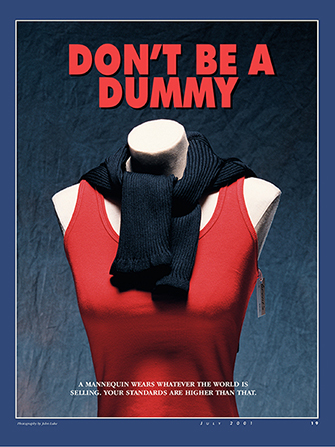
  • Poster, Don’t Be A Dummy: A mannequin wears whatever the world is selling. Your standards are higher than that.—www.lds.org/media-library/images/mormonads/dress-and-appearance?lang=eng#mormonad-dont-be-a-dummy-1118328 [Church standards of modesty apply equally to all genders.]
  • Poster, Don’t Short Change Yourself: The way you dress advertises your standards. Send the right message. (See For The Strength Of Youth, P. 8.)—www. lds.org/media-library/images/mormonads/dress-and-appearance?lang=eng#mormonad-short-change-1118313 [Church standards of modesty apply equally to all genders.]
  • Article, “Why Do We Let Them Dress Like That?”, Jennifer Moses, Wall Street Journal, 19 Mar 2011—online.wsj.com/news/articles/SB10001424052748703899704576204580623018562
  • Address, “The Moral Force of Women,” D. Todd Christofferson, LDS General Conference, Oct 2013—www. lds.org/general-conference/2013/10/the-moral-force-of-women?lang=eng
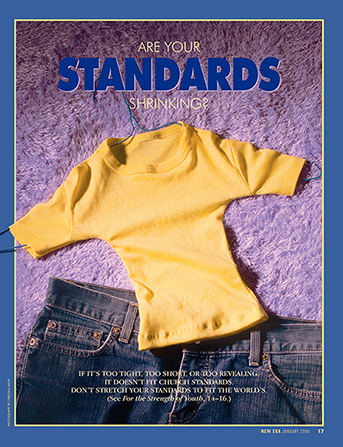
  • Poster, Are Your Standards Shrinking? If it’s too tight, too short, or too revealing, it doesn’t fit church standards. Don’t stretch your standards to fit the world’s. (See For The Strength Of Youth, P. 14-16.)—www. lds.org/media-library/images/mormonads/dress-and-appearance?lang=eng#mormonad-standards-shrinking-1118383 [Church standards of modesty apply equally to all genders.]
  • Address, “Motherhood and the Moral Influence of Women,” Bruce C. Hafen, World Congress of Families II, Geneva, Switzerland, Plenary Session IV, 16 Nov 1999 —worldcongress.org/wcf2_spkrs/wcf2_hafen.htm
  • Blog Post, “You’re a stay-at-home mom? What do you DO all day?”, Matt Walsh—themattwalshblog.com/2013/10/09/youre-a-stay-at-home-mom-what-do-you-do-all-day/
  • Address, “It Is Not Good for Man or Woman to Be Alone”, Sheri L. Dew, LDS General Conference, Oct 2001—www. lds.org/general-conference/2001/10/it-is-not-good-for-man-or-woman-to-be-alone?lang=eng
  • Address, “Mothers Who Know”, Julie B. Beck, LDS General Conference, Oct 2007—www. lds.org/general-conference/2007/10/mothers-who-know?lang=eng
  • Book, Daughters in My Kingdom: The History and Work of Relief Society (2011, Intellectual Reserve, Inc., United States of America)—www. lds.org/relief-society/?lang=eng

——– End of WebCredits ——–

Being Brave: Pre-mortality, Priesthood Power, and the Family Proclamation

A friend just shared this Vocal Point video with me, and an entire post popped in my head. The song is “(I Want To See You Be) Brave,” by Sara Bareilles. I thought of my wife, Kim, of our six adult kids and their families. I especially liked the sign that reads, “When I talk to new people.”

As a Mormon, as a member of The Church of Jesus Christ of Latter-day Saints, I  believe that we lived with God before we were born. True of anyone. And by celestial design, none of us remember — It was all veiled at birth. For eons before we came here, we studied hard, acquired knowledge, and learned skills, all with the goal of trying our guts out to live as God had taught and to do whatever we could to keep ourselves and others on the narrow path back to him. As we prepared with him for the moment of our birth, we knew that we would learn more from life on earth, because here we would be able to learn to walk not by memory, not by sight, but by faith, for the first time making decisions on our own in an environment where Heavenly Father was no longer around. As he sent us off, I wonder if he was singing to us a similar pre-lullaby message of “I want to see you be brave!”

This idea of a pre-existence changes many a perspective. I see my body not as mine, not to do with as I please, but as a temple of God, a gift from him, a house for my spirit now that I’m no longer with him. Such a view demands that I treat my body with respect and not with selfishness. The idea of a pre-mortal life and the idea of your body being a temple and not your own are ideas that permeate the popular post of Mormon blogger Seth Adam Smith, “Marriage Isn’t For You” (at his blog or at Huffington Post). His earthly father taught him, “Marriage isn’t for you. It’s not about you. Marriage is about the person you married.” While I heartily agree, I also counsel our kids as they head to the altar that marriage is so dang fun (for themselves as well as for their spouse).

These ideas and others are discussed concisely in the LDS Family Proclamation. These ideas help protect me, keep me be safe and secure. These perspectives, these teachings, are why families are so important. Families help us get ourselves back to God.

And in addition to giving us a family to help, God went further to give us another gift, both urgent and important. He allowed us to have a portion of his power. He gave us his priesthood, the authority to act for him, to do what he would do, if he were here with his ample arm around us, whispering what he would like us to know, to do, to be, to become. The priesthood of God isn’t for some and not for others — It’s for any of us, for all of us. It applies equally to people of any gender, in any country, of any position in life. For example, watch how Sheri Dew answers the great question: “In the Church of Jesus Christ of Latter-day Saints, what do women get?”

http://www.youtube.com/watch?v=-QYlDLChzig

I can see how God sent ALL of us here well prepared, not just to thrive, but to fight to find our way back. When we’re unsure of the path, he continues to guide us. We call that prayer, and it works like a phone. With a bit of effort, it’s a two-way communication device. Beats a cell phone or Star Trek communicator with a stick.

Dieter Uchtdorf taught us to be brave against doubt when he said, referring to another’s phrase which was first penned in 1924: “It’s natural to have questions—the acorn of honest inquiry has often sprouted and matured into a great oak of understanding. One of the purposes of the Church is to nurture and cultivate the seed of faith—even in the sometimes sandy soil of doubt and uncertainty. Therefore, my dear brothers and sisters—my dear friends—please, first doubt your doubts before you doubt your faith.” (See F.F. Bosworth, Christ the Healer (1924), Page 23, as quoted in “Come, Join With Us”.)

Most importantly, these perspectives shift my thinking, so that I tend to view life through a lens of patience and peace. These ideas give me hope and humility. Seth’s dad is spot on — It isn’t all about me. Sometimes, I don’t want my stinkin’ thinkin’ shifted, but if I learn to adjust my vision to a more godly perspective, I realize that it was short-sighted to fight the shift in thought. I hope it makes me a better husband, a better father, a better man, a better person. It helps me be brave.

From the lyrics of Brave: “Show me how big your brave is.”

Seeing Ourselves As Brave -- Being Brave For Others

Seeing Ourselves As Brave — Being Brave For Others

——– End of Post ——–
WebCredits—List of web resources used in this post but not explicitly credited above:

  • Video, “Brave by Sara Bareilles—BYU Vocal Point (a cappella tribute)”—www. youtube.com/watch?v=XeX3r8j66Qk
  • Blog Post, “Marriage Isn’t For You”, Seth Adam Smith—sethadamsmith.com/2013/11/02/marriage-isnt-for-you/
  • Blog Re-post, “Marriage Isn’t For You”, Seth Adam Smith—
    www. huffingtonpost.com/seth-adam-smith/marriage-isnt-for-you_b_4209837.html
  • Document, The Family: A Proclamation to the World
    www. lds.org/topics/family-proclamation
  • Video, “Lean on My Ample Arm”—www. youtube.com/watch?v=iWn48w7vX80
  • Hymn, “Lean on My Ample Arm”, music, recordings, lyrics—www. lds.org/music/library/hymns/lean-on-my-ample-arm?lang=eng
  • Video, “What Do LDS Women Get?”—www. youtube.com/watch?v=-QYlDLChzig
  • Address, “Come, Join With Us,” Dieter F. Uchtdorf, LDS General Conference Oct 2013—www. lds.org/general-conference/2013/10/come-join-with-us
  • Illustration, Seeing Ourselves As Brave — Being Brave For Others—https://www. lds.org/media-library/images/primary/illustrations?lang=eng#children-barking-dog-778662

——– End of WebCredits ——–

Showing Initiative, Saving Goals, and Second Efforts

Mongolian Archer

Mongolian Archer

At the archery portion of the Naadam Festival held in July each year in Ulaanbaatar, a female archer in elegant Mongolian dress aims to topple a small wall of marked blocks from over half a football field away. The skill demonstrated by the archers in the competition is absolutely amazing as they more often than not hit the center portion of the marked blocks.

For Hunger Games archer Katniss Everdeen, it was take initiative or starve to death. After her father died and her mother was crippled with grief, feeding the family fell to Katniss. It took time, but she learned to recognize that she had developed skills that could save her family if she would put to work the tools her father had given her:

For a while, I hung around the edges of the Meadow, but finally I worked up the courage to go under the fence. It was the first time I’d been there alone, without my father’s weapons to protect me. But I retrieved the small bow and arrows he’d made me from a hollow tree. I probably didn’t go more than twenty yards into the woods that day. Most of the time, I perched up in the branches of an old oak, hoping for game to come by. After several hours, I had the good luck to kill a rabbit. I’d shot a few rabbits before, with my father’s guidance. But this I’d done on my own.

We hadn’t had meat in months… The woods became our savior, and each day I went a bit farther into its arms. It was slow-going at first, but I was determined to feed us. (The Hunger Games, Chapter 4, Paragraphs 17-19, Pages 50-51)

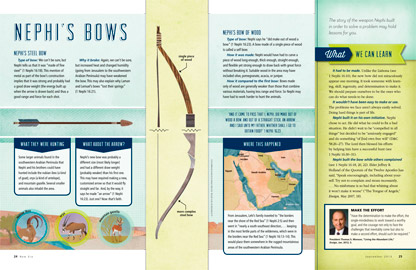
Nephi also learned to show initiative when faced with severe difficulties. His ability to feed his family was threatened when his bow made of fine steel was broken. He made a decision that saved his family. While others complained, he set a self-imposed goal: To make a bow of wood and to put it to work. Nephi would have had to carve a piece of wood long enough, thick enough, straight enough, and flexible yet strong enough to draw back with great force without breaking it. Suitable wood in the area may have included olive, pomegranate, acacia, or juniper.

Nephi Finds Food While Others Complained

But it’s what he did next that sets Nephi apart. He went to his spiritual leader to seek his counsel. And it came to pass that I, Nephi, did make out of wood a bow, and out of a straight stick, an arrow. … And I said unto my father: Whither shall I go to obtain food?

Nephi chose to act. He did what he could to fix a bad situation. He didn’t wait to be “compelled in all things” but decided to be “anxiously engaged” and to do something “of [his] own free will” (D&C 58:26–27). The Lord then blessed his efforts by helping him to have a successful hunt (1 Nephi 16:29–31). His goals were not just self-imposed goals; they were goals that saved his family.

Clay Christensen and Ideas That Change The World

Clayton M. Christensen has put this same lesson to work. As a world-renowned innovation expert and the Kim B. Clark Professor of Business Administration at the Harvard Business School, he has bit of experience with showing initiative. Throughout his book, The Power of Everyday Missionaries, Clay describes repeatedly how he has used self-imposed goals to bring about incredible changes in his own life and in the lives of others. No simple quote — Just lots of inspiring counsel from one who knows, from one who learned by doing.

I have learned for myself the importance of showing initiative. It helps us to aim high, to stretch ourselves and our bowstrings, and to reach new goals. It especially helps when we seek counsel from a trusted spiritual leader. And I know that by so doing, we may save our ourselves and our families.

Nephi's Bows

Nephi’s Bows

Article: Nephi’s Bows

PDF: Nephi’s Bows

——– End of Post ——–
WebCredits—List of web resources used in this post but not explicitly credited above:

  • Photo, Mongolian Archer—www .pinterest.com/jurekes/arco/
  • Book, The Hunger Games, Suzanne Collins (2008, Scholastic Press, New York NY), ISBN 978-0-439-02348-1
  • Painting, Nephi Finds Food While Others Complained—www.lds.org/manual/book-of-mormon-student-manual/chapter-5-1-nephi-16-18
  • Photo, Ideas That Change The World—www.claytonchristensen.com
  • Book, The Power of Everyday Missionaries: The What and How of Sharing the Gospel, Clayton M. Christensen (2012, Deseret Book, Salt Lake City UT), ISBN 978-1-60907-315-2 (paperbound), 978-1-60907-316-9 (hardbound)
  • Article, “Nephi’s Bows”, New Era, Sep 2013, www .lds.org/new-era/2013/09/nephis-bows?lang=eng
    or www.lds.org/bc/content/shared/content/images/magazines/new-era/2013/09/ne13sep24-25-000-nephis-bows.pdf

——– End of WebCredits ——–

Privileges, Potentials And Principles

GlassesHaving trouble seeing, you say? My glasses work great. They really help me see a lot better. Here, put them on — I’m sure they’ll work for you, too. No, really, try them…

Swiss countryside through train window

Swiss Countryside Through Train Window

Have you ever noticed how we all see things differently? I’ve had experiences in which, **POP**, my vision changes and I see things in a totally new light. For example, as we traveled by train from Switzerland to Italy, our cabinmate happened to be a young Swiss woman returning from home to her studies in Italy. Out the window, I saw with interest how the scenery changed from the über neat, carefully kept Swiss houses, each looking like a music box cottage, to the houses of the Italian countryside, with a few roof tiles askew and some external wall plaster that needed patching. Initially, I was disappointed with some of the residents of Italy, thinking, “Don’t they care?” I mentioned it to our new student friend, and she said simply, “Yes, isn’t it quaint?” **POP** I began to see these dwellings through her eyes — Instantly, I got it, and in place of the seemingly dilapidated houses I had seen in my mind’s eye just a moment before, the homes looked lovely to me. Suddenly, I couldn’t make these homes stay in the train window long enough, and I missed them after they disappeared from view. I thanked our friend, and I was stunned by the speed of the process by which she helped me to adjust my vision.

Sometimes, the needed adjustment is of little consequence. For example, who knew of the potential to use one’s body as a percussion instrument?

http://www.youtube.com/watch?v=lWZcRTSnX2A&feature=youtu.be

At other times, however, the needed adjustment may indeed be costly, especially when we underestimate our privileges or our potential:

As Dieter Uchtdorf is teaching, the costs can be great of not seeing my own potential. The potential for poor vision increases as I base my views on poor principles. Since I live in a world where principles are prized less and less, where principles are more and more mocked and scorned, discarded as a garment in a hot furnace, sad experience has taught me the importance of seeing on a higher plane.

Young Man Adjusting His Vision

Young Man Adjusting His Vision

I have learned for myself that I achieve little or nothing when I fight against God — That’s when I fail. In contrast, I am most successful, I achieve things of eternal importance, when I succeed in getting my understanding to **POP**, when I adjust my vision, when I see others as the Lord sees them, when I see myself as the Lord sees me. And I have learned for myself that this is true for each of us, for all of us.


——– End of Post ——–

WebCredits—List of web resources used in this post but not explicitly credited above:

  • Drawing, glasses—www.123rf.com/photo_8284355_cartoon-eyes-with-glasses.html
  • Photo, “Swiss Countryside Through Train Window”—graphics.stanford.edu/~lucasp/pictures/switzerland/countryside/
  • Address, “Your Potential, Your Privilege”, Dieter F. Uchtdorf, LDS General Conference, Apr 2011—www .lds.org/general-conference/2011/04/your-potential-your-privilege?lang=eng
  • Photo, “Young Man Adjusting His Vision”—www.lds.org/media-library/images/youth/gospel-living?lang=eng&start=11&end=20#young-man-praying-738191
  • Photo, “Mountains Through Train Window”—mattstansberryblog.wordpress.com/2009/12/16/rome-day-5/train-window/

——– End of WebCredits ——–

train-window

Mountains Through Train Window

Bats, Courage, And The Modern Pioneer

Townsend's Big-eared Bat

Townsend’s Big-eared Bat

Our prophet has recently highlighted the global need for pioneers today. In what ways can we be a pioneer?

Bats And Blind, Shallow Courage
I was a pioneer once, and it was scary. A friend with a new baby called and asked my son, Todd (then in high school), if he could come help her out—Her husband wasn’t at home, and she had a bat in her house.  It seems that bats and mothers of new babies don’t do well together. Todd assured her that he’d be right over. Then he called me immediately. I was in a meeting, which was terminated for the bat. Neither Todd nor I had any batty experience; it was just the blind leading the bat. Fortunately for us, our friend happened to have a wastecan, which we emptied in order to shroud the squeaky thing. Fortunately for the bat, it had become more orderly by the time we arrived. We grabbed the empty can and a piece of cardboard large enough to cover the mouth of the wastebasket, calmly placed the container over the stationary animal, inserted the cardboard between the can and the wall, and carried the contained bat outside. Our meager courage did not fail.    

While our winged mammal required us to have courage, its capture is a fairly wussy example of being a modern pioneer. Dictionary.com defines a pioneer as “one who is first to settle a region for development by others” or “one who is among the earliest in a field of inquiry, enterprise or progress.” So there may be a lot to learn from a non-wussy pioneer. For instance, there’s Matt Harding. Stuck in a job he didn’t enjoy, he decided that he was willing to take a risk and try something new. He has turned his silly characteristic dance into a video model of global community outreach, and people all over the world jostle to be with Matt, to laugh, jump and clap hands together. Now, it’s his full-time (yes, paying) job. All from some great music and from being willing to dance badly in front of people: Fun to watch.

Seeing More Deeply
So why pioneer? What’s the urgency to pioneer? The importance? As President Monson taught us, “We forget how the Greeks and Romans prevailed magnificently in a barbaric world and how that triumph ended—how a slackness and softness finally overcame them to their ruin. In the end, more than they wanted freedom, they wanted security and a comfortable life; and they lost all—comfort and security and freedom.” (See Paragraph 11.)

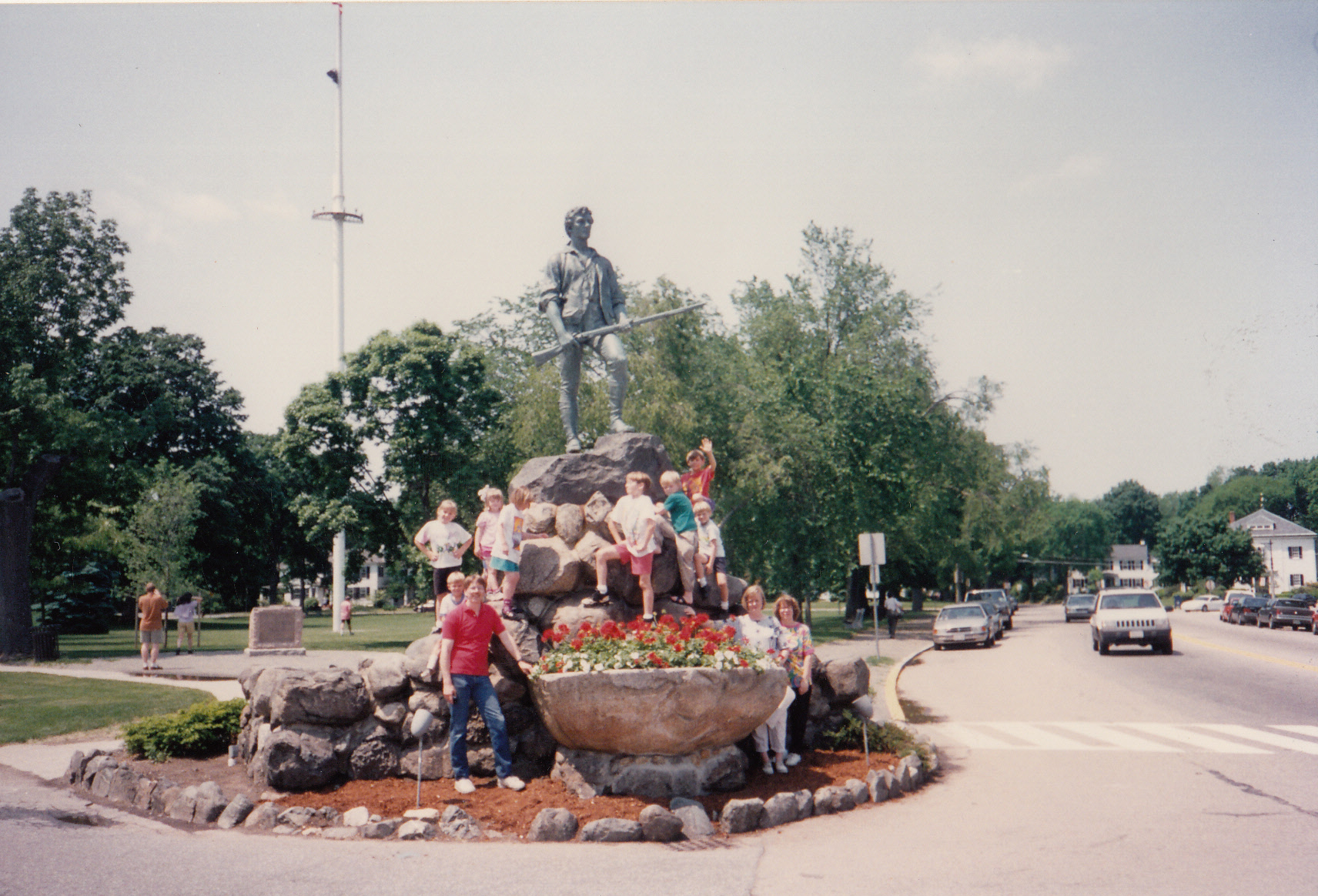
Learning Our Heritage--Minute Men in the Making at Lexington

Learning Our Heritage: Minute Men In The Making At Lexington, Massachusetts

I love the hymn They, the Builders of the Nation. Becoming a pioneer today takes courage, and it takes some out-of-the-box thinking. How may each of us be a “pillar, guide, and inspiration to the hosts of waiting youth”? (See Verse 3—sing, read or listen.) What are some important ways that we may broaden our understanding of how to serve more effectively the community around us? How to serve those who may have needs that we don’t perceive, and how we may be a part of meeting those unmet needs? Each of us can do things to become modern-day pioneers and to tread new ground in some important ways. Even if it isn’t to us, it can be very important to whom we serve.

Bogatyri (“Valiant Warriors of Old”) (1898), Viktor Vasnetsov

Bogatyri (“Valiant Warriors Of Old”) (1898), Viktor Vasnetsov

Now that I think deeper, I was indeed a pioneer when I hurried to help my friend whose wife and family had just died in a plane crash. Despite being suicidal at the time, he and I bonded, and in his darkest moments, his extended family would seek me out repeatedly: “Come, Davy—Come quick. He needs you again.” I’d hasten once more to his side—we’d sit, sometimes talk, but I felt that our hearts were in constant conversation, even in silence, and I could feel him taking strength from me, and I gave freely, for I knew that I had strength to spare. By connecting with those around him, with people for whom he cared deeply, he quickly learned to develop his own sources of strength.

Again, I was a pioneer when I served diligently in our congregation as a home teacher (volunteer shepherd) to a family with five young children. Despite his severe substance abuse concerns, this young father and I bonded easily, and he sometimes called me in the wee hours when the pull of drugs was strong and he was weak and needed to talk. As we’d sit on the stoop of his small house in the darkness, we’d have the most amazing talks filled with light. He opened the door to whole new era in my home teaching experience when one day, he interrupted me mid-sentence to ask, “How do you do it, Dave? How do you get us to feel these things?” We opened our hearts to each other like never before, and our souls were knit together like David and Jonathan of old. It was as if we could read each other’s minds. When we talked of truths at night (Hymn 147, “Sweet Is the Work,” end of Verse 1), I remember many times thinking, “There is nowhere else on earth that I would rather be than right here, right now, on this stoop, talking with this man.” I could feel him taking courage from me, and I gave freely, for I knew that I had courage to spare. He moved away, then I moved, and always I will miss our conversations.

Consider More Deeply
So, consider increasing your courage. Do what is right. Serve others not on your terms but on theirs; meet them on their level not yours. Get out of your box. Each of us may enjoy doing what we can to stand with other people for that which is good, for that which we know to be right. Be a pillar, a guide. Maybe be an inspiration. Maybe to youth. Couldn’t we all benefit from spending some time to consider how we may improve our efforts to become a modern pioneer? I know I will.

Modern Pioneers in Many Ways

Modern Pioneers In Many Ways

——– End of Post ——–
WebCredits—List of web resources used in this post but not explicitly credited above: 

  • Photo, “Townsend’s Big-eared Bat”—en.wikipedia.org/wiki/File:Big-eared-townsend-fledermaus.jpg
  • Address, “The World Needs Pioneers Today”, President Thomas S. Monson, Ensign, Jul 2013—www .lds.org/ensign/2013/07/the-world-needs-pioneers-today?lang=eng
  • Painting, «Богатыри» Or Bogatyri (“Valiant Warriors Of Old”) (1898), Viktor Vasnetsov (Tretyakov Gallery, Moscow)—en.wikipedia.org/wiki/File:Die_drei_Bogatyr.jpg
——– End of WebCredits ——–