Sometimes, you just gotta rock the boat and stand up for what you believe.
I remember that, when I was a kid in Columbia, Missouri, a friend at school picked a fight on the playground. He had criticized my beliefs as a Mormon and called me a moron. I chose to say, “Yes, I believe those things,” and he beat me up. A couple years later in Fifth Grade, while waiting in line at the water fountain in the hallway, another friend asked me, “Do you really believe that Old Joe Smith saw God?” I remember thinking, “Who the heck is Old Joe Smith?” And then it hit me that he was referring to the prophet Joseph Smith (whom I’d never heard called Old Joe Smith before). I said, “Yes, I do believe that Joseph Smith saw God.” He shrugged his shoulders, and that was the end of it. We got our sips of water and went back to class.
Sometimes We Row Alone
In my previous post, I discussed the importance of being at our best—Not the importance of individual achievement but of working as a team, when we all get in the boat together and pull as one. Have you noticed that being our best can demand more than mere teamwork? Sometimes, when singled out to row without help, criticized for what we think is right, we are called upon to stand alone. And while on occasion, it happens with a bang, like my fight on the playground, I’ve noticed that in general it happens quietly. Like when I volunteer at the Family History Center—I thought I would help others learn to connect with their families, but most of the time, I find I’m slowly learning more myself. Or when I’m together with friends of multiple faiths—Not only do I learn to listen better but also to express myself better so that I invite rather than annoy. No bang, just slow progress towards being our best and working as a team.
But, on occasion, we must be willing to rock the boat.
Mashed Potato Face
One young woman learned this as an LDS missionary. “My companion and I saw a man sitting on a bench in the town square eating his lunch. As we drew near, he looked up and saw our missionary name tags. With a terrible look in his eye, he jumped up and raised his hand to hit me. I ducked just in time, only to have him spit his food all over me and start swearing the most horrible things at us. We walked away saying nothing. I tried to wipe the food off of my face, only to feel a clump of mashed potato hit me in the back of the head. Sometimes it is hard being a missionary, because right then I wanted to go back, grab that man, and say, ‘EXCUSE ME!’ But I didn’t.”
Unfortunately, messengers of divinely mandated commandments are often no more popular today than they were anciently, as at least two spit-upon, potato-spattered sister missionaries can now attest.
⁞
Run Along And Pick Marigolds, Or Stand For Something
It is a characteristic of our age that if people want any gods at all, they want them to be gods who do not demand much, comfortable gods, smooth gods who not only don’t rock the boat but don’t even row it, gods who pat us on the head, make us giggle, then tell us to run along and pick marigolds. [See Henry Fairlie, The Seven Deadly Sins Today (1978), Pages 15-16.] ⁞ Defend your beliefs with courtesy and with compassion, but defend them.
I have learned for myself the value of standing for something. It’s especially satisfying when I may do so as part of building a team that rows as one.
——– End of Post ——–
Bonus Material:
The importance and vitality of the strait and narrow path:
Be strong. Live the gospel faithfully even if others around you don’t live it at all. Defend your beliefs with courtesy and with compassion, but defend them. A long history of inspired voices, including those you will hear in this conference and the voice you just heard in the person of President Thomas S. Monson, point you toward the path of Christian discipleship. It is a strait path, and it is a narrow path without a great deal of latitude at some points, but it can be thrillingly and successfully traveled, “with … steadfastness in Christ, … a perfect brightness of hope, and a love of God and of all men.” In courageously pursuing such a course, you will forge unshakable faith, you will find safety against ill winds that blow, even shafts in the whirlwind, and you will feel the rock-like strength of our Redeemer, upon whom if you build your unflagging discipleship, you cannot fall. [Jeffrey R. Holland, “The Cost—and Blessings—of Discipleship”, Ensign, May 2014, Pages 6-9.]
Sometimes, You’ve Got To Rock The Boat
——– End of Bonus Material ——–
WebCredits—List of web resources used in this post but not explicitly credited above:
Photo, “Sometimes We Row Alone”—pseudophilosoph.wordpress.com/2014/05/01/welcome-life-has-no-meaning-but-it-can/
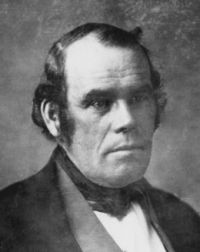
In my last post, we explored three ways in which Mormons are peculiar. For me, these significant three are like finding a treasure after a life-long search. They’re why my ancestors decided to be Mormons, why anyone has decided to be a Mormon, and certainly why I’m a Mormon. To illustrate, I’ll share the story of Wandle Mace, my great-great grandfather.
Wandle Mace, Younger
Wandle (pronounced not like magic “wand” but like “band”, rhyming with “candle” or “handle”) grew up in the early 1800s and was taught to read by reading the scriptures. In his journal, he records that he had memorized the New Testament by the time he was twelve years old. While in his day that was unusual, I know of others of that period who achieved the same goal, so it appears it was more common then than now, and with no TV, more achievable. For example, we know high schoolers today in the Amish/Mennonite communities of Oklahoma and Arkansas who memorize the New Testament before they graduate. Because of his education at his mother’s knee, Wandle knew that the many churches he attended around him did not teach the same things he knew for himself were in the Bible, and for years he searched for a church that taught those same things. He was expelled from some of them for teaching things from the New Testament that conflicted with their teachings, but he held to the things he knew to be true.
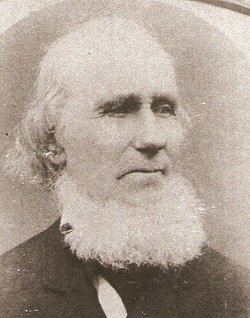
Parley P. Pratt
Eventually, Parley P. Pratt knocked on Wandle’s door, talking about a church that matched in every respect the teachings Wandle had learned as a boy, the three same teachings that Elder Holland described. Wandle explained to Parley that while he was glad finally to find someone who taught the truths found in the New Testament, that fact alone did not give Parley the authority that Jesus Christ held allowing him to teach these truths. Wandle said that, before they were to continue on discussion, he would need to know that they possessed this authority from God.
Three months later, when Wandle’s baby Charles took sick, Wandle and his wife called in the elders to bless and heal Charles. Parley returned, Charles was healed, and Wandle and his family decided in their hearts that this church indeed included the power and authority originally established by Jesus Christ. It was insufficient to teach the proper things; Wandle knew that they had to be taught with proper authority in order to be from God. And Wandle recognized that the holy priesthood, which had been restored to the earth by those who held it anciently, signaled the return of divine authorization, for which he had been watching and waiting for many years.
Wandle was not alone. People before him and after had similar experiences regarding authority. If you wish, feel free to view the experiences of Vincenzo di Francesca, which are similar to Wandle’s, in the movie How Rare a Possession—The Book of Mormon. (Length: 63:19.)
I will always be grateful for great people in my life who are willing to teach things they feel down deep, even when it’s difficult, even when people around them disagree with them. Like them, I feel that it is important to stand strong for correct principles, even against tremendous odds, and I am glad to see my adult children all standing tall for what they have learned for themselves to be true. Wandle would be pleased.
“Why do these Mormons stir up such emotions in people, and why are they not considered Christian by some?” As we approach General Conference next month, authority issues are as relevant today as ever. Interesting questions and answers from Elder Jeffrey R. Holland of the Quorum of the Twelve Apostles, The Church of Jesus Christ of Latter-day Saints, as he spoke at Harvard Law School. Answers below.
Returning to my academic roots in New England, I am reminded today of—and stand with—a marvelous congregational cleric who, a century ago, had a little parish in Springfield, Massachusetts, about equidistant from New Haven and Cambridge, which seems appropriate. He said 100 years ago:
“The loss of respect for religion is the dry rot of social institutions. The idea of God as the Creator and Father of all mankind is to the moral world, what gravitation is in the natural; it holds everything else together and causes it to revolve around a common center. Take this away and any ultimate significance to life falls apart. There is then no such thing as collective humanity, but only separate molecules of men and women drifting in the universe, with no more cohesion and no more meaning than so many grains of sand have meaning for the sea.” [Henry Martyn Field]
⁞
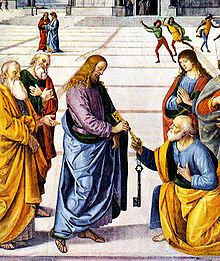
Christ Handing the Keys to St Peter (Gesupietrochiave), by Pietro Perugino (1481-82)
We are not considered Christian by some because we are not fourth-century Christians, we are not Nicene Christians, we are not creedal Christians of the brand that arose hundreds of years after Christ. No, when we speak of “restored Christianity”, we speak of the Church as it was in its New Testament purity, not as it became when great councils were called to debate and anguish over what it was they really believed. So if one means Greek-influenced, council-convening, philosophy-flavored Christianity of post-apostolic times, then we are not that kind of Christian. Peter we know, and Paul we know, but Constantine and Athanasius, Athens and Alexandria we do not know. (Actually, we know them, we just don’t follow them.)
Thus, we teach that:
1. God the Father and His Son, Jesus Christ, are separate and distinct beings[, both divine,] with glorified bodies of flesh and bone. As such, we stand with the historical position that “the formal doctrine of the Trinity as it was defined by the great church councils of the fourth and fifth centuries is not to be found in the [New Testament].” [Harper’s Bible Dictionary, Paul F. Achtemeier, ed. (1985), Page 1099]
Studying the New Testament
We take Christ literally at His word—that He “came down from heaven, not to do [his] own will, but the will of him that sent [him].” Of His antagonists, Jesus said they have “hated both me and my Father.” These, along with scores of other references, including His pleading prayers, make clear Jesus’s physical separation from His Father, subordinating Himself to His Father, saying regularly, in one way or another, my Father is greater than I. However, having affirmed the point of Their separate and distinct physical nature, we declare unequivocally that They were indeed “one” in every other conceivable way—in mind and deed, in will and wish and hope, in faith and purpose and intent and love. They are most assuredly much more alike than They are different in all the ways I have just said, but They are separate and distinct beings as all fathers and sons are. In this matter, we differ from traditional creedal Christianity, but we do feel that we agree with the New Testament.
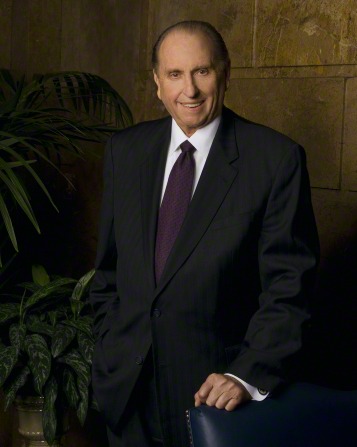
The Open Canon Continues: President Thomas S. Monson
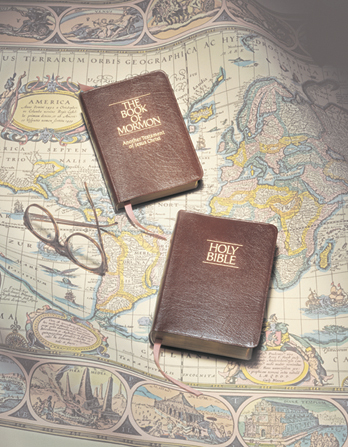
2. Next, we also differ from fourth and fifth century Christianity by declaring that the scriptural canon is not closed, that the heavens are open with revelatory experience, and that God meant what He said when He promised Moses, “My works are without end, and…my words…never cease.” We believe that God loves all His children and that He would never leave them for long without the instrumentality of prophets and apostles, authorized agents of His guidance and direction. The Book of Mormon and other canonized scripture, as well as the role of living oracles, witnesses to the fact that God continues to speak. We agree enthusiastically with the insightful Protestant scholar who inquired, “On what biblical or historical grounds has the inspiration of God been limited to the written documents that the church now calls its Bible? …If the Spirit inspired only the written documents of the first century, does that mean that the same Spirit does not speak today…about matters that are of significant concern?” [Lee M. McDonald, The Formation of the Christian Biblical Canon, rev. ed. (1995), Pages 255-56.]
3. Lastly, for today, we are unique in the modern Christian world regarding one matter which a prophet and president of The Church of Jesus Christ of Latter-day Saints called our “most distinguishing feature.”
Peter, James and John Confirm the Keys to Joseph Smith and Oliver Cowdery
That is, divine priesthood authority to provide the saving sacraments—the ordinances—of the gospel of Jesus Christ. The holy priesthood, which has been restored to the earth by those who held it anciently, signals the return of divine authorization. It is different from all other man-made powers and authorities on the face of the earth. Without it, there could be a church in name only, and it would be a church lacking in authority to administer in the things of God. This restoration of priesthood authority eases centuries of questions and anguish among those who knew certain ordinances and sacraments were essential but lived with the doubt as to who had the right to administer them. Breaking ecclesiastically with his more famous brother, John, over the latter’s decision to ordain without any divine authority to do so, Charles Wesley wrote:
How easily are bishops made
By man or woman’s whim: Wesley his hands on Coke hath laid, But who laid hands on him?
[Quoted in C. Beaufort Moss, The Divisions of Christendom: A Retrospect (n.d., “no date”), Page 22.]
In The Church of Jesus Christ of Latter-day Saints we can answer the question of “who laid hands on him” all the way back to Christ Himself. The return of such authority is truly “the most distinguishing feature” of our faith.
Thank you for your courteous attendance. I will be pleased to devote the remaining time to your questions. I leave my love, my witness, and a personal blessing on every one of you for whatever righteous need you may have, in the name of Jesus Christ, amen.
I think that’s pretty clear, don’t you? Again, from Elder Holland:
Clearly, acting with divine authority requires more than mere social contract. It cannot be generated by theological training or a commission from the congregation. No, in the authorized work of God, there has to be power greater than that already possessed by the people in the pews or in the streets or in the seminaries—a fact that many honest religious seekers had known and openly acknowledged for generations leading up to the Restoration.
It is true that some few in that day did not want their ministers to claim special sacramental authority, but most people longed for priesthood sanctioned by God and were frustrated as to where they might go to find such.
Clarity can be wonderful, huh? And it’s all for free. Just as Christ used His priesthood power freely to bless others without charge and taught everyone to do likewise, today we use His priesthood power freely to bless others. (Avoiding “priestcraft”; see in New Testament Matthew 10:8, Acts 8:9-18 (especially Verse 18), 1 Peter 5:2, or in Book of Mormon 2 Nephi 26:29, Alma 1:12, Helaman 7:5, 3 Nephi 16:10.) God has designed it so that we use his priesthood only to bless others; for example, I cannot use the priesthood to give myself a blessing.
Through me, my sons also have this authority to bless their own families and to carry on the work of righteousness as God would do himself if He were here counseling and coaching us. I have learned for myself that true strength comes from magnifying the priesthood. Clearly, that makes me peculiar. I also know that everyone has the blessings of this authority available to them.
——– End of Post ——–
Bonus Material:
1. Watch or listen to Elder Holland at Harvard Law School below. Or read.
2. The priesthood of God isn’t for some and not for others — It’s for any of us, for all of us. It applies equally to people of any gender, in any country, of any position in life. For example, watch how Sheri Dew answers the great question: “In the Church of Jesus Christ of Latter-day Saints, what do women get?”
3. Why is authority important? An 18-year-old learns one reason.
“Sanctify Yourselves”:
4. Pilots get lost if they don’t follow their instruments.
We get lost if we don’t follow the commandments.
“Mormon Spiritual Vertigo”:
5. Sometimes, answers are long in coming. Sometimes, answers come quickly. Either way, healing happens on His time, and that’s for an important reason.
“He Will Give You Help”:
WebCredits—List of web resources used in this post but not explicitly credited above:
Photo, “Austin Hall” of Harvard Law School—en.wikipedia.org/wiki/File:Austin_Hall,_Harvard_University.jpg
Article, “Elder Jeffrey R. Holland’s Remarks to the Harvard Law School: Mormonism 101”, 20 Mar 2012—www. mormonnewsroom.org/article/harvard-elder-holland-mormonism-remarks
Photo, “Christ Handing the Keys to St Peter (Gesupietrochiave), by Pietro Perugino (1481-82)”—en.wikipedia.org/wiki/File:Gesupietrochiave.jpg
Photo, “Studying the New Testament”—www. lds.org/media-library/images/scripture-study?lang=eng
Photo, “The Open Canon Continues: President Thomas S. Monson”—www. lds.org/media-library/images/gospel-art/latter-day-prophets?lang=eng&start=41&end=80&order=
Photo, “Peter, James and John Confirm the Keys to Joseph Smith and Oliver Cowdery”—www. lds.org/media-library/images/gospel-art/church-history?lang=eng
Photo, “Open Canon: Bible and Book of Mormon”—www. lds.org/media-library/images/gospel-art/church-history?lang=eng
As a Mormon, to me it means accepting an assignment from church leaders to serve others. I know my leaders have pondered and discussed and prayed before asking me to serve. After saying Yes, I have the responsibility to kneel and to find out for myself that such a calling is from God. Because I belong to The Church of Jesus Christ of Latter-day Saints, I want to magnify my calling.
Magnifying my calling is less concerned with what I do as I serve others and more concerned with how or why I serve others.
Conducting Music At Church
For example, I had a friend in college who moved into our congregation and immediately accepted a calling to lead the music in church each Sunday. Kathy was a recent convert to the Church of Jesus Christ, and she felt the calling was inspired of God. She gathered her roommates around her, told them of the new calling, and explained that she was terrified, as she had no musical experience whatsoever. They rallied around her, practiced singing and leading hymns in their living room over and over and over, for weeks on end, until she was comfortable directing the congregational music on her own.
I remember that first Sunday when Kathy stood before the congregation. Her fear was clear in every movement. With her hands, she deftly directed a perfect 3/4 meter in a little tiny triangular pattern, moving her hands about four inches from top of pattern to bottom. Her roommates ran up to her afterwards and all gave her a big hug. Weeks later, in our next testimony meeting, Kathy bore witness to how she had grown by accepting this calling and how she felt it was inspired of God. Then, the member of the bishopric who had issued the calling to her stood to explain that congregation leaders had been misinformed about her musical experience, were surprised to discover otherwise, and were pleased by Kathy’s willingness to serve in any capacity and by her roommates’ willingness to assist. As Kathy’s musical confidence grew over the next few months, the pattern of her musical direction grew to a more normal size. During those months, I remember seeing some of her roommates with tears streaming down their smiling faces as they watched Kathy’s trembling hands. We all watched as Kathy’s face smiled more and as her countenance glowed more each week as she stood before us. This calling had little to do with the knowledge of man and much to do with the knowledge of God. Kathy’s willingness to submit and to say Yes, to take initiative to educate herself, to learn new skills outside of her comfort zone, inspired us all.
Again, callings are less concerned with what we do as we serve others and more concerned with how or why we serve others. Kathy is proof. I’m glad there are so many Kathy’s in the world.
Having Learned For Ourselves, We’re Responsible To Help Others Know
——– End of Post ——–
Bonus Material:
1. Watch, listen, or read Elder Dallin H. Oaks as he speaks to the general membership of the Church as one of the twelve apostles of the Lord Jesus Christ in his address, entitled “Why Do We Serve?” (Length: 19:47.)
2. Watch, listen, or read the address of Elder M. Russell Ballard on showing our love and appreciation for the Savior’s atoning sacrifice through our simple, compassionate acts of service, entitled “Finding Joy through Loving Service.” (Length: 15:03.)
3. Watch, listen, or read Elder Derek A. Cuthbert in his beloved address, entitled “The Spirituality of Service.” (Length: 9:35.) It was a landmark address, quoted for years afterwards, particularly: “Over the years, many people, especially youth, have asked me, ‘Elder Cuthbert, how can I become more spiritual?’ My reply has always been the same: ‘You need to give more service.’ ”
4. Watch, listen, or read the wonderfully inspired words of President Barbara B. Smith, entitled “She Stretcheth Out Her Hand to the Poor.” (Length: 9:54.)
5. Watch, listen, or read President Thomas S. Monson as he describes, “The Service That Counts.” (Length: 22:26.)
6. Watch, listen, or read the address of Elder Dallin H. Oaks on how our Savior teaches us to follow Him by making the sacrifices necessary to lose ourselves in unselfish service to others, entitled “Unselfish Service.” (Length: 17:19.)
——– End of Bonus Material ——–
WebCredits—List of web resources used in this post but not explicitly credited above:
Photo, “We’re Responsible To Know For Ourselves”—www. lds.org/media-library/images/prayer?lang=eng
Photo, “Conducting Music At Church”—www. lds.org/media-library/images/music?lang=eng
Photo, “Having Learned For Ourselves, We’re Responsible To Help Others Know”—www. lds.org/media-library/images/education/spiritual?lang=eng
Photo, “Studying To Learn”—www. lds.org/media-library/images/education/miscellaneous?lang=eng
Quick: What do you think of when you hear this word? “Ordinances.”
Okay, that may be a bit strange. Try this one: “Covenants.”
What went through your mind? Good? Bad? Ugly? Modest? Fight? Commitment?
Sometimes (often?) I feel a need to fight against expectations. At times those expectations are of good behaviors, at other times of bad. In the movie “Frozen”, the character Elsa seemed to feel much the same way:
Not everyone appreciates her the way I do, but I love the way Idina Menzel sings. To me, the good in this song is inspiring. But not the bad. In the song, good and bad are juxtaposed, in opposition to each other, just as they are in life. And as in life, I thank Heaven for the bad. By Celestial design, the bad helps me to recognize, appreciate, and embrace the good. Some of the lyrics:
I don’t care what they’re going to say.
Let the storm rage on.
Cold never bothered me anyway. (All good.)
⁞
…the fears that once controlled me, can’t get to me at all. (good)
It’s time to see what I can do, to test the limits and break through. (good)
No right, no wrong, no rules for me. (bad) I’m free. (good)
⁞
Let it go, let it go. (good) That perfect girl is gone. (bad)
Good, bad. Bad, good. What the heck does it matter? Well, according to the prophet Isaiah, it matters a lot:
Woe unto them that call evil good, and good evil; that put darkness for light, and light for darkness…
“The emphasis on truth as the way things really are suggests that it contrasts with the way things seem to be, no matter how convincing that deception may be. One such truth is the reality of evil. As Isaiah pointed out, at the heart of moral relativism is an inability or unwillingness to recognize evil.”
—Daniel L. Belnap
Dave, what does this good-evil stuff have to do with ordinances? I thought you’d never ask. Ordinances in any faith community help us to shun evil, to choose the right, to commit to be good. It draws a line in the snow. It draws a line in the sand, in the dirt, on the concrete. A bar/bat mitzvah means “son/daughter who is subject to the commandment, to the law of God”. The first pillar of Islam is kalima shahadah, meaning to promise/testify/witness my word to God. Christian baptism is a covenant with God to repent, to be clean before Him, to accept Christ’s invitation when he said, “Come, follow me.” Ordinances and covenants are a two-way promise: We promise to follow God; he promises us certain blessings.
One thing I really, really love about being a Mormon is that my faith is full of ordinances. At eight years old, I was baptized. At twelve, I was ordained to the priesthood. At twenty-four, my wife and I were sealed for time and all eternity. Then our family gets to go to the temple together and do it all for others. Over and over. Each time, each ordinance, is a line in the snow/sand/whatever. Each is an additional level of commitment and reverence to God. Throughout life, we all make decisions. Ordinances help. They help us choose the right. They help us witness to God and to others that we will choose good over evil.
So, do what Elsa did. Do what you think is right. Be brave, and do it your way. Stay modest. Thumb your nose at a world that wants you to take your clothes off, and keep them on. Instead, yank off the gloves, and pull no punches. Stretch your powers as far as they can possibly go, and then stretch them a bit more. Say what is on your mind and in your heart.
FIGHT. Commit. Draw lines with ideas. Fight the good fight. Fight the good fight of faith.
I don’t care what they’re going to say.
Let the storm rage on — Good never bothered me anyway.
Elsa Ready To Fight, Gloves Off
——– End of Post ——–
Bonus Material:
1. Just like Elsa has powers she must learn about and learn to control, so do we. Listen or read Elder Ronald A. Rasband’s address regarding ways to tutor ourselves in having our hearts knit together in unity and in love one towards another, entitled, “Building Spiritual Power in Priesthood Quorums”. (Length of audio: 16:18.)
2. Listen or read how God’s covenant with Abraham blesses us all. (Length of audio: 12:36.)
3. Read more about moral absolutes contrasted with moral relativism in an address by Dallin H. Oaks, “Religious Values and Public Policy“, Ensign, Oct 1992.
——– End of Bonus Material ——–
WebCredits—List of web resources used in this post but not explicitly credited above:
Illustration, “Else Ready To Fight, Gloves Off,” www. moviefanatic.com/gallery/frozen-elsa-idina-menzel/
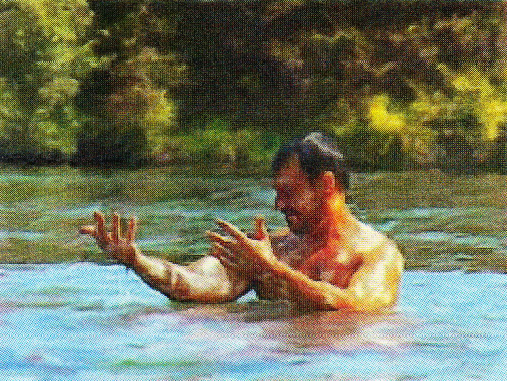
Have you ever seen a person with a conspicuous disease such as leprosy? We read of an honorable military leader in the Old Testament, “a mighty man in valour, but he was a leper.” Naaman sought the help of God and then rejected it: the task was too small, too simple. But upon submitting to God’s counsel, upon bathing in the small river as instructed, he was cleansed. He was healed of the leprosy, and his skin was restored to the flesh of a baby.
As Heavenly Father established His teachings among mankind, He designated symbolic cleansing as an outward proclamation of an inward commitment to serve Him. By celestial design, the act of baptism is a small and simple thing. Note that God did this not to demand subservience as does a king, queen or any human magistrate but rather because He knows that, as humans, we are at our best when serving a Higher Source than self. When the Father sent His Son to bring us back to His teachings, he re-emphasized man’s need for baptism. After we strayed anew from those teachings, God did so as He restored His truths once again.
I was very young when I learned the value of all this. I grew up on a farm in Missouri in a friendly Mormon congregation, where a number of folks in the community decided to join us in our faith. Those who joined our church were baptized in our pond. Bob, a local college student, yearned to be baptized, and he wanted first to receive the permission of his parents, whom he loved dearly. For years they refused, and, as Bob waited for their hearts to change, after each time someone else was baptized, he would stay down at the pond. For long periods of time, he would cry out his soul to God for patience and understanding, with clenched fists and raised voice. I remember seeing him come up to the farmhouse, his eyes red and puffy, and I heard him say through tears how much he looked forward to his turn in our pond, when he could finally show his willingness to put his sins behind him. His earnestness made an impression on my young spirit, and to this day, each time I see a baptism, I see in my mind’s eye the intensity of Bob’s joy when he was finally able to do this for himself.
Short-sightedness and sin have made lepers of us all. A little symbolic cleansing can help.
Cleansing Hands
——– End of Post ——–
Bonus Material:
Watch, listen, or read Elder David A. Bednar’s entire address regarding the priesthood ordinance of baptism, entitled, “That We May Always Have His Spirit to Be with Us”. (Length: 16:33.)
——– End of Bonus Material ——–
WebCredits—List of web resources used in this post but not explicitly credited above:
Have you ever felt the delight of rebirth from restoring a garden, breathing new life into the soil with the work of your hands? I’ve found that digging a hole in the yard can be a great stress reliever. Whether the result be a vegetable garden, flower garden, water garden, or rock garden, the creative act of re-awakening a previously well-tended plot grows plenty of comfort and joy.
The same sense of recovering something of worth may come from restoring a chair or a desk. Furniture restoration not only reclaims the beauty of an old furniture friend, it can add to the elegance of your home, and the joy of revival can be just as satisfying as for a restored garden.
Have you had the joy of restoring the trust of a friend? A renewed confidence is more poignant if, as a headstrong loved one, I have turned myself from unruly ways, returning from an unwise path of my own obstinate will, back to the path of submitting to the will of another—And by so doing, discovering that he was always the wiser. While a recalcitrant, I treasured my errant ways, blindly unaware of my short-sightedness, until I rebuilt the foundation of the original shared trust that I had dismantled. The reawakened trust is especially sweet when for years my friend has invited me to return to his wiser ways.
My topic in this post is restoring a faith that has fizzled. Since Father Adam and Mother Eve, God has established His teachings among us. Because He loves us and because we are prone to wander, God gave us guidelines of good, better, best. And because we are prone to wander, we all have strayed from those guidelines, even when we know better. Each time a person strays, he or she may return through repentance. Each time a people strays, God always has sent someone to teach and persuade society yet again. That’s what He did with the Childrenof Israel, with the peoplein Christ’s day, and with the people who lived long after Christ. Watch how one person explains that he noticed a period of falling away (length: 2:04).
So what did God do? Even when I notice a broken chair or a disregarded plot of ground, I may choose to do nothing but simply to continue to neglect it. But when it comes to truth, God chose to restore the teachings that we had chosen to neglect. He sees our unyielding self, misguided intents, resistant societies—And He continues to see something of worth in us and sends someone to recover it. Watch as someone explains how she learned this for herself (length: 1:27).
Consider how Heavenly Father works with us. When we strayed from Adam’s teachings, God sent a babe in the bullrushes to bring us back to His ways. When we strayed again, He sent His Son as the Babe of Bethlehem to restore the Balm of Gilead, to redeem the world, and to bring us back to His ways. When we strayed yet again, He sent an uneducated, unvarnished farm boy of no renown, who asked important questions with confidence that God would reveal to him the answers. And God answered his prayers, because He trusted him to care for Hispeople and for His truths. He knew that the young man would tend them well and make them grow.
I have learned for myself the beauty and elegance of these truths that God has restored, truths that have allowed me to rebuild my trust in Him. I have renewed and strengthened my faith, so that no matter what happens, despite pain and trials and difficulties, I can be safe and secure. As I become a person that Heavenly Father may trust, as He rebuilds me into the simple beauty of a finished chair, I should not be surprised that, as did Harry T. Burleigh, I find “a religious security as old as creation, older than hope, deeper than grief, more tender than tears.” I know these things are true, that the faith that God has restored is true. Everyone on earth may know these truths for themselves, directly from God. And that’s why I’m a Mormon.
The Simple Beauty Of A Finished Chair
——– End of Post ——–
Bonus Material:
1. Harry T. Burleigh, the pioneering African-American singer/composer, published in 1916 the song Deep River, which speaks both of emancipation from physical captivity and of an assurance of spiritual relief. It was the first (and would prove to be the most popular) of Burleigh’s published vocal arrangements. He regarded these songs as “prayers” that proclaim “a religious security as old as creation, older than hope, deeper than grief, more tender than tears.” (See The Crisis, Page 29.) Watch Paul Robeson sing Deep River in 1940:
2. Not all moments in time are alike. Some moments are more pregnant with meaning than others. It’s a rare experience to see God eye to eye. Such was the experience of Joseph Smith. Elder Neal A. Maxwell tells of the experience of Professor Arthur Henry King’s response, after he read it, to the prophet Joseph Smith’s account of the First Vision. Brother King said: (By the way, this is the quintessential Englishman, with bowler hat and many degrees, and this is how he reacted to the First Vision.)
“When I was first brought to read Joseph Smith’s story, I was deeply impressed. I wasn’t inclined to be impressed; as a stylistician, I have spent my life being disinclined to be impressed. So when I read his story, I thought to myself: This is an extraordinary thing. This is an astonishingly matter-of-fact and cool account. This man is not trying to persuade me of anything. He doesn’t feel the need to. He is stating what happened to him, and he is stating it not enthusiastically, but in a quite matter-of-fact way. He is not trying to make me cry or feel ecstatic. That struck me, and that began to build my testimony, for I could see that this man was telling the truth. And his was not the prose of someone who was trying to work it out and make it nice. It is the prose of someone who is trying to tell it as it is, who is bending all his faculties to expressing the truth and not thinking about anything else. And above all, though writing about Joseph Smith, not thinking about Joseph Smith, not thinking about the effect he is going to have on others, not posturing, not posing, but just being himself.” (1991 CES Old Testament Symposium.)
All of us may know for ourselves that God has restored the fulness of the gospel to us through the prophet Joseph Smith. The Book of Mormon isn’t just a popular musical; it’s a book that changes lives every day. Will yours change?
3. Come, Thou Fount Of Every Blessing, traditional American hymn, arrangement by Mack Wilberg, sung by Mormon Tabernacle Choir:
4. Watch how God prepared to restore the unchanged gospel of Jesus Christ through Joseph Smith’s search for truth. (Length: 19:18.) Read also in Joseph’s own words.
5. Watch a motion picture about the life and legacy of Joseph Smith, the founding prophet of The Church of Jesus Christ of Latter-day Saints. (Length: 1:02:04.)
6. Watch, listen, or read President Boyd K. Packer’s entire address regarding these restored eternal truths, entitled, “The Standard of Truth Has Been Erected”. (Length: 16:37.)
——– End of Bonus Material ——–
WebCredits—List of web resources used in this post but not explicitly credited above:
Photo, family restores garden—www. watergardengems.com/index/index.php/about-us/our-testimonials
Enjoy reading our posts, and join in the discussions! We encourage a panorama of opinions with cordial dissent or support, and ask that comments be respectful and relevant to the post, allowing all to enjoy the shared thoughts and experiences. Entries subject to editing. Comments not in keeping with these standards may be removed at the discretion of blog editors.



















 Todd
Todd Dave
Dave Brendan Sweeny
 MormonPanorama
 Brian
Brian Brittany
 Mike
Mike Kim
Kim Kevin
Kevin Whit
Whit MormonPanorama